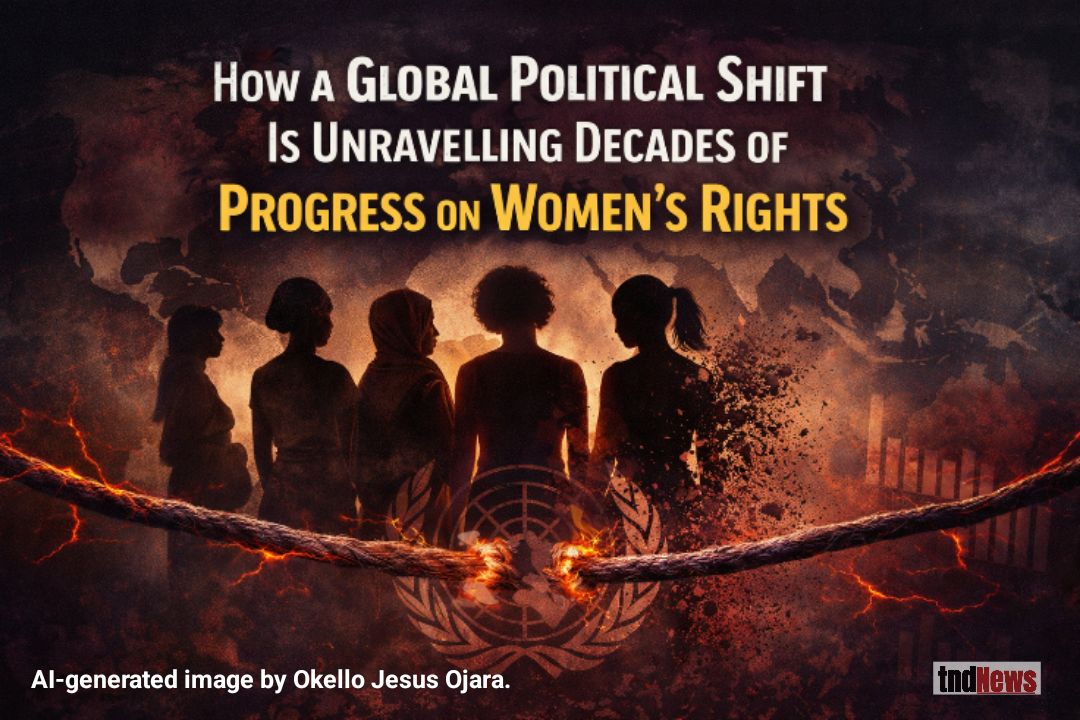
Gulu City | For millions of women and girls across Africa, the global rollback on gender equality is not an abstract diplomatic shift and it is a direct threat to survival, health and justice.
As 2026 begins, hard-won gains in maternal health, protection from violence and access to sexual and reproductive care are increasingly at risk, shaped by political decisions made far beyond the continent.
This moment of regression follows decades of unfinished business. Despite international commitments to gender equality and the right to health, progress has been slow and uneven. Gender-based violence remains alarmingly high, with little decline in violence by intimate partners and others since 2000.
Further, harmful practices such as female genital mutilation/cutting persist in several African countries, even as global leaders pledged to eliminate the practice by 2030, instead, FGM/C rates have risen by 15 percent globally over the past eight years.
Now, a new wave of backlash threatens to deepen these failures. In January 2026, the United States announced its withdrawal from 66 international organizations, including 31 UN entities such as UN Women, alongside agencies that support sexual and reproductive health, humanitarian response and development, many of which play a critical role in African health systems.
A handful of other countries are beginning to follow suit, raising fears of funding gaps, weakened institutions and stalled reforms across the continent.
“We need to understand and acknowledge the sinister link between gender injustice and patriarchy, capitalism, militarization and religious fundamentalism,” said Shobha Shukla, Coordinator of SHE & Rights (Sexual Health with Equity & Rights), speaking at the January 2026 opening plenary.
She further noted that, “we owe so much to feminist leaders who have championed gender justice for decades. Progress was made despite historic push backs and frontline defenders continue to protect those gains today.”
At the start of the year, the United States announced its withdrawal from 66 international organizations, including those central to advancing gender equality and health rights. Among them are 31 UN entities, including UN Women, as well as agencies working on sexual and reproductive health, development and humanitarian response.
A handful of other countries have begun echoing this retreat, raising alarms across feminist, health and human rights movements worldwide.
A crisis of multilateralism and funding
For many advocates, the US withdrawal signals more than diplomatic disengagement; it represents a direct threat to lives.
“The withdrawal from UN organizations, including the World Health Organization, is of deep concern,” said Dr Mabel Bianco, physician, feminist leader and founding president of FEIM in Argentina.
Mabel however disclosed that it appears as if gender equality and the right to health of women, girls and diverse peoples are no longer a priority.
Beyond symbolism, the consequences are tangible and US disengagement has been accompanied by the suspension of funding, triggering economic crises for human development programmes particularly in low-and middle-income countries.
“In the past, the US supported critical initiatives to protect people in Africa, Latin America and the Caribbean from malaria, HIV and tuberculosis,” Dr Bianco noted.
Adding that, “sudden stoppage of funding is deeply disruptive; many countries have been forced to reduce health services, especially around sexual and reproductive health. This reflects a rejection of multilateralism.”
Yet amid the fallout, there are glimmers of hope. “Other countries are stepping up their development financing and that gives us some reason to keep pushing forward,” he added.
‘Patriarchy never takes a vacation’
For feminist movements, the current political moment feels both familiar and more dangerous.
“Patriarchy never takes a vacation and neither have feminists; from Cairo to Beijing, feminist movements have always organized, amplified each other’s agendas and resisted backlash,” said Paola Salwan Daher, Senior Director for Collective Action at Women Deliver.
What is different today, she argues, is the rise of unapologetic, hegemonic masculinity with online and offline now embodied by several governments.
“We are seeing far-right and fascistic agendas that openly claim women and marginalized communities deserve fewer rights. This is not just about women; it’s about all people pushed to the margins,” Paola revealed.
As convener of the Women Deliver Conference 2026, set to take place in Melbourne in April, the organization is positioning global solidarity as a form of resistance.
“We need to mobilize together to counter conservative agendas and advance a progressive vision that centres autonomy, dignity and rights,” Paola added.
She also warned that the erosion of multilateralism did not begin in 2026 citing that it has been brewing for years fuelled by double standards in international law and exposed by global crises, including Palestine citing that the system was fragile from the start, steeped in colonialism.
Still, she stressed, a world without multilateralism is not an option. “The task now is to re-imagine it, make it people-centred, accountable and rooted in legal obligations.”
Anti-rights narratives, real-world impacts
One flashpoint in global negotiations has been the Geneva Consensus Declaration, an anti-abortion, anti-gender document promoted by conservative actors. “It has no legal bearing,” Paola emphasized.
Adding that, “yet it is amplified at every negotiation. It is propaganda and we must counter it with strong feminist narratives.”
At national and sub-national levels, the consequences of global rollbacks are already visible.
In Nepal, where maternal mortality has declined and women’s political representation has increased, advocates fear gains could unravel. “Much of this progress was supported by UN agencies,” said Tushar Niroula, a gender justice advocate and former head of Marie Stopes International Nepal.
Tushar further revealed that when international support is withdrawn, marginalized women – Dalit, indigenous, migrant women, women with disabilities are hit hardest.
Similar dynamics are playing out in the Philippines, where abortion remains criminalized.
Pauline Fernandez of the Philippine Safe Abortion Advocacy Network (PINSAN) warned that global signals matter, citing that when a superpower deprioritizes gender equality, governments feel emboldened to ignore treaty obligations.
During the Philippines’ recent Universal Periodic Review (UPR), recommendations to decriminalize abortion were rejected, dismissed as incompatible with “national culture and religious values.”
“This is why we keep fighting; No one should be punished for seeking healthcare,” Pauline said.
Despite the backlash, human rights mechanisms remain vital tools and the Universal Periodic Review, which evaluates every UN member state every four years, continues to provide a pathway for accountability.
“UPR links global obligations to national policies, budgets and service delivery, and it transforms advocacy from moral appeals into evidence-based accountability,” explained Dr Virginia Kamowa of the Global Center for Health Diplomacy and Inclusion.
Encouragingly, 76 percent of UPR recommendations overall are accepted by governments, rising to 82 percent for health-related commitments. Yet acceptance alone is not enough.
“Public oversight is essential, and without it, commitments risk stagnation.”Dr Kamowa stressed.
The road ahead
As countries prepare for key moments like the 70th Commission on the Status of Women in March 2026, feminist leaders are clear: resistance must be collective, global and unrelenting.
“All countries that stand for gender equality, diversity and human rights must unite against this anti-rights push, and the hope lies in solidarity especially among Global South nations,” Dr Bianco urged.
Gender equality was already off track. But as 2026 unfolds, the choice is stark: allow the backlash to deepen or organize, resist and re-imagine a more just global order.
Discover more from tndNews, Uganda
Subscribe to get the latest posts sent to your email.