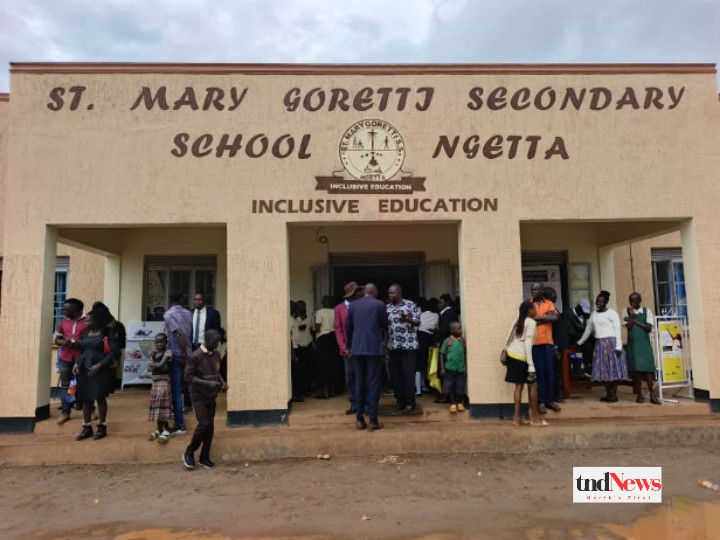
Lira | 8 km from the city center, St. Mary Goretti Secondary School is situated in Ngetta, Lira City East Division. It is the only school in the Lango sub-region dedicated to visually impaired students.
However, despite its importance, the school faces significant challenges due to a lack of essential adaptive technologies.
The lack of tools like talking calculators, braille tablets, and adaptive computers continues to limit these students’ ability to succeed in today’s increasingly digital world.
The Itinga Charity Education Foundation (ICEF), a non-governmental organization led by Kevin Acen, established the school, which is built on land donated by the Lira Catholic Diocese.
Acen says the school has made commendable strides in providing education to visually impaired students, but their biggest challenge is a lack of modern digital tools, which further marginalizes students with visual impairments in a world that is becoming increasingly reliant on technology.

With 45 students enrolled in senior one and two, Acen notes that the school serves 10 students who are completely blind and 12 students who have low or partial vision, describing the school as a beacon of hope for the visually impaired seeking access to quality education.
This comprehensive report delves into the experiences of visually impaired students, the challenges they face, and the role of a dedicated teacher in ensuring an inclusive education. It also discusses the inspiring intervention of MTN Uganda, which attempted to address some of these issues.
For many students with visual impairments at St. Mary Goretti Secondary School, the lack of adaptive technologies creates significant barriers to education.
These students agree that they lack essential resources and technology, including audio learning aids, which are critical tools for navigating subjects such as mathematics, language, and science.
Luke Etuk, the headteacher, is concerned about the impact of a lack of adaptive devices on students’ education.
“Routine tasks such as reading, solving math problems, or even engaging with digital learning materials are difficult without the right tools,” Etuk explains.
“For instance, we need talking calculators to help students navigate math problems. But the calculators available here are not designed to communicate directly with visually impaired learners. This is a significant challenge that hinders their progress,” he adds.
With the introduction of the new lower curriculum, Etuk is pleased that St. Mary Goretti has embraced the initiative, with students clustered in various projects while considering inclusive learning elements such as creativity, creation, and innovation.
Etuk’s frustration stems from the fact that tools like computers with Braille software and audio learning aids are critical for promoting independence and academic growth. Without these tools, students are forced to use traditional methods, which are often time-consuming and inefficient.
In addition to a lack of digital tools, the school is facing logistical challenges in obtaining necessary materials such as Braille books and Orbit readers.
The limited number of Orbit readers available at the school forces students to rely on traditional Braille, which incurs high transportation costs to obtain materials from Kampala, further impeding their ability to learn independently.
“Many of the textbooks used in secondary schools have not been converted into Braille format. So the teacher uses but the student cannot use, especially learners with visual impairment.”
He also urged the Ministry of Education to prioritize health sciences over general sciences for students with visual impairments.
Despite significant technological and logistical challenges, teachers at St. Mary Goretti Secondary School remain deeply committed to ensuring that visually impaired students receive the education they deserve, with 12 teaching staff members.
Emma Namwamba, a teacher at the school, is among those who have dedicated their careers to working with students with disabilities.
“It’s not easy to teach students with visual impairments, but it’s incredibly rewarding,” says Namwamba.
He says the resilience and determination these students demonstrate every day inspire him to use tactile methods or find new ways to engage them with the materials they require.
Namwamba’s passion for teaching visually impaired students stems from his belief and love that all children, regardless of ability, should have the opportunity to succeed in life if given the proper support and environment.
Regardless of the obstacles, Namwamba finds immense joy in seeing his students progress, whether it is mastering a difficult math concept or successfully reading a Braille passage.
“There’s nothing more rewarding than seeing a student master a concept they struggled with. It’s that moment of triumph that keeps me motivated every day,” he adds.
He also urged parents and the community to treat children with disabilities and support their education.
To better understand the difficulties that visually impaired students face, we spoke with several students from St. Mary Goretti Secondary School. These students, despite their circumstances, are determined to continue their education.
Nazaneen Goi Inyonu, a senior two student, is sighted and acts as a peer for visually impaired students.
“I see how hard my friends struggle, especially when it comes to reading or working on assignments,” Sarah says.
“There’s a huge gap in resources for them, a reason as to why I come through all the time to help my classmates especially those with visual impairment. I have equally learnt how to write my name using Braille.

Sarah has become a vocal advocate for increased inclusivity at her school, emphasizing the importance of community support.
Stephen Awany, a senior two student with low vision, discussed his experience with computers, which he claims has helped him and others perform well.
Awany, who is passionate about ICT, notes that, despite the limited computers they share, the need for talking calculators, Braille tablets, and computers to assist them with their studies remains urgent.
Sarah Akullu, a senior two student who is completely blind, emphasized the value of independent learning.
“I want to be able to solve math problems on my own without waiting for someone to help me,” saya Akullu.
Once more talking calculators and Braille books are provided, Akullu is hopeful that they will work faster and be more independent.
These students, despite significant challenges, are resilient and determined to succeed. Their stories highlight the critical need for technological interventions that level the playing field and provide them with the resources they require to thrive.
Recognizing the difficulties faced by visually impaired students at St. Mary Goretti, MTN Uganda intervened to provide much-needed assistance through its MTN Change Maker initiative.
The initiative aims to bridge the digital divide by offering educational resources to underserved communities.
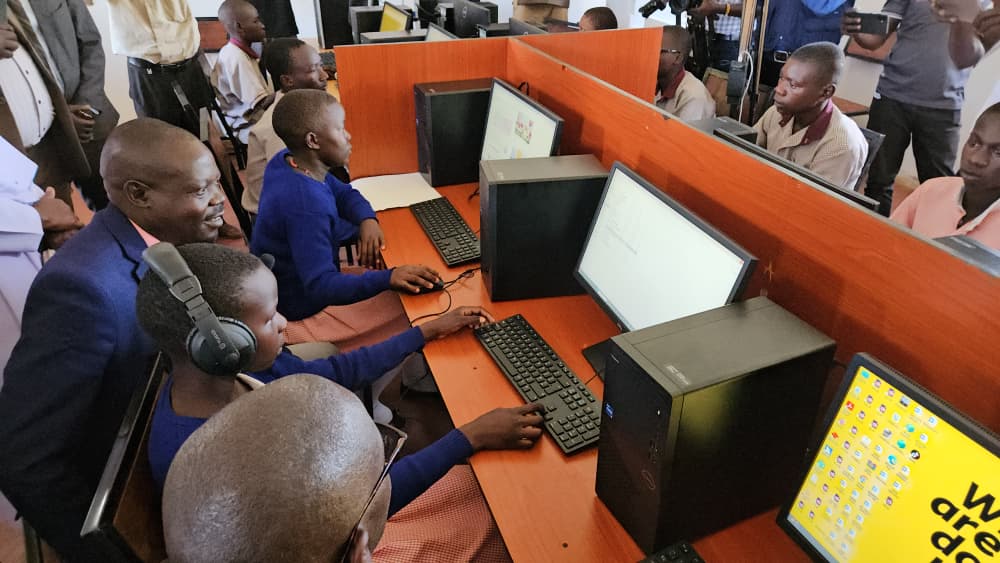
As part of this initiative, MTN Uganda donated three desktop computers with Braille JAWS software to the school, totaling shs20 million.
These computers are specifically designed to meet the needs of visually impaired students by converting written text to speech and allowing them to interact more fully with digital content.
In addition to the computers, the telecommunications giant donated 40 sitting desks, resulting in 80 more learning spaces for students.
This intervention seeks to improve the overall learning environment at St. Mary Goretti, making it more conducive to academic success for visually impaired students.
Brian Kagwisagye, MTN’s Regional Business Manager for Northern Uganda, emphasized the significance of the donation.
“Education is one of the most powerful tools for empowerment, but for many learners with disabilities, access remains a challenge. Through technology and infrastructure support, we hope to enable these students to pursue their ambitions without any barriers,” he says.
He also noted that the donation aligns with MTN Uganda’s broader Ambition 2025 strategy, which focuses on fostering digital and financial inclusion and promoting education for all across Uganda.
The donation from MTN Uganda is an important step in addressing the digital gap for visually impaired students, but it is not enough to solve the problem entirely.
Mathew Omara, Lira City’s councilor for people with disabilities, emphasized the importance of continued government, non-profit, and private sector support.
“This donation is a great start, but we need more. The government must step in and ensure that schools like St. Mary Goretti are properly funded and equipped with the resources they need to support students with disabilities,” Omara stated.
He also urged the Ministry of Education to officially recognize St. Mary Goretti as a specialized institution for visually impaired students, which would ensure that the school receives adequate funding and resources to meet its students’ needs.
The Lira Resident City Commissioner (RCC), Emmy Lawrence Egole, emphasized the significance of tackling the obstacles encountered by students with disabilities and voiced his support for the initiative.
“This donation is a welcome intervention, but it is only one piece of the puzzle. We must continue to work together to ensure that visually impaired students receive the education they deserve. This includes not just providing technology but also creating an inclusive environment where these students can thrive,” Egole said.

He also encouraged other organizations, both locally and internationally, to follow MTN Uganda’s lead and contribute to ongoing efforts to assist visually impaired learners in Lira and beyond.
While MTN Uganda’s donation has had a significant impact at St. Mary Goretti Secondary School, the journey to digital inclusivity is far from over.
There is still much work to be done to ensure that visually impaired students in Uganda and around the world have access to the resources and support they require to thrive in a digital age.
As technology advances, it is critical that all students, regardless of ability, are given the tools they require to fully participate in the educational process.
With continued government, private sector, and community support, there is hope that visually impaired students at St. Mary Goretti and other schools will be able to reach their full potential and contribute meaningfully to society.
Discover more from tndNews, Uganda
Subscribe to get the latest posts sent to your email.