Last week, a herd of elephants strayed into farming villages, destroying several acres of cassava and maize plantations, inciting panic and frustration in communities in Orom sub-county, Kitgum district.
The incident occurred in the early hours of Thursday in Madi Opei village in Lulia parish, Orom sub-county, leaving more than ten households counting heavy losses.
According to Ayoo Olga, one of the affected farmers, the elephants emerged from the direction of Kidepo Valley National Park and roamed through gardens unchallenged for several hours before retreating into the nearby bush.
The affected farmers are Ayoo Olga who lost two acres of cassava, Ocen John Michael, two acres of cassava, Ocan Bosco, three acres of maize, Apio Monica two acres of maize, and Apio Sidonia two acres of maize gardens.
Farmers wake to ruined gardens
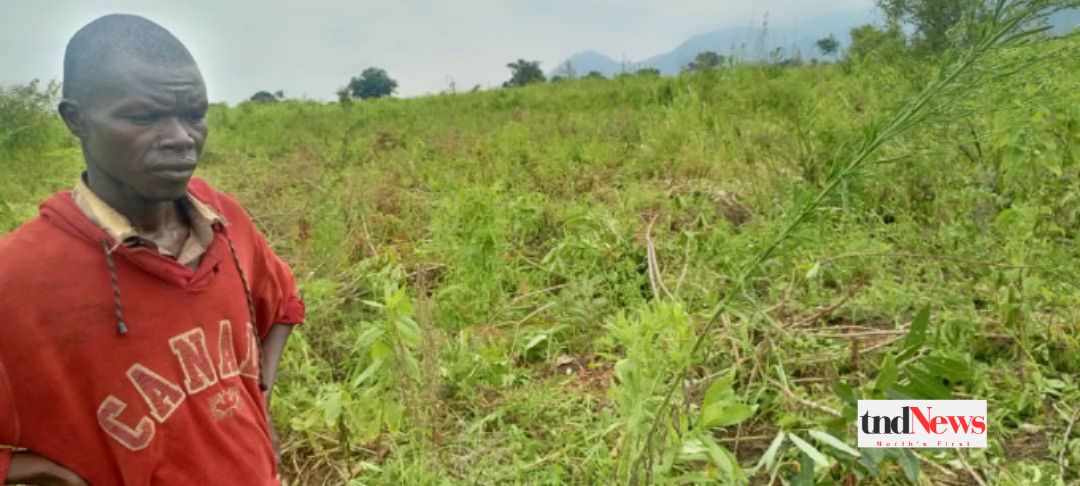
Apio Sidonia, a farmer from Lulwa Parish in Orom sub-county who lost two acres of maize, told our reporter that he discovered the destruction just after 6 a.m.
“I woke up to check on my maize garden only to find elephants had destroyed everything. This is our only source of food and income. I had just applied fertilizer a week ago,” she narrated bitterly.
Ayoo Olga, another affected farmer in Orom who lost two acres of cassava, said the animals had also damaged a water source her family depends on.
“Not only did they eat the cassava, but they also broke the water container near my garden. We are afraid they may return at night. Our children are now scared to go to school,” she said.

Local leaders demand urgent action
The LC3 chairperson of Orom sub-county, Todera Johnson Acellam, condemned the rising incidents of wildlife invasions and called for quick intervention.
“This is becoming a monthly problem. UWA needs to increase their patrols and compensate the affected farmers. Our people are suffering losses every season,” he said.
Kitgum district LC5 chairperson Christopher Arwai, confirmed receiving reports from the affected sub-counties and pledged to raise the matter with Uganda Wildlife Authority (UWA) immediately.
“We cannot allow this to continue unchecked. As a district, we shall write formally to UWA requesting for emergency deployment of rangers and community sensitization,” Arwai said.
When contacted for a comment, Martin Oryem, a community chief warden in-charge of Kidepo Valley National Game Park with UWA, acknowledged the report and said a team is being dispatched to assess the damage and guide next steps.
“We are aware of the invasion this morning in Kitgum. Our rangers are on standby and will be working with the local leaders to monitor and drive back the animals safely. We are also urging residents to avoid confronting the elephants for their safety,” he stated.
Experts recommend elephant collaring to prevent future crop raids
As pressure mounts for more sustainable solutions to human-wildlife conflict in Kitgum, Agago and Otuke districts, conservation experts are urging Uganda Wildlife Authority (UWA) to consider collaring elephants in the region.
The technology, which involves fitting GPS tracking devices around the necks of elephants, allows conservation teams to monitor elephant movements in real-time and respond more quickly to potential threats.
What is elephant collaring?
Elephant collaring is a wildlife management practice where a satellite-enabled GPS collar is fitted around an elephant’s neck. The collar sends location data to rangers and conservation teams, allowing them to track the elephant’s location, route, and behavior through mobile or computer systems.
According to Martin Oryem, the conservation Warden in charge of Kidepo, and also wildlife ecologist working with UWA said, “Collaring enables UWA to monitor the movements of individual elephants or herds, and identify patterns of crop-raiding behavior. When they approach community land, alerts can be triggered, and early warnings sent to local leaders and farmers.”
Benefits of collaring include early warning and rapid response with real-time GPS data; rangers can intercept elephants before they reach community areas.
Scientific research: Tracking migration paths helps in understanding seasonal movement, feeding zones, and conflict hotspots.
Improved planning: Data from collaring supports the development of long-term strategies such as wildlife corridors, buffer zones, and fencing.
Protection of both humans and wildlife; It reduces unnecessary harm to elephants by promoting non-lethal interventions and lowers the risk of human-elephant confrontation.
Call for action
Local leaders in Kitgum are now asking UWA and the Ministry of Tourism, Wildlife and Antiquities to introduce elephant collaring in affected districts like Kitgum, Lamwo, and Agago.
“If we had this technology in place, we would have known in advance that the elephants were heading toward our people’s gardens this morning. We strongly advocate for collaring to be rolled out here as a preventive measure,” LC5 chairperson Arwai, said.
Previous success
In other regions of Uganda, such as Queen Elizabeth National Park and Murchison Falls Conservation Area, elephant collaring has proven successful. The data has not only reduced human-elephant conflict but also helped in anti-poaching operations and wildlife tourism planning.
Cost and feasibility
While collaring one elephant can cost between $2,000 to $5,000 depending on the tracking technology used, conservationists argue that the long-term savings outweigh the initial investment.
Martin Oryem from UWA added: “We have piloted collaring in some parts of the country, and the results are promising. We are looking into resource mobilization to expand the program to northern Uganda, including Kitgum and Lamwo districts.”
Ongoing human-wildlife conflict
The incident adds to a growing list of wildlife conflicts in northern Uganda, especially in areas adjacent to conservation zones. Kitgum borders parts of Kidepo Valley National Park, and communities here frequently experience crop raids, mostly by elephants and monkeys.
Farmers and civil society groups are now demanding clear policies on wildlife control, timely compensation, and construction of deterrent infrastructure such as electric or chili fences.