In the obstetrics ward of Gulu Regional Referral Hospital, the numbers tell a grim story and over a recent 15-month period, the facility recorded 1,317 cases requiring post-abortion care and seven of those women did not leave the hospital alive.
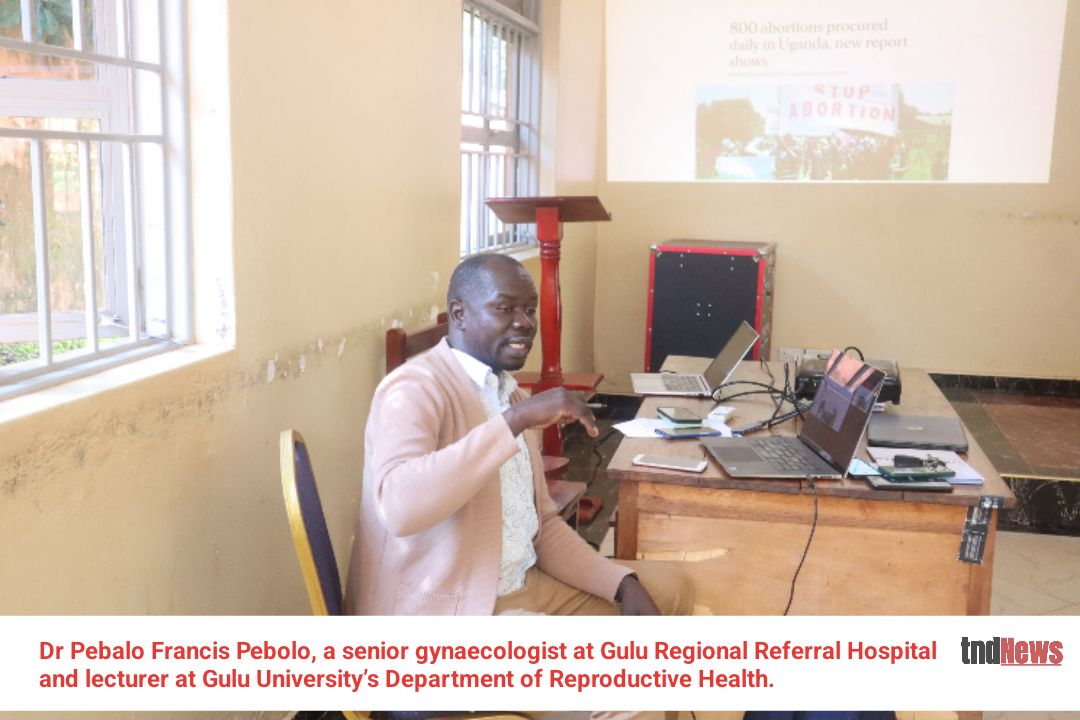
For Dr. Pebalo Francis Pebolo, a senior gynaecologist at Gulu Regional Referral Hospital and lecturer at Gulu University’s Department of Reproductive Health, these are not just statistics and they are the mothers, daughters, and wives that Uganda is losing to a crisis that is almost entirely preventable.
Dr. Pebolo is the corresponding author of a landmark 2024 study published in Women’s Health that dissects the harsh reality of abortion care in Northern Uganda.
As the country debates restrictive laws, Dr. Pebolo is on the front lines advocating for a pragmatic shift – the Harm Reduction Model.
“We are dealing with a public health emergency,” Dr. Pebolo told journalists, reflecting on the study’s findings.
Adding that “abortion-related complications are the third leading cause of maternal death in Uganda, accounting for approximately one-quarter of all maternal deaths and the majority of these are preventable if we can get women to use the full package of post-abortion care [PAC] services.”
While unsafe abortion is a national crisis, Northern Uganda bears a specific and brutal burden and decades of conflict disrupted health systems and family structures, and now, the region is grappling with one of the highest rates of maternal morbidity in the country.
Dr. Pebolo’s research, conducted with colleagues Jackline Ayikoru, Jimmy Opee, and Felix Bongomin, focused specifically on the utilisation of PAC services at Gulu Regional Referral Hospital and the results, drawn from 364 participants between March and June 2023, were alarming.
The study found that only 21.1% of women seeking care after an abortion utilized four or more of the essential PAC components which include emergency treatment, counseling, family planning, and linkage to other reproductive health services .
Therefore, this means the vast majority of women are walking away with only half the care they need and they receive the emergency evacuation to save their lives, but they leave without the mental health support or the contraception required to prevent the next crisis pregnancy.
“If you only treat the complication and send her home, you have failed,” Dr. Pebolo explains.
He further explained that the harm reduction model insists that you treat the medical emergency and you offer Long-Acting Reversible Contraception (LARC) right there hence you break the cycle.
The face of the crisis
The data collected under Dr. Pebolo’s supervision paints a specific picture of who is most at risk in Northern Uganda.
Across the wider region, a concurrent study at Lira Regional Referral Hospital found that 47.8% of admitted married women had suffered unsafe abortions a staggeringly high prevalence driven by poverty and rural isolation .
The two studies revealed that women from rural settings were found to be more than twice as likely to experience an unsafe abortion compared to their urban counterparts, largely due to lack of access to information and safe providers.
At Gulu, Dr. Pebolo’s team identified specific barriers to care and the study highlighted that a lack of knowledge about PAC services and a lack of partner support were major hurdles .
“Having a supportive partner increased the likelihood of utilizing full PAC services by nearly double,” Dr. Pebolo notes .
“We cannot treat women in isolation and the stigma is so high that many women arrive alone, terrified, and bleeding thus, they delay coming because they are ashamed and by the time they get to us, their infection is severe,” he added.
What harm reduction model looks like in practice
The term “harm reduction” is often associated with drug policy or needle exchanges, but Dr. Pebolo argues it fits perfectly into Ugandan obstetrics.
“The law is restrictive, but the bleeding woman does not care about the penal code and she cares about surviving,” he states.
To him, the model he advocates for does not seek to promote abortion but to accept that it occurs often under horrific conditions.
Additionally, in Northern Uganda, where poverty drives women to untrained local providers, the “harm” is hemorrhage, sepsis, and infertility.
Dr. Pebolo’s research advocates for a three-pronged approach; emergency treatment with immediate non-judgmental medical care, contraceptive integration with immediate post-abortion insertion of IUDs or implants which his study suggests is critically underutilised, and privacy and respect which the study found that women who were given physical privacy during prescription and procedures were 2:3 times more likely to utilize full services.
“Respectful care is not just a nice-to-have; it is a medical intervention,and when a nurse judges a woman, that woman runs away and she will not take the family planning and she will not also come back if she hemorrhages thus, she will die at home,” Dr. Pebolo insists.
The findings from Gulu University, under Dr. Pebolo’s academic leadership, and Lira Regional Referral Hospital are clear and the current system is failing to reach the majority of women.
Dr. Pebolo calls for a massive scale-up of male partner involvement programs and community health education to bridge the knowledge gap .
He further argues that midwives and nurses need specific training to de-program their own biases against abortion patients.
“From March 2023 to June 2023 alone, we enrolled 364 women in this study at just one hospital,” he says.
“This is just the tip of the iceberg. If we continue to treat this as a moral crime rather than a medical reality, we will continue to bury women in Northern Uganda,” he added.
For now, Dr. Pebolo and his team continue the difficult work of saving lives one patient at a time, pushing for a health system that prioritizes preserving life over passing judgment and in the harm reduction model, every woman who walks out of Gulu Regional Referral Hospital with a healed infection and a contraceptive implant is a victory against the statistic.
Discover more from tndNews, Uganda
Subscribe to get the latest posts sent to your email.