Toxic herbs have become a weapon of last resort for desperate young women in the Acholi sub‑region, where restrictive abortion laws and widespread confusion about their application are driving a preventable public health crisis.
At the centre of the crisis is Lutoto (wandering Jew), a common weed used as pig feed that is now being inserted or ingested to terminate pregnancies.
Medics describe it as highly toxic and capable of causing intense uterine contractions, cutting off blood supply, and even killing parts of the uterus.
Another plant, Atakarac (Aloe vera), is also being used with devastating consequences.
At Gulu Regional Referral Hospital alone, doctors say they admit between five and ten women daily suffering from post‑abortion complications, many of them teenagers.
“The deaths we see are just the tip of the iceberg,” said Dr. Pebalo Francis Pebolo, a senior gynaecologist at Gulu Regional Referral Hospital and lecturer at Gulu University.
 “For every woman who dies from post‑abortion complications, thousands more suffer severe health consequences,” he added.
According to Dr. Pebalo, fear of the law compounded by stigma and poverty drives women away from health facilities until it is often too late.
“The rich find safer options, but young girls and poor women resort to dangerous methods because they have no alternatives,” he said.
The law: restrictive, ambiguous, and feared
Uganda’s legal framework on abortion is one of the most restrictive in East Africa. The Penal Code Act, in sections 141 to 150, criminalises abortion, with exceptions permitted only in narrow circumstances typically where the mother’s life is at risk or the fetus is not viable.
Human rights lawyer Cinderella Alimuchan, who has studied reproductive health law extensively, explained the legal landscape in stark terms.
“Any person who attempts to procure an abortion commits an offence punishable by law,” she said, summarising the general rule.
 The Penal Code provides that a person who, with intent to procure a miscarriage, unlawfully administers any poison or other noxious thing, or uses any instrument or other means, is liable to imprisonment for up to fourteen years and a woman who procures her own miscarriage also faces criminal liability.
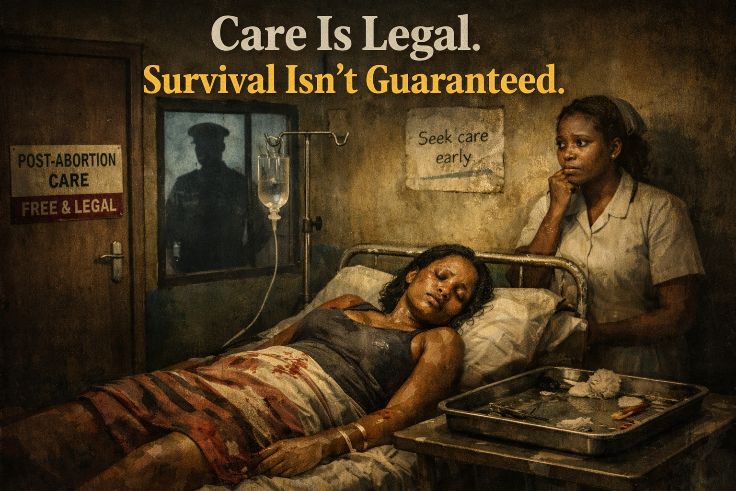
“There is a critical distinction between illegal abortion and lawful post‑abortion care,” she said.
She added that no law in Uganda prohibits a health worker from providing post‑abortion care and denying such care would violate a woman’s right to health and life, as guaranteed under the Constitution.
The Constitution of Uganda (1995) does not explicitly recognise a right to abortion, but it guarantees the right to life and the right to health.
In practice, courts have allowed abortion where it is the only means to save a woman’s life but that narrow exception does little to address the daily reality of unwanted pregnancies, particularly among survivors of sexual violence, young girls, and impoverished women.
Additionally, the ambiguity of the law has created a climate of fear that reaches far beyond the courtroom.
Health workers in Acholi report that women often delay seeking care because they worry they will be reported to police or stigmatised by medical staff.
In some instances, doctors themselves have been arrested for providing post‑abortion care, a practice that human rights lawyers say is entirely legal.
“The confusion is dangerous, most of these patients come when the situation is already very bad. They delay at home, or seek unsafe methods first, and by the time they reach us, they are in critical condition,” said Dr. Pebalo.
He further disclosed that many women arrive with severe bleeding, overwhelming infections, or organ failure and some need emergency surgery to remove damaged reproductive organs, leaving them infertile for life.
“When your uterus is torn, literally, you can’t have a baby, and you are ruining yourself; you are killing yourself,” Dr. Pebalo said.
According to Dr. Pebalo, the consequences extend beyond physical harm but the combination of legal sanctions and community stigma leaves many young women feeling they have no safe way out.
A preventable toll
Across the Acholi sub‑region, maternal mortality data reveals the scale of the crisis and nearly 9.4% of maternal deaths have been linked to post‑abortion complications, but experts believe the true figure is much higher because many deaths in remote villages never reach official records.
At Gulu Regional Referral Hospital, Dr. Pebalo and his colleagues treat women who have used everything from Lutoto to sharp objects to unregulated drugs obtained over the counter with each case, he said, represents a failure of the system, a system that criminalises rather than cares.
“This is preventable, and no woman should die from something we can address,” Dr. Pebalo stressed.
The debate over whether Uganda should liberalise its abortion laws has long been politically and morally fraught.
However, some legal experts argue that even without changing the law, the government could take immediate steps to save lives.
Alimuchan points to three key actions: first, issuing clear guidance to health workers that post‑abortion care is always legal and must not be denied; second, ensuring that no woman or girl is arrested for seeking such care; and third, expanding access to comprehensive sexual and reproductive health education, including information about contraception, to prevent unwanted pregnancies in the first place.
“The Penal Code was written in 1950, long before Uganda ratified international human rights treaties that protect women’s health and dignity,” Alimuchan said.
“We need to interpret the law in a way that prioritises life and not punish women who are already suffering,” he added.
For now, the daily flow of women into Gulu’s hospital continues and the hospital struggles with shortages of blood, equipment, and staffing, especially in lower‑level facilities where many women first seek care.
However, the greatest shortage, doctors and lawyers agree, is the political will to confront the root causes: poverty, stigma, and a legal framework that drives women to the weeds of death.
Discover more from tndNews, Uganda
Subscribe to get the latest posts sent to your email.