Gulu, Uganda | As global leaders convene at international summits to negotiate emissions targets, biodiversity protection, and climate finance, another form of leadership is quietly shaping the climate response and one rooted in faith, values, and lived experience.
At the forefront of this movement are women of faith, whose moral leadership is influencing climate action far beyond formal negotiating rooms.
In interviews conducted following the seventh session of the UN Environment Assembly (UNEA-7), women faith leaders and women-led networks spoke candidly about why climate change cannot be solved by science and policy alone.
For them, the crisis unfolding across ecosystems and communities is also ethical and spiritual, challenging humanity to rethink its relationship with the Earth and with one another.
Their message was consistent and clear: without moral grounding, inner reflection, and values shaped by faith traditions, climate solutions risk becoming abstract, technocratic, and disconnected from the people most affected.
Inner leadership alongside scientific action
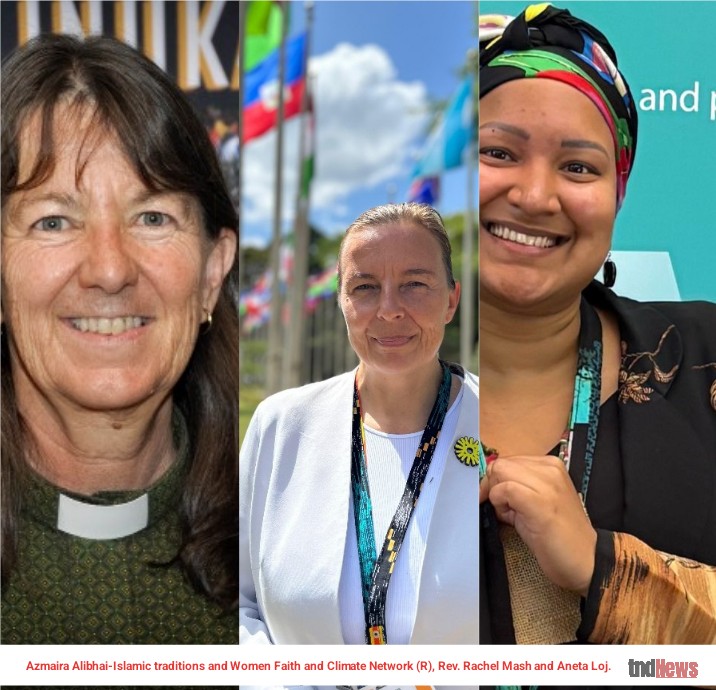
Aneta Loj of the Brahma Kumaris, one of the organizers of the first Interfaith Talanoa Gathering held alongside UNEA-7, women’s leadership in climate spaces begins with inner awareness.
“We are not asking governments to replace science. It tells us what is happening. Silence helps us decide how to respond,” Loj explained.
In her view, silence is not withdrawal but a source of ethical clarity – a space where values emerge, conscience is awakened, and fear-driven reactions can give way to thoughtful and compassionate decision-making.
“Silence is where we slow down enough to listen. Not just to data, but to our responsibility to people, to nature, and to future generations,” she said.
The Brahma Kumaris have encouraged policymakers to introduce brief moments of silence before or during negotiations intentional pauses that allow leaders to reconnect with inner values before making decisions with global consequences.
“Evidence must guide our decisions but values determine how that evidence is used. When scientific knowledge and inner wisdom come together, policies become more humane and resilient,” Loj noted.
Faith-informed ethics and care for the Earth
Across faith traditions, women leaders emphasized a shared belief that the earth is not a commodity, but a sacred trust.
“Our faith reminds us that the Earth is not just a resource to be extracted; It sustains us like a Mother. From that awareness comes gratitude, care, and non-violence toward all life,” Loj echoed.
This ethic shapes how women of faith approach climate action placing stewardship, intention, and responsibility at the center. Rather than focusing solely on outcomes, they emphasize how decisions are made and who they serve.
“Every action begins with a thought, and if we nurture thoughts of respect, inclusion, and care, our policies and behaviors will follow,” Loj reflected.
These principles translate into concrete initiatives led or supported by women within the Brahma Kumaris network, including solid waste management programs, solar energy research, natural and yogic farming, and projects empowering women, youth, and smallholder farmers.
Furthermore, at international forums, they have also raised ethical concerns around ocean governance and deep-sea mining, arguing that technological capability must never override moral responsibility.
Women’s ethical leadership in times of climate stress
Faith leaders interviewed underscored that ethical leadership often carried by women at community level is no longer optional. Climate change is increasingly intertwined with displacement, conflict, mental health challenges, and social fragmentation.
“Many communities are facing climate impacts alongside poverty or instability and in these situations, faith-based approaches help foster inner stability, wellbeing, and social cohesion,” Loj said.
Religion, she explained, offers language, rituals, and trusted community structures that help people cope with uncertainty and loss, while also motivating collective action.
Adding: “When people are grounded internally, they are better able to collaborate externally.”
This role is especially critical as climate anxiety rises, particularly among young people. Faith-based environmental education programs often led by women are using meditation, reflection, and values-based learning to transform anxiety into constructive action.
Women, faith, and climate justice
Nowhere is the moral dimension of climate change clearer than at the intersection of gender and justice.
Representatives from the Women, Faith, and Climate Network (WFCN) highlighted how women especially in marginalized communities are disproportionately affected by environmental degradation, while also being essential to solutions.
“Women are on the frontlines of climate impacts;they manage water, food, and family wellbeing, yet their leadership is too often overlooked.”one WFCN leader said.
The network describes women as “radical collaborators” bridging households, communities, faith institutions, and policy spaces.
“Women do not work in silos, we translate global commitments into local action.” the representative explained.
WFCN is calling on governments and UN institutions to meaningfully engage women-led, faith-based organizations in climate policymaking and implementation.
This includes gender-responsive policies, access to funding, and recognition of women not just as beneficiaries, but as co-implementers of climate solutions.
“Faith communities already reach billions of people, but when women of faith are empowered, climate action becomes part of everyday life,” the representative said.
Faith, trust, and lasting hope
Across the interviews, faith emerged as a source of moral clarity, hope, and trust qualities often missing from top-down climate frameworks.
“Environmental harm hits women, children, and marginalized communities first and hardest, and responding to that is a moral obligation,”WFCN members emphasized.
Faith traditions frame environmental protection not as a lifestyle choice, but as an act of justice and care for the vulnerable. They also offer something many institutions struggle to build: trust.
Through long-standing community networks, faith organizations often led by women can mobilize quickly and sustain engagement over generations.
“Policy frameworks come and go, and faith communities stay,”one participant said.
Barriers women of faith continue to face
Despite their reach and impact, women faith leaders still face significant barriers. Interviewees pointed to limited recognition in policy spaces, persistent funding gaps for women-led initiatives, and the misconception that faith is symbolic rather than practical.
“There is still a tendency to separate spirituality from environmental responsibility, but faith shapes ethics, behavior, and daily choices. That’s where real transformation begins,”one WFCN representative said.
In some religious contexts, resistance to gender equity continues to limit women’s leadership undermining community resilience at a time when it is most needed.
“Climate justice and gender justice are inseparable, and you cannot solve one without addressing the other,” the representative added.
A moral turning point led from the ground up
Together, these voices point to climate change as a moral and spiritual turning point and while science defines urgency and policy provides structure, women of faith bring meaning, motivation, and ethical depth to climate action.
“The environmental crisis is not only scientific or political, it is deeply moral and spiritual and without justice, compassion, and shared responsibility, solutions will remain incomplete,” a WFCN leader said.
Faith leaders called for stronger interfaith collaboration, greater investment in grassroots women-led initiatives, and climate policies that integrate ethical reflection alongside scientific evidence.
For Aneta Loj, the call to action is both simple and demanding.
“Every thought is a seed, and if our thoughts are grounded in care for the Earth and for one another, our actions and our policies will follow,”she said.
Beyond the halls of UNEA-7, women of faith on the frontlines of climate change are demonstrating that the crisis is not only about emissions or timelines.
It is a test of humanity’s values and an opportunity to reimagine leadership guided by ethics, empathy, and respect for a shared and sacred planet.
Discover more from tndNews, Uganda
Subscribe to get the latest posts sent to your email.