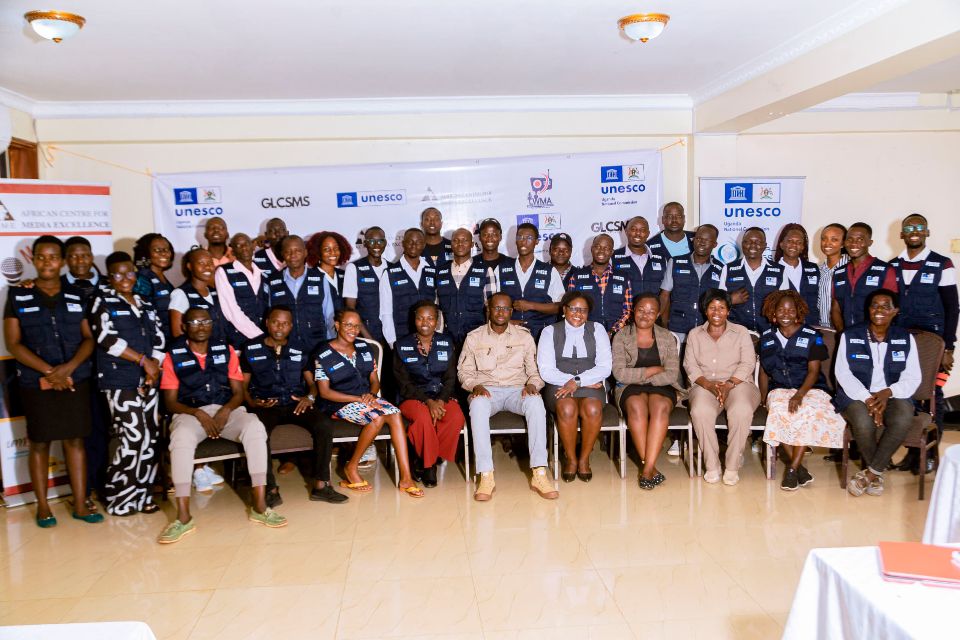
Lira City | Journalists, development partners, civil society actors, and government representatives gathered at Good News Hotel in Lira City on Friday, October 31, to commemorate the International Day to End Impunity for Crimes Against Journalists (IDEI2025).
The event was held under the theme “Raising Awareness on AI-facilitated Gender-Based Violence Against Women Journalists.”
Godwin Okiror, representing ACME, made the opening remarks and welcomed participants. He emphasised the critical role of journalists in society.
Okiror underscored the urgency of addressing violence and impunity against media practitioners, particularly women.
On behalf of ACME, he pledged continued advocacy, collaboration and capacity building of journalists and media managers in the Lango sub-region.

In his official opening remarks, Steven Odongo, Deputy RCC for Lira City East Division who represented the RCC of Lira Egole Lawrence, said the day was significant for journalists and stakeholders to renew their commitment to promoting safety, accountability, and transparency.
“We acknowledge the role of journalists in promoting transformation in the country,” he stated, urging collective efforts to curb impunity.

Odongo said good governance is participatory through collective efforts to protect citizens, noting that Lira City had not recorded any serious incidents involving journalists and the authorities. He pledged continued collaboration between the media and the various authorities to ensure peace and stability.
Keynote address
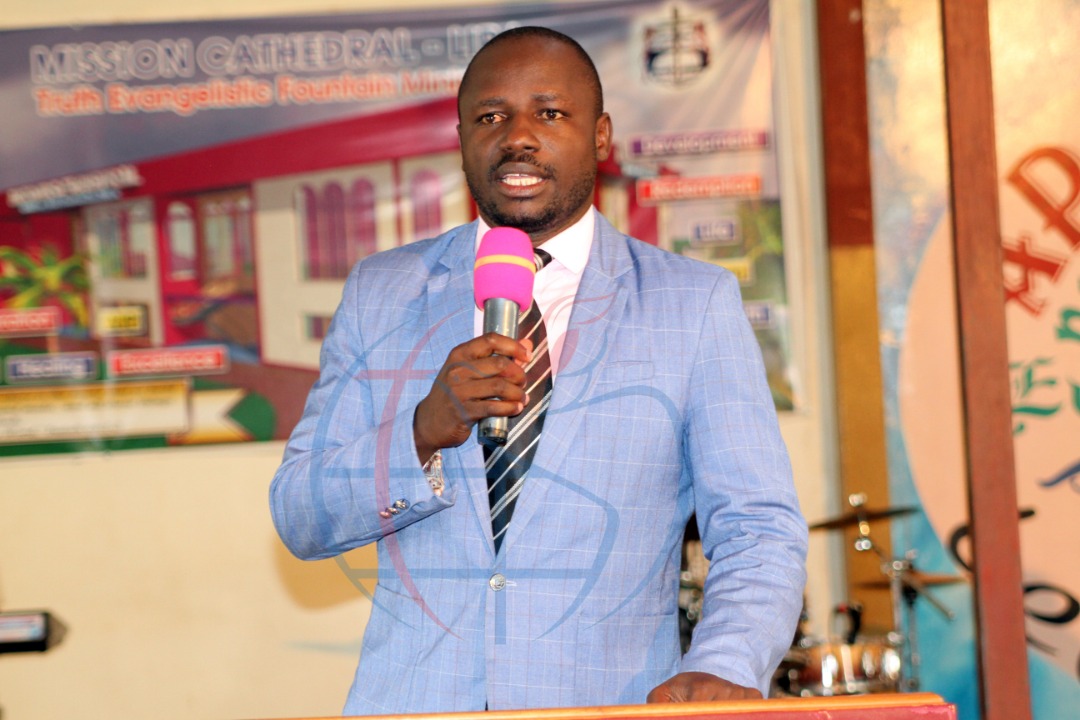
The commemoration, held in honour of media professionals targeted for their work, featured a keynote address by Comrade Newton Noble Odongo, a renowned human rights activist and environmentalist.
In his keynote, Odongo praised journalists for their courage in uncovering the truth, holding those in power accountable, and giving a voice to the voiceless. He noted that while Uganda has made progress in media freedom, journalists still face intimidation, arbitrary arrests, harassment, and violence—especially women who are increasingly exposed to gender-based attacks both offline and online.

“The rise of AI has created new avenues for harassment,” he said, citing deepfakes, manipulated images, and automated bots used to discredit women journalists. “Such digital violence often goes unpunished, posing a serious threat not only to press freedom but also to democracy.”
He called for accountability, stronger protection mechanisms, responsible AI regulation, and empowerment of women in the media. “No crime against a journalist, whether physical or digital, should go unpunished,” he emphasised.
Quoting Nelson Mandela, the keynote speaker reminded participants that “freedom of the press is not just important to democracy; it is democracy.” He urged the creation of an environment where every woman journalist can speak boldly without fear. “When truth is silenced, injustice thrives. But when journalists are protected, society prospers.”
Doreen Opio, chairperson of the Lango Women Media Association, was a member of the panel that discussed the theme at length. She said no journalist should ever have to pay the price for doing their job.
“It’s time to call for justice. You don’t have to pay with your life, your gadgets, or anything because of what you are doing,” she said, reminding participants that when a journalist is silenced, the public is left in darkness.
She noted that the theme speaks directly to the different stakeholders ahead of elections in 2026, citing that female journalists face a lot of threats and risks compared to their male counterparts.
To address such, she called for more gender safety training sessions, noting that it is essential because journalists are sometimes emotionally, physically or even mentally broken down.
“Newsroom safety policies also help in harassment mitigation for journalists,” she added.
She also called for the strengthening of collaboration between police, the president’s office and media initiatives, among others.
Counsel Winnie Anyango, an Advocate of the High Court in Lira, emphasised that journalism is protected by the Constitution under Article 41. She said impunity can end if media laws, such as the Uganda Communications Act, are fully implemented.
 “Just about two days ago, a media house in this country was stopped without justification from covering parliamentary proceedings,” she noted. “This is happening in broad daylight despite the Constitution.”
Anyango added that while Uganda has the right laws in place, enforcement remains weak. She advised journalists to always preserve authentic and original evidence whenever harassed.
Counsel Noel Awor, said impunity is a legal matter and should be handled with integrity. She called for professionalism as journalists conduct their day-to-day duties.
Polline Angwec, who works with UNESCO, had earlier informed the gathering that there are impunities at media houses, calling for an end to such.
Speaking with one voice, journalists at the Lira event urged governments to investigate and prosecute attacks on journalists, while calling on media houses to protect their staff and citizens to stand in solidarity with the press.
They emphasised that ending impunity is not the duty of one actor but a collective responsibility.
The event urged a unified call to action: “Together, we can end impunity. Together, we can protect press freedom. Together, we can build a world where every journalist is safe to tell every story.”
The Lira event also resolved that media houses offer adequate capacity building for journalists, and that ACME and partners like UNESCO amplify their presence in the Lango sub-region going forward.
 It was also unanimously resolved that the next commemoration will have more participants (journalists) across districts in the Lango sub-region since impunity can happen anywhere.
Collaboration with the police and judiciary to ensure safety and justice for the victims.
Polline delivered the message of UNESCO Director-General Audrey Azoulay, who described journalism as a cornerstone of democracy that must never be punished for speaking truth to power.
“Journalism is not a crime, and truth-telling must never be punished,” she said, warning that crimes against journalists threaten freedom of expression and public accountability.
According to UNESCO and the International Centre for Journalists (ICFJ), over 70 per cent of women journalists worldwide have experienced online violence, and one in four have also suffered physical attacks as a consequence.
“These are not just personal assaults,” the Secretary-General’s message stated. “They are assaults on press freedom, on truth, and on every citizen’s right to be informed.”
The United Nations, through UNESCO and the UN Plan of Action on the Safety of Journalists, continues to work with governments, media houses, and civil society to strengthen legal frameworks, create safer newsroom environments, and amplify survivors’ voices.
The commemoration was moderated by Milton Emmy Akwam, Executive Director of GLCSMS and Managing Editor of tndNews, Uganda.
Discover more from tndNews, Uganda
Subscribe to get the latest posts sent to your email.