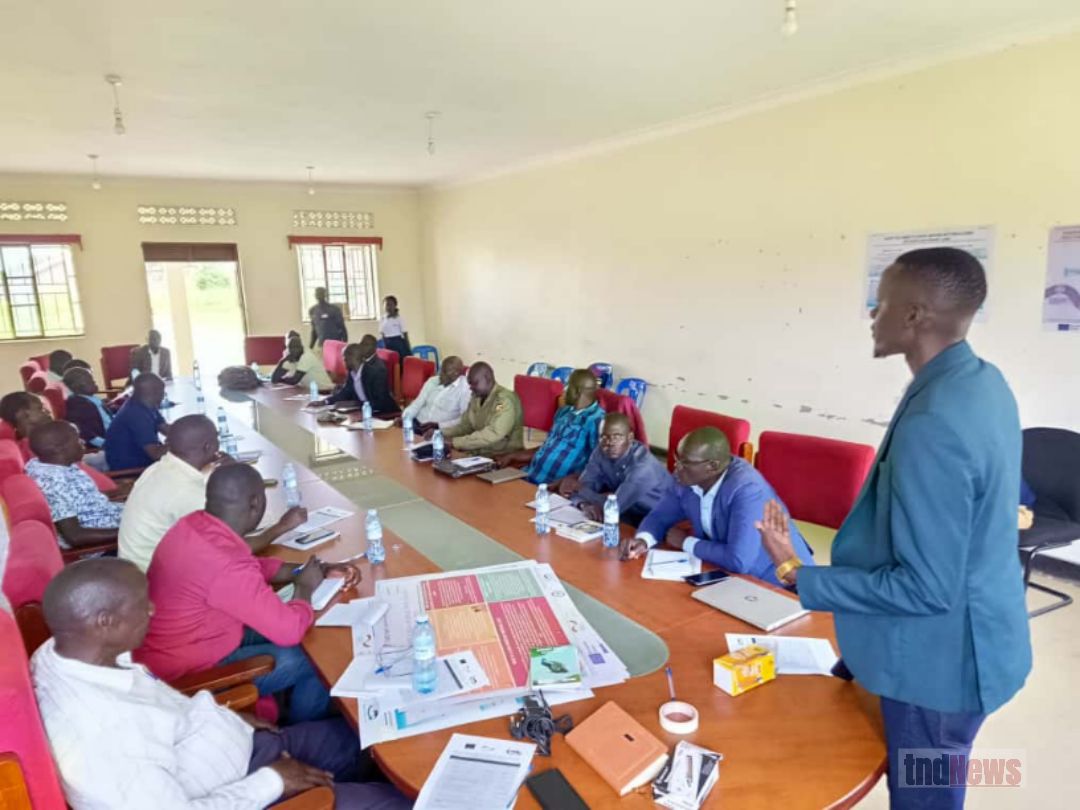
Land and Equity Movement in Uganda (LEMU) on September 26, 2025, convened the Lango Regional Multistakeholder Dialogue on the Use of Customary Land Documents as collateral for loans at the Dokolo district natural resource hall.
 Key findings and recommendations were presented. The findings reveal community and family members’ perceptions, including hindrances with different financial institutions regarding the use of Certificates of Customary Ownership (CCO) for bank loans.
Adventino Banjwa, a researcher with LEMU presented the findings. It was noted that while GIZ was successful in making sure that CCOs were obtained, finding their way to the banks has not yet happened.
 “Our question was to understand why,” Banjwa said. “These are snippets of what we found and part of what we are going to do is also to interact with us here.”
“The first was the question of consent. This is customary land. So, community members were telling us. ‘This is land owned by family – you are not talking about individual and therefore if Adventino has an issue that cannot be resolved by personal means or within the circle of the family that I need to go to a financial institution and I am proposing to use the family CCO or land to back up my application for this loan, I have to get consent of the family members.’
“If it is a CCO, the first is the family, but there is also a clan. So, the consent – family members say: the fact that CCOs are not merging into the banks – one of the key considerations is that you have to get consent from the family members. This does not make the roadmap – the journey to the bank straightforward.”
Researchers found from the communities that an individual family member cannot interact with CCO without the consent of the family members. The study also reveals hindrances in the use of CCOs and Land Inventory Protocols (LIPs) as collateral for loans. Communities told LEMU: “Look, for us, when we were going to register for those CCOs, we did not consider that they would be taken to the banks.”
Adventino and the team of researchers also discovered that the farther you go in the rural areas, the demand for loans is not so much, especially the loans needed from bigger financial institutions. Community members were telling us that the little money we need may be obtained from the village loan saving scheme. Many of us don’t need the bigger financial institutions, which will need titles; the CCO and big financial institutions also need titles that are in individual names.”
Communities also had fears about what happens when they take their CCOs to the banks. “Will the banks do the photocopy and remain with their originals?” “We told them: “The financial institution can’t do that; they have just given you the money, you can’t walk back with the originals because it is a family document: you have to leave it there – they will give you all the guarantee that it’s safe unfortunately you don’t go back home with it.”
To the family members LEMU engaged, “This was unacceptable. “They want to have access to the originals all the time. There were fears that financial institutions would retain the originals when they apply for a loan,” adds Adventino.
Another finding was delays in issuing Certificates even when community members apply for them under GIZ financing. Cooperatives, those that are involved in large-scale agriculture or other businesses for which they may need a loan from a financial institution, were a little demotivated because of the delays. “They applied and had to wait longer. They were saying this ‘thing took longer, and we were demoralised and we just found other ways’,” Banjwa told the gathering.
There were also fears of not being able to repay a loan. “The community members feared the loan. They were telling us: “This loan, if I fail to repay, I put family land at risk. What is going to happen?” “That fear is not personal fear; it is fear of being responsible for putting family property on the frontline,” he said.
Recommendations
These were made during the study, and at the regional dialogue. Financial institutions, LEMU says, told them and partner GIZ to sensitise their regulators, the Bank of Uganda and Uganda Microfinance Regulatory Authority (UMRA), on the use of Certificate of Customary Ownership.
Meanwhile, communities recommended that financial institutions should help them understand and develop business plans. In their view, the loans should be directed towards business. The second recommendation was that financial institutions should not issue a loan whatsoever where there is even the mildest family disagreement.
The other recommendation was that financial institutions give loans in instalments and monitor the progress of their clients. For example, they say, “If one family member came for a loan of shs5m, first send shs2m. Don’t send it all so that when they fail the family will manage to repay the balance.”
Communities also recommended that loan officers visit families and discuss loans being applied for. “From the interactions we have had with financial institutions, they told us they do. Now, this is a challenge because the financial institutions told us they do this thoroughly and community members are saying ‘please your loan officers should embark on work. They should go and explain these matters to family members before the loan is issued; even when they have accepted – go and explain every detail to them – the terms and conditions’,” says Adventino.
Another recommendation was that financial institution should issue documents confirming or acknowledging receipt of peoples’ original documents, in addition to knowing that customary land is managed by the clans, and when doing background checks, clans should be consulted.
It was also recommended that financial institutions follow up on the loans to ascertain if they’re being used for the reasons it was borrowed.
Sale of mapped land should also involve local authorities, clan leaders and sub-county. Only then should subdivisions also happen.
What banks say
Banks interacted with said customary land is not for one family member, thus multiple ownership. Additionally, customary lands are village-based and have less value, with the nature of land as being difficult to sell to recover money owed.
The puzzle of consent on customary land is a challenge within the clans today. Financial institutions also noted that when they give out loans using CCOs, some family members intervene by paying off the loan to recover their documents.
In addition to other recommendations, comprehensive financial literacy for applicants and family members should be undertaken before loan issuance, and loan applicants should focus on viable businesses that will help them to repay the loans once applications are accepted.
Odwe John, Centenary Bank manager for Amolatar branch, said the findings LEMU and GIZ came up with are something very-very important. “As a financial institution (I am talking on behalf of Centenary Bank), we’re trying to address one of our biggest challenges: how to secure facilities that we give out there or secure the loans.”
 He stated that the bank does handle farmers, business people. “This particular component of CCOs, we are looking more of the farmers than the business people basically because many of our business people are having capacity; they have vast land and have gone ahead to work out ways of getting their titles.”
Odwe, defining who farmers are, said they form part of one of the bank’s core peoples and areas of concerns. “I want to tell you that once you are doing fishing, you are a farmer, if you are in production, to us you are a farmer. You are doing poultry, that is farming. We have animal fattening – maybe goats rearing, piggery, cows – all those – you are in dairy farming. When you are doing produce marketing, you are a farmer to us – when you are doing agro processing – all these are farmers to us.”
He noted that those using CCOs are people involved in production. One of the issues communities raised was that they present photocopies for bank loans. In response, Odwe said, “The answer is no, we take the original” – sending the hall into laughter.
Another concern of the communities has been that banks target their land. “As Centenary Bank, we don’t target land, we advise. Some come and say, ‘I have 40 acres.’ But they are using it for subsistence farming and want to get a loan. We advise that ‘please, you are not a farmer according to us. First, get serious a bit.
Weja Odyek Geoffrey, LC3 chairperson of Okwongdul sub-county in Dokolo, gave a vote of thanks to LEMU for the awareness and sensitisation on how to use customary land with CCOs. “In our culture here, our aim is just to safeguard the land but now you are giving us some advice that when you are securing land let it be for a purpose.”
The sub-county leader said that they will take the message from the dialogue to people who have registered their land so that their land becomes effective. “On behalf of this room, keep on going to sub-counties where the project is in so that they also get the same message,” Weja advised.
LEMU hailed for enhancing land security
District Police Commander of Dokolo, SP Patience Baganzi, has hailed LEMU for advocating for land rights. She said that through LEMU, customary land security has limited encroachers from trespassing on the already titled lands in the district.
SP Baganzi added that most of the cases in the district are land-related. “In relation to Certificate of Customary Ownership (CCO) vis-a-vis financial institutions, I am glad that when we are handling the CCOs, getting the loan consent is paramount. In the security perspective, when we look at other land tenure systems where one or two people can go and at the end of the day get a loan – with customary it is different.”
Under customary ownership, she noted that the vulnerable, especially the children and women, are safe because consent is paramount. “It may take time processing the loans, but where consent is a must for so many people, it is a credit in the security perspective.”
 She added that the CCOs have “really helped us in customary tenure security, where at least it limits the encroachers from trespassing on the already titled land, unlike where customary land is not titled. So, all in all big ups to LEMU.”
Odongo Tonny Ocen, the LC5 vice chairperson of Dokolo, said ever since LEMU started their operations in the district, they have never registered any serious issues in the community or at the district. “If it has ever happened, then I think it has been managed at a level that has not reached my office – the office of my boss.”
He urged the dialogue participants to understand the information before they disseminate it. “What you have not understood, that idea you have, bring it out to be discussed. At the level of the district, we are guided by communities because your ideas, information, and opinion are what guide our direction to give you the best services.”
Discover more from tndNews, Uganda
Subscribe to get the latest posts sent to your email.