There’s a quiet heartbreak playing out across Uganda, one that rarely makes headlines but devastates lives daily. It’s the story of our young people, full of hope and promise, walking into interviews for public service jobs believing their hard work and qualifications will speak for them. Instead, they walk out invisible, overlooked and disregarded.
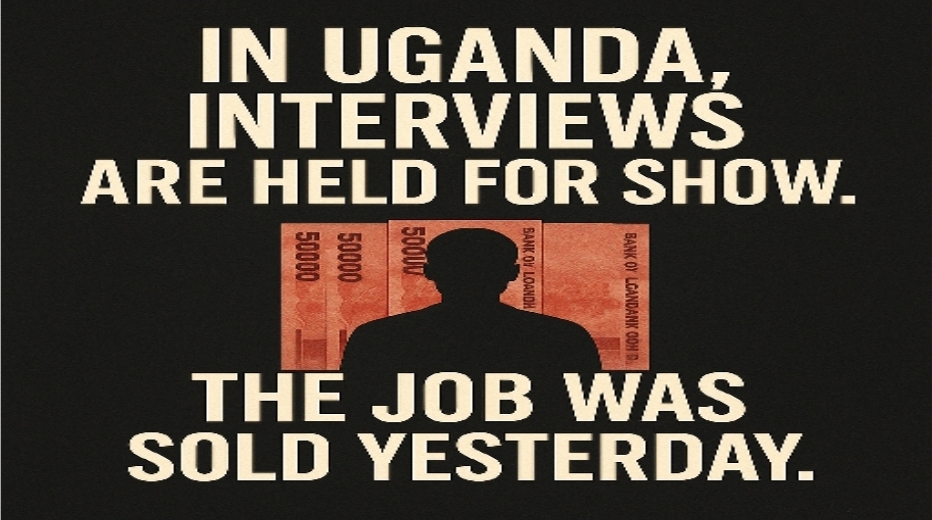
In today’s Uganda, the rules of the game have changed: jobs are sold, not earned. Corruption in civil service recruitment has shifted from hushed rumour to open secret. Across towns like Kwania, Soroti, and Mbarara (it’s happening in the entire country), qualified young Ugandans are being sidelined by nepotism and bribery. Jobs that should be awarded on merit are auctioned off to the well-connected.
According to the Inspectorate of Government’s 2022 report, recruitment-related corruption was the second most reported form of corruption in the public sector, accounting for 24% of complaints.
Uganda reportedly loses over UGX 500 billion ($137million) each year to public sector corruption, a loss not only in money, but in human dignity and national potential.
The lived experience: Stories behind the statistics
In Kwania, a district recovering from decades of conflict, I met Otim Emmanuel, a first-class graduate in Public Administration. He had stellar references, internship experience, and passed his aptitude tests.
But he lost a district job to a candidate who performed poorly in interviews, because she was related to a senior official. When Otim inquired, a staff member told him, “Here, who you know matters more than what you know.”
In Soroti, an audit uncovered 112 ghost workers on the payroll, siphoning off UGX 870 million annually. When Sarah Apenyo, a brave HR officer, exposed the scam, she was dismissed, threatened, and ostracized. Her sacrifice has gone unnoticed. Meanwhile, hundreds of genuine applicants remain jobless.
In Mbarara, corruption is more covert. Brenda, a single mother of two, prepared for three years to apply for an administrative assistant post. After passing the written exam, she was discreetly told that an oral interview would require a UGX 2 million “facilitation.” She refused and was never contacted again.
And then, a more personal account: a friend of mine in Kampala negotiated a “deal” with a private recruitment firm contracted to staff a government agency. She paid UGX 2 million, without receipts, so her son could be shortlisted.
Questions were leaked ahead of the interview. Her son passed and got the job. But this outcome was rare. Most families invest their last coins chasing phantom promises. They end up with no job, no refund, and no accountability.
What the World has done differently
Uganda is not condemned to this fate. Singapore, for instance, runs one of the world’s most respected civil service systems. The Public Service Commission (PSC) uses rigorous assessments, anonymous scoring, and transparent panel interviews.
New Zealand ensures all public jobs are advertised and vetted through publicly auditable processes. Its civil service enjoys over 80% trust ratings from citizens.
Closer to home, Rwanda has deployed a national e-recruitment system. Candidates apply online. Scores and decisions are posted publicly. Within three years, transparency improved by 65% and citizen trust grew to 78%, according to a 2021 report.
Uganda has the human capital. What we lack is the political will.
What Uganda must do—now!
We can fix this, but only through decisive reforms. Here are seven urgent actions the Government of Uganda should adopt:
■Transparent recruitment guidelines: Publicize all government vacancies, use standardized written tests, and anonymize candidate identities during scoring.
■Open interviews to scrutiny: Record all interviews on CCTV and archive footage for transparency and accountability.
■Rotate District Service Commissions: For fairness, districts like Kasese could supervise recruitments in Kibuku, and vice versa, preventing local collusion.
■Digitize the process: Launch a centralized e-recruitment portal, where applications, scores, and interview outcomes are logged and made traceable.
■Create an independent oversight body: Establish a national recruitment audit authority with investigative powers and legal autonomy.
■Protect whistleblowers: Pass strong legal protections, offer financial support, and ensure confidentiality for those who report recruitment fraud.
■Public awareness campaigns: Empower youth through civic education about fair recruitment, anti-corruption channels, and legal recourse options.
Conclusion: This is about Justice, not just jobs
Civil service corruption is not just a failure of systems; it’s a failure of justice. It tells our children: don’t dream too big if you don’t know the right people. It tells the poor: your poverty is permanent. And it tells the nation: you must settle for mediocrity in public leadership.
But we must refuse this narrative. Otim deserves better. Brenda deserves better. Sarah deserves protection. Uganda deserves better. Let this be our collective stand: we will not allow the future of our youth to be bought and sold. We will not allow merit to be strangled by nepotism. And we will not allow our public institutions to continue bleeding integrity.
We must speak up, push back, reform; monitor an expose. Because when recruitment is corrupt, every service that follows, health, education, and justice, becomes compromised.
Let’s rise together, for truth, fairness, and a Uganda where what you know matters more than who you know.