

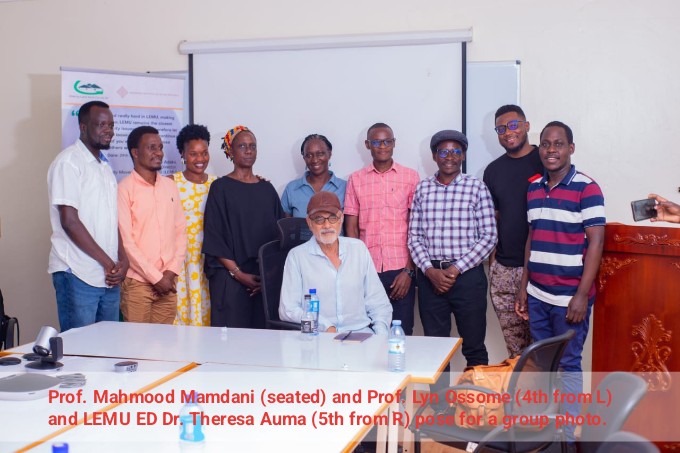
Following the successful inaugural “Judy Adoko Memorial Lecture” on February 26, a significant resolution was announced to forever honor her legacy and Mahmood Mamdani.
First, Mamdani, a Herbert Lehman Professor of Government and Anthropology at Columbia University in the United States, was Director of the Makerere University Institute of Social Research (MISR) from 2010 to February 2022.
He was a guest speaker at the first lecture in honor of his late friend and land rights activist, Judy Adoko.
Judy died in March 2023, after serving as the founding director of the Land and Equity Movement in Uganda (LEMU) from 2003 until 2019.
LEMU Dr. Theresa Auma, introduced Judy to the audience, saying, “It is difficult to speak about one side of Judy, because she had many sides and it is difficult to speak about her in a few minutes, because she engaged from several fronts for quite a duration of time.”
Judy Adoko, she added, was a Ugandan Lawyer “who dedicated her life to the service of humanity through Civil Society Work in Uganda – her passion was land.”
“Judy Adoko and her contemporaries founded LEMU in 2003 as movement in support of customary land tenure and against the domination of neoliberal land marketization reforms that had been adopted by the 1998 Land Act.”
Dr. Theresa revealed that in the movement, Judy recruited several constituencies within society who believed in, and to understand and support a land tenure system she believed was more aligned to the needs of a peasant and formerly colonized people.
“Although she was not a scholar based in an academic institution, Judy adopted theorizing as a method of articulating and challenging the dominant views and paradigms that emerged in relations to land and agrarian reforms (the neoliberal paradigms),” she spoke of Judy.
“On March 5, 2025, we will mark the second anniversary of Judy Adoko’s untimely passing. Her tireless efforts, critical thinking, and writings have significantly shaped contemporary discourse on customary land tenure in Uganda and Africa. In her honor, LEMU has established the annual Memorial Lecture and Workshop as a platform to reflect on the ongoing struggles surrounding land rights, the peasantry, and the challenges posed by neoliberal market ideologies.”
Judy’s contributions to policy and intellectual debates
Her direct influence and input into the 2009 National Land Policy or the 2007 amendment to the Land Act are details, the LEMU Executive noted.
“She personally transformed the way customary land was represented and debated, personally pivotal in it being taken seriously.”
She engaged with the Uganda women’s movement in the land and gender question, underscoring the need to understand gender as just one dimension of power in land grabbing;
As a founding director, Dr. Theresa remembered Judy for engaging in the debate on legal pluralism, championing the harmonization of the state and traditional institutions in land management and land dispute adjudication.
“Most of the debates Judy engaged in have not been resolved. MISR and LEMU are working together to organize a workshop in which her full biography and papers that re-engage these debates will be presented with the hope that a book will be the final result of these engagements,” she added.
Afterwards, Prof. Mamdani spoke, praising Judy and responding to key land-related concerns raised by the audience.
On the possibility of sustaining customary land tenure in Uganda in the face of a hostile political environment and land policy, Mamdani responded, “Short answer, Yes. I mean, look, Museveni is not interested in customary land tenure…”
He also observed that in Uganda, the majority of land sales are due to people’s urgent need for cash to pay medical bills and school fees.
More praises for Judy!
Dickson Ogwang Okul, awitong of the Pala Ocol clan and current Minister of Foreign Affairs for the Lango Cultural Foundation, remembered Judy as being effective and strong, adding that she left an impression that will last in the communities.
Judy, according to Ogwang, was always an advocate for land rights and fought to protect land boundaries in Lango. Judy eventually joined cultural leadership’s efforts, according to Awitong Ogwang, after doing her work very effectively in her own direction.
While working for the cultural institution, he described Judy as “a referee in a friendly match” and served as cabinet secretary for the Lango Cultural Foundation. “This commitment reflects her profound belief in our cultural heritage and the importance of preserving our traditions. She was always there, like that mooyao you need for food and everything would go well.”
She was a fierce advocate for an agrarian system where land ownership is rooted in our customary tradition. “She tirelessly championed the rights of all Lango people ensuring that land was equally distributed among men and women and even children born out of wedlock. She was like a mother hen making sure that all her chicks get fed.”
“On behalf of the Paramount Chief of Lango Mzee yosam Odur Ebii and on my own behalf as Minister of Foreign Affairs who stands for Lango outside Lango and Uganda, I stand here before you to celebrate her life and pledge our continued dedication to the ideals she championed.”
In his remembrance message, Henry Nickson Ogwal mentioned both Judy and Prof. Mandani. He said, “In 1992, I was a student in Makerere University in year one, and that was the first time I attended your prolific keynote presentation in receiving Professor Nabudere (Dani Wadada) back to Uganda and a statement which you said, which I still vividly remember is: ‘I, Mamdani, I welcome you back Nabudere at a time when broad-basedness of movement is increasingly reducing [room floods with laugher]’.”
“Back to Judy Adoko who is and was my cousin. A clan where I come from Judy is a chief [ you know chiefs don’t die]. Judy is the chief; she was Rwot Judy Adoko; she was appointed a chief to do a lot of technical-legal work in reforming a system in the Oyima clan. So, other clans in Lango benefited from that.”
“There are two major comments from her work. The first one, Judy said, as long as you begin to register traditional ownership of land, you make it available into the land market and people who own it – that is now the loss they will never reserve. You need to note this. The second one Judy said and her work demonstrated is that many people who say they are cultural leaders especially in Lango, they do not understand the cultural governance of land. In Lango, the true cultural governance of land never denied women and girls land, and the current leaders have not educated themselves.
“…in the old Lango and Oyima clan, your land would only be given to you because that was the garden of your mother – not your father. So, the land ownership and inheritance was through the mothers. So, no woman and no child would ever be landless because of that.”
He said there is currently miseducation about the cultural ownership of land and bringing in the patriarchal ideology from outside to explain our own culture. “We need to disabuse ourselves from that.”
Ogwal honored Professor Mamdani for agreeing to “celebrate this illustrious daughter of Uganda whose work benefits and impacts us all.”
In her closing remarks, Prof. Lyn Ossome, Director of MISR, announced the Mamdani-Adoko Post-Doctoral Research Fellowship for PhD graduates.
According to her, the fellowship is intended to ensure that academic research is organic and relevant to the distinguished persons’ work.
Discover more from tndNews, Uganda
Subscribe to get the latest posts sent to your email.