Gulu | In an effort to improve justice for victims, the Gulu High Court Circuit has implemented advanced witness protection mechanisms to prevent testimony delays and reduce case backlog.
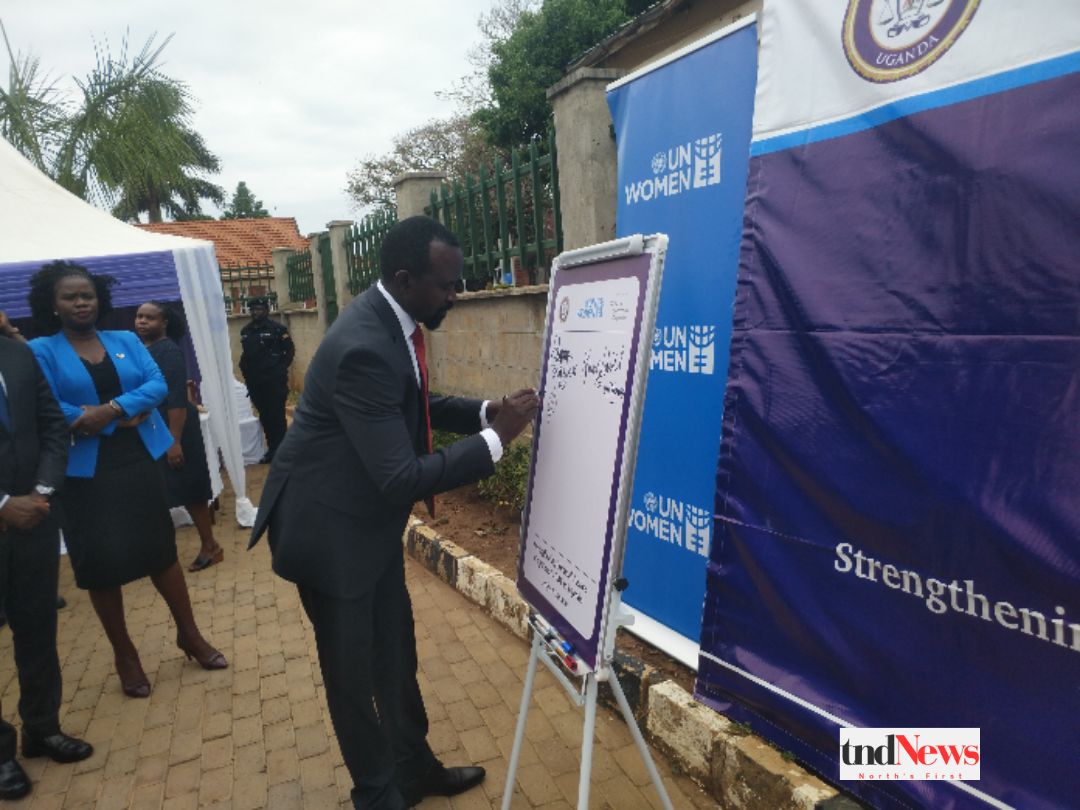
The initiative was launched on 20 March by the Principal Judge, who also serves as the Deputy Chief Justice of Uganda, in collaboration with UN Women.
The “Justice for Her” project, funded by Austrian Development Cooperation, aims to combat gender-based violence (GBV) in the Acholi sub-region.
The Gulu High Court Circuit hosted the launch event, which was attended by key dignitaries such as the Deputy Registrar, the UN Women country representative, the Chief Registrar, the Gulu Resident Judge, the Resident City Commissioner (RCC), Gulu district leaders, advocates, and city leaders.
Justice Phillip Odoki, the Resident Judge of the Gulu High Court Circuit, emphasised the importance of protecting witnesses, survivors, and victims so they can testify without fear.
“We have dedicated a specific room at the Gulu High Court to protect all witnesses, survivors, and victims, allowing them to testify freely before the court,” Justice Odoki stated.
He referenced the Ugandan Constitution, highlighting Article 28, which mandates timely justice, and Article 128, which prohibits delays in the judicial process.
“That is why I say we have failed our people in delivering timely justice,” he added.
Justice Odoki provided an update on the current case backlog at the Gulu High Court Circuit noting 1,876 as total cases registered, 867 backlogged cases, 433 criminal cases ready for trial, while Gender- Based Violence (GBV) backlog cases amounting to 230 of which 53% of these being criminal in nature.
He emphasized that the “Justice for Her” project would address these backlogs, providing renewed hope for justice and restoring public confidence in the judiciary.
“For this project to succeed, key stakeholders must show commitment. As the head of the Gulu Court Circuit, I pledge our full dedication to ensure ‘Justice for Her’ achieves its goals,” he urged.
Adekemi Neili, UN Women’s Deputy Country Director, expressed concern about the high prevalence of gender-based violence in Uganda. She stated that GBV not only violates human rights but also severely impedes Uganda’s socio economic development.
“Uganda still faces systemic gaps in justice delivery, weak legal enforcement, and challenges that discourage victims from reporting cases,” she noted.

Prevalence of physical violence against women in Uganda stands at 51% compared to Africa’s average of 37.7%.
According to data from Uganda Health Development Survey 2022, 70% of women and 60% of men aged 15-49 experienced sexual violence in the past year. Meanwhile, 2 out of every 3 randomly selected women have experienced sexual violence.
A significant rise in defilement, rape, and domestic violence cases were also recorded, according to findings from the Uganda Police Crime Report (2021 – 2024)
Adekemi highlighted that, on average, GBV cases take three years (approximately 919 days) to be resolved.
“This means a case filed in 2022 would still be unresolved today. There is an urgent need for a survivor-centered, gender-sensitive, and trauma-informed approach to GBV cases,” she said.
Justice Dr. Flavian Zeija, Principal Judge, acknowledged the slow pace of case resolution in Uganda’s judicial system. However, he stated that the new funding would allow for faster processing of backlogged cases.
“With this funding, we will conduct daily trials, rather than waiting three months between hearings, to clear the backlog of GBV cases in the region,” he stated.
He also emphasized the need for capacity-building programs to support judicial officers, police, prison staff, and advocates. The project will include training on mental health, community outreach, and digital witness protection technology.
“Fear of retaliation and limited legal awareness among rural communities continue to fuel GBV cases in Uganda,” Justice Zeija noted.
According to him, this project will provide legal education and digital tools to improve witness protection and case management.
Adekemi described the “Justice for Her” project as a pilot initiative that could serve as a model for other African countries.
“All eyes in East and Central Africa are on Uganda. If we succeed, other nations will adopt similar best practices,” she stated.
Justice Zeija concluded by urging the government, civil society, law enforcement, and communities to work together to combat gender-based violence and ensure accountability.
“We must unite to challenge harmful gender norms, strengthen legal protections, and provide support for survivors,” he emphasized.
The “Justice for Her” project is expected to significantly improve judicial efficiency and enhance witness protection mechanisms in Uganda’s courts, offering hope for victims and survivors of GBV.
Discover more from tndNews, Uganda
Subscribe to get the latest posts sent to your email.