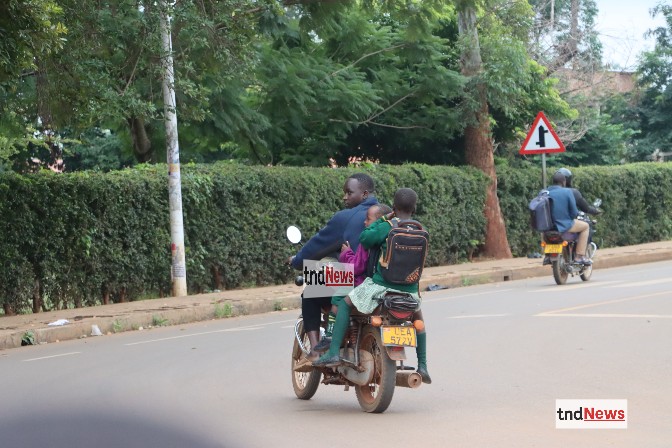
Gulu, Uganda | Motorcycles are not just a mode of transportation in many Ugandan communities, as they are in other parts of the world; they are a way of life and are considered the norm for transporting children to school.
Fastening through crowded city streets or rural paths, this two-wheeled ride provides a quick, inexpensive, and often enjoyable mode of transportation.
However, when children ride as passengers on motorcycles, what appears to be a convenient situation can quickly turn deadly. In many cases, parents and guardians underestimate the risks, unaware that a seemingly simple ride can expose a child to life-threatening hazards.
In Gulu City, in particular, families frequently rely on motorcycles for daily errands, school runs, and family outings, putting their children in the hands of riders they know little about.
It is uncommon, however, to see riders balancing small children on the seat behind and in front of them, sometimes without helmets or safety gear; the practice, while common, is fraught with risks that are frequently overlooked.

Joe, an 11-year-old pupil at Vanguard Primary School in Gulu City, is one of the children who wake up at 6:30 a.m. every day to prepare and catch a ride to school. Unaware of the dangers, Joe, enjoy the ride daily to school.
“It is fun and fast, I love seeing us pass the trees and them running after us,” Joe expressed his joy while riding on the motorcycle daily to school.
Joe’s smaller body and developing bones make him far more vulnerable to serious injury in the event of a crash, as does his inability to properly hold on or brace himself, as well as the lack of adequate child safety measures, making every journey a potential disaster.
Motorcycles lack the protective shell of a car, so even minor collisions can have disastrous consequences. According to Uganda traffic police data, two children are killed every day in motorcycle crashes.
In Uganda, 650 motorcycle crashes involved child passengers in 2022, 872 in 2023, with the majority of the children suffering serious injuries and fatalities, and 839 in the last six months of 2024.
According to the WHO, road injuries are the leading cause of death among children and young people aged 5-29 years around the world, with rates of road traffic death among children being three times higher in low-income countries than in high-income countries.
“Younger children are limited by their physical, cognitive and social development making them more vulnerable in road traffic than adults,” the WHO stated in its global status report on road safety 2023.
“Because of their small stature, it can be difficult for children to see surrounding traffic and for drivers and others to see them; in addition, if they are involved in a road traffic crash, their softer heads make them more susceptible to serious head injury than adults,” the report further explained.
While helmet and road traffic laws exist in many countries, including Uganda, they are often poorly enforced or ignored, particularly by motorcycle riders. Even when they are worn, they may not be designed to fit a child’s head properly, providing little to no real protection.
President Yoweri Kaguta Museveni signed into law the new Traffic and Road Safety (Wearing of Safety Belts) (Amendment) Regulations 2023, which only targets motor vehicle users, increasing the fine from shs200,000 to shs2 million for motorists who exceed the prescribed speed limit of 50km/hr.
Geoffrey Omony, a parent who used to hire a motorcycle rider to take his children to school, revealed that exposing his children to the morning cold caused him to spend more money treating pneumonia, a disease that his children contracted as a result of daily exposure to the cold at school.
Omony also testified that many parents, like him, trust their children to a rider who is a complete stranger to him or the family, but he or she would not trust the same motorcycle rider with shs 10 million.

“You find a mother or a father of a child who pretends to be loving the child so much, and trusts that child whom he loves to be a boda rider whom he does not even know where he comes from,” Omony said.
He added: “Now if the life of a child becomes number two, then I ask myself, do we really love our children in depth or do we just love by word of mouth?, I normally pity and sympathise with children who are always carried on a boda; you find one boda is carrying six children on that same motorcycle, including the rider.”
Lucy Florence, head teacher of Vanguard Nursery and Primary School, explained that the challenge with boda riders is cramming so many children into one seat while parents cannot afford other modes of transportation to get their children to school every day due to poverty.
“But the challenge that they [boda riders] always have is putting so many children on one seat; like a motorcycle, a boda rider may pick four children or five, some are in front, the nursery kids are put in front and then the primary pupils are at the back seat,” Lucy said.
“So you find a motorcycle is carrying five or six learners to school; there is high risk for them to get in an accident and the whole family can die at once,” she added.
Lucy noted that at her school, they have collected all the telephone contacts of the boda riders who bring learners to the school as a mechanism of ensuring the safety of the children both on the road and in case of anything that may happen to the child.
“So at our school, we have the telephone contacts of the boda boda riders and that is one thing that we have seen as a way of protecting our children because at least we know if a child gets in an accident, we know the boda rider,” Lucy further explained.
She did, however, advise parents to hire a boda rider who can transport at least one or two children to school while wearing protective gear, as well as improvise clothing to keep the children warm in the morning cold.
“These children are rushed to school in the morning, when sometimes the weather is not good, the children are brought to school in that coldness; they really face a lot of challenges on motorcycles when they are coming to school daily,” she noted.
“I know that parents may not have better transport means to take their children to school and these children also come from very far away to the school the parents want; you see, a child passes very many schools and comes to that very school they [parents]want. I advise parents to get a boda who can carry at least not more than one child or two,” she added.
Emmy Ocen, Chairperson of the Gulu City West Boda Boda Association, stated that motorcycles are so common in daily life that riding with children has become second nature.
According to Ocen, parents frequently use boda riders to transport their children in order to save time, avoid traffic, or because they lack other affordable transportation options.
“Growing cities like Gulu, where public transit is unreliable, motorcycles become indispensable; though the convenience comes at a steep price, as the casual attitude towards motorcycle safety perpetuates a dangerous norm,” Ocen said.
Ocen said that though motorcycles provide an efficient way to navigate the world, they were never designed with children in mind and for the youngest passenger, even a short trip can present hidden dangers that far outweigh the convenience.
“By raising awareness of the risks and advocating for stronger safety regulations, we can protect our most vulnerable children and ensure that no child faces the devastating consequences of a preventable accident. The safety of our children should always come first-no matter the mode of transportation,” Ocen emphasized.
He urged all boda riders to receive road safety training, avoid carrying two or more children on their motorcycles, and obtain riding permits to ensure the safety of the children they transport to school on a daily basis.
Ocen highlighted that a riding permit is what qualifies that a person can use the road and since the majority of the riders do not have the riding permit, it puts the lives of the children and other passengers at a greater risk.
“So my appeal to those who do not have the riding permit, please get training, after the training, then you get the riding permit. Although we understand that there are some people who always get the shortcut of getting a riding permit without getting trained; we will act on you if we get you,” Ocen appealed to fellow riders.
“We also need riders to have the training of road safety because without the knowledge, you are unable to ride properly and pass the vehicle, all the pedestrians, all those who are riding motorcycles at the same time,” he added.
According to Joseph Ojambo Komakech, Executive Director of Responsive Drivers Uganda, children, particularly girls, who sit on motorcycle fuel tanks risk injuring their private parts.
According to him, because the tank vibrates and vapours come out on a regular basis, the safety of the private parts is called into question, and thus the girl child should not sit on a motorcycle’s tank.
“Even girls who are sitting on top of the tank, they are not safe because these children are vibrating and the vapours are coming up every time, so the safety of the private part is not guaranteed,” Ojambo said.
“When it comes to the children going to school in the morning, they are not dressed properly; they do not have helmets, they do not have jackets for protection from the cold weather; helmets protect, the dust and these, parents do not know and have these things,” he added.

Ojambo went on to say that parents should stop thinking they are saving money by having their children carried to school by a boda boda rider because the children are extremely vulnerable while riding on these motorcycles.
“After some years, these children will need more attention on the treatment of diseases like pneumonia because they are exposed to dust and cold weather,” Ojambo said.
According to Ojambo, children sitting behind motorcycles are in grave danger; for example, a child recently fell from the motorcycle because he was sleeping and tired during the morning ride.
However, Ojambo stated that Responsive Drivers Uganda has discovered that there are few pedestrian crossings in all of the schools along the roads, with others faded.
“The children do not have guidance to guide them on the road, to cross the road and the children do not have road signs. The drivers are not respecting pedestrian crossings,” Ojambo said.
He did, however, reveal that even teachers do not have road safety materials in their schools, and they are not teaching children about road safety, so there is no school discussion about it.
“We want to have this highway called the road signs to be drawn; in all the schools, we have to bring them a lot of road safety materials. We shall have road safety ambassadors,” Ojambo said.
These will be schoolchildren who will be trained to sensitize their peers for five weeks, and they will discuss road safety first and foremost during the assembly, he explained.
Furthermore, Ojambo explained that every day and morning for five weeks, the children in these schools will be trained, sensitized, and provided with equipment that must be visible from that school.
“And they have to make it work out; we shall work with police traffic to make sure that all this is being done on the road,” Ojambo disclosed.
According to Michael Kananura, the Uganda Traffic Police Spokesperson, two children between the ages of 7 and 17 are killed in motorcycle crashes every day, whether they are going to school or not.
“We do not know whether they are in school, but they are between 7 years and 15 years old. In 2022, we lost 650 children, in 2023, we lost 872 children and in just six months in 2024, we lost 839 children in road crashes,” Kananura said.
Kananura stated that as traffic police, they could not protect and safeguard the children on their own; parents and riders must both assist in protecting and safeguarding the children.
“Even if we are to conduct operations, you cannot chase a boda rider that is carrying three or four children; you are causing more problems; so who is to help us? Teachers need to help us, parents and riders themselves need to help us,” Kananura noted.
He added: “Let them stop putting these children onto boda boda. It would really be madness of the highest order to see a traffic officer chasing a boda rider carrying three or four children; it means that this person will hit them down and they will all die.”
Kananura revealed that the traffic police department plans to visit 50 primary schools per term to promote road safety among young children, teaching them what they are supposed to do and how to conduct themselves on the road.
“Parents stop putting children on boda boda riders and waiting for traffic to act; as traffic we have a role to play; we are doing it, teachers must come on board or school administration must come on board to play their role,” Kananura revealed.
“Especially, when they are picking these children, when they are dropping them, they must make sure that the environment around the school is safe for the children to cross as they enter the school and even when they leave the school,” Kananura noted.
Children like Joe get a little nervous on the bumpiest stretches of road or when they hit a patch of gravel and wonder what would happen if they ever had a serious crash.
Though the fear lingers in the back of their minds, the children understand that they cannot miss school because education is everything to them, and their teachers constantly emphasize the importance of arriving on time.
“There have been days when the weather turned against them-rain hammering down on their backs as they rode to school, Joe clutching an umbrella that did little to shield them from the storm,” Joe recalls that fateful day.
“On that morning, I arrived at school soaked to the skin, my shoes muddy, and my books damp but I never complained; the thrill of learning always outweighed the discomfort of the journey to school,” Joe narrated.
However, Joe and his friends continue their daily rides to school, the motorcycle cutting through the early morning air like a blade through the wind; they continue with one of quiet determination, hopes for a safer future and the unspoken bond between a boda rider and children navigating the dangers of their world together.
In class, Joe sits, writing down his English problems or paying close attention to his teacher. He understands that every day he gets to school safely is another step closer to realizing his dream.
He hopes to graduate, get a good job, and support his family.
This story was produced with the support of Media Monitoring Africa as part of the Isu Elihle Awards.
Discover more from tndNews, Uganda
Subscribe to get the latest posts sent to your email.