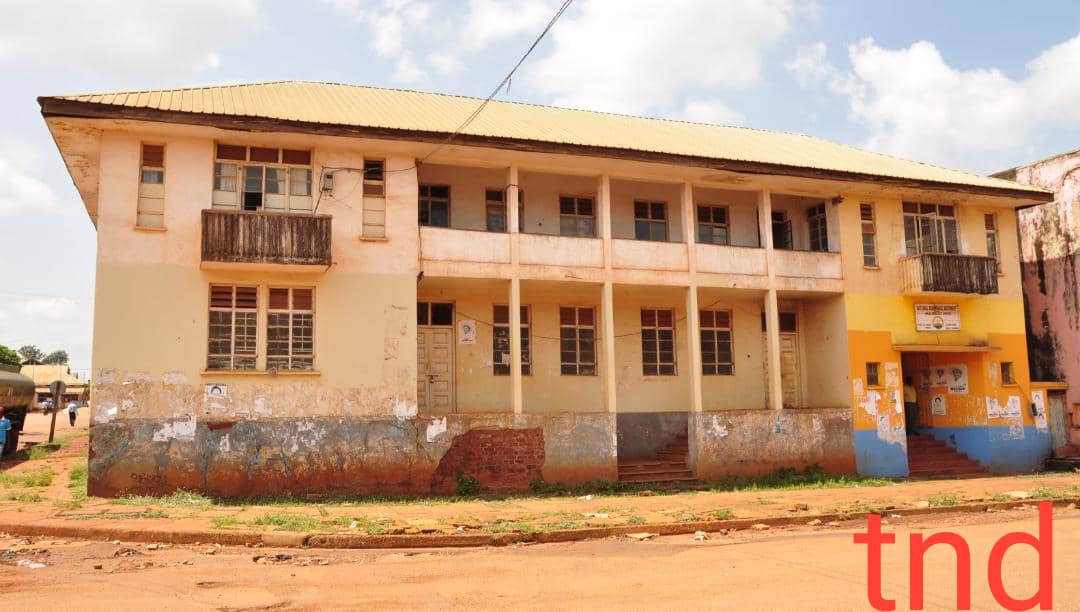
According to a list generated from City Hall, Kirinya Road has the largest share with 18 buildings condemned, followed by Spire Road 12, among others.
By Nelly Otto
Jinja – August 13, 2022: Jinja City Council (JCC), once known as the East African industrial hub and one of the best-planned cities currently have hundreds of condemned structures. These structures or buildings are dotted everywhere in the Central Business District (CBD).
A CBD is that part of the city that contains the principal commercial streets and main public buildings.
Throughout history, the CBD has been characterized by several land use changes that include industrial, residential, commercial, administration, and consumption.
What is a condemned building?
According to experts, a condemned building means it’s considered unsafe to live in or simply inconvenient. It may be dilapidated with missing facilities like running water, blocked drainage, collapsing ceilings, and walls, or hygiene problems, among others.
They also say for a building to be condemned, it must also be proved by a qualified officer that it has structural engineering defects which threaten the lives of occupants, neighbors, or members of the public.
Jinja City does not have a shortage of such buildings, albeit the heavy presence of civil servants referred to as “technical staff” headed by the City Clerk, supposedly knowledgeable on the matter.
It should be recalled that way back in 2006, JMC officials including those from the Physical Planning and Public Health Departments plus the political wing (councilors led by the then mayor Al Hajji Mohammed Besweri Kezaala) condemned 123 buildings, but most of them are still in use.
Among the recommendations on the spared structures was that the occupants should paint the buildings and restore broken facilities to make them suitable for human habitation.
However, Jinja City Physical Planner Charles Nampendo has feigned ignorance of the list, saying there are clear guidelines that can lead an authority like JCC to condemn a building.
“…first of all, I have to look at the list and find out which department took a lead in the exercise whether it’s Public Health or Engineering to decide condemnation…,’ Nampendo said.
The often-ignored National Physical Planning Act, of 2010 provides for numerous roles and responsibilities of the urban authorities as well as sanctions for developers who flout some of its aspects.
For example, any developer who does not paint his building or does not provide a dustbin at his business premise, among others, stands heavily accused before the law should any citizen take up the matter legally.
The Act, according to Assistant Commissioner Lands David Wamai, was put in place to operationalize Article 39 of the 1995 Constitution which stipulates that every citizen has a right to live in a healthy environment.
“…because we deserve so, the law says everybody who acts contrary to the legal provisions as per the Act, commits an offense…” Wamai cautions.
Wamai who is also the Acting Executive Director of the Physical Planning Board says every citizen must report anybody who dumps in a wetland or drops an empty bottle of mineral water; fails to paint his building.

He wants them to face courts of law. If his directives were to be enforced, the prisons in Uganda would be full by now because Ugandans are the poorest when it comes to issues about environmental protection.
Implementation remains shelved in dusty files due to conflicting interests from different players like politicians who fear losing votes in the next elections while some technical officers are simply scared of the backlash from some well-connected business personalities or harbor ulterior motives.
According to a list generated from City Hall, Kirinya Road has the largest share with 18 buildings condemned, followed by Spire Road 12, Main Street 9, Iganga Road 8, Oboja Road 4, Owen Road 4, trailed by Parekh and Lubas Roads with one building condemned on each.
Most of these buildings were built between the 1920 and 1940s and have been without repairs. Jinja has been the ebst destination for decades and it is struggling to regain its past glory.
TND News Nelly Otto further reports that some buildings have been deliberately left out of the list for historical and tourism purposes which in turn can bring in revenue to the Council treasury.
Among the condemned buildings is Plot 1C, currently at the center of conflict between a section of tenants and a Ugandan business guru, Vijay Armitlal Kotecha over ownership question.
Discover more from tndNews, Uganda
Subscribe to get the latest posts sent to your email.