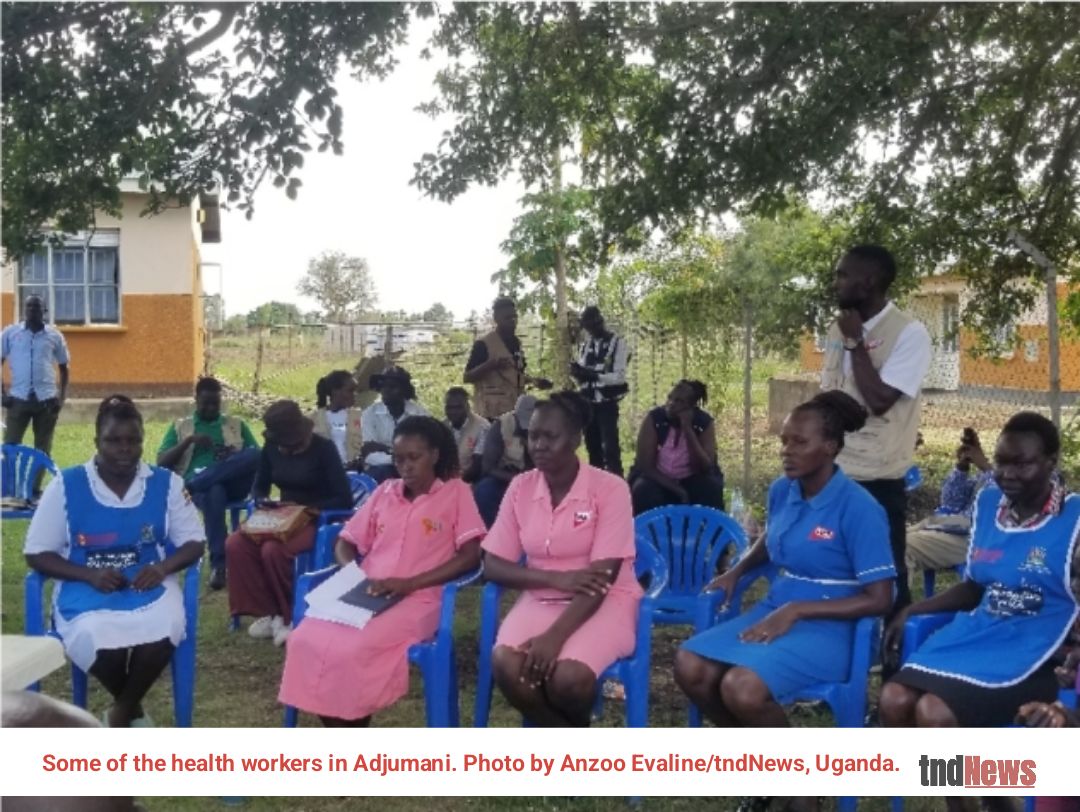
Health service delivery in Adjumani district is slowly regaining ground following the recruitment of 154 staff by Medical Teams International (MTI) with funding support from UNOCHA, after a crippling funding gap forced the layoff of over 288 health workers earlier this year.
The staffing crisis, which unfolded at the beginning of January, left health facilities severely understaffed, disrupting critical services, particularly in maternal health care.
According to Dr Lulu Henry Leku, the Assistant District Health Officer in charge of maternal health care in Adjumani, the sudden loss of workers pushed the district into a near-emergency situation.
“When we woke up on the 1st of January that all the 288 staff were going home, we were heading into crisis and indeed had a challenge losing 288 staff just like that, which affects hand service delivery.
“And I love one that used to serve the second-highest number of persons in the district with only three staff. One of them was an Askari and then two were the only technical officers. So, you can see that that was a big problem.”
The impact was immediate and far-reaching. Facilities that once handled high patient volumes were reduced to skeleton teams, forcing some to scale down operations while others shut down completely.
Maternal and child health services were among the hardest hit, with fewer skilled health workers available to attend to deliveries and emergencies. Despite the setback, district health leadership chose resilience over despair.
“We never gave up. We never went into lamentation mode. We ensured that we reorganised ourselves. And we waited. We were patient. We were knocking on doors. And today we are beginning to see that positive progress. So, I will say 154 is progress in the right direction. 14 midwives from UNFPA. This is progress in the right direction,” Dr Lulu stressed.
The newly recruited staff are expected to ease the burden across facilities, although officials admit the numbers are still insufficient to fully restore services to previous levels.
Meanwhile, there is cautious optimism that more former health workers may return to service.
“The health workers who were working under these various partners have been called for validation of their papers by the Ministry of Health, and we hope many of them will be absorbed into the system. So, we’re still optimistic that we shall navigate and overcome some of the challenges,” he said.
At the facility level, the crisis was deeply felt. Iceta Michael, the in charge of Ayilo Health Centre III, described the overwhelming pressure faced by the few remaining staff.
“We serve a population of 25,963. Our daily OPD attendance is 120 to 150. Our monthly delivery is 80 to 100. By then, we had 38 staff. They were laid out, but as of now, we are only eight who are on the ground. From first to sixth, the facility was closed until the LC5 organised meetings with the IP, UNHCR, and OPM, which were part of that.”
The temporary closure of the facility highlighted the severity of the staffing gap and its direct consequences on community access to care.
“On 6th January, we received two midwives. After some days, we received a clinical officer and a nutritionist. But as of now, we are only eight who are on the ground,” Iceta added.
For frontline health workers like Judith Akello, a midwife employed by MTI and posted at Ayilo Health Centre III, the additional support has made a noticeable difference, though challenges remain.
“I really wanted to thank the medical team internationally because at the beginning of the year, there were only three steps. The medical team brought in two more midwives to support.
“Gradually, the translator and clinical officers increased which at least kept the workload from reducing. So, we keep on requesting them to continue supporting us because we had a great number of populations like 25,963.”
District leaders say the funding shortfall exposed systemic vulnerabilities in the humanitarian health response, particularly in refugee-hosting districts like Adjumani.
Abina Polly Irene, the Resident District Officer from the Office of the Prime Minister, acknowledged the visible gaps and their consequences.
“There are a lot of gaps. And these are very evident. When you look at the issue of health, MTI had to drastically reduce their staffing to be able to meet the funding gap that they were able to raise.
“And I want to say that we saw issues. We saw an increase in death, mortalities in the communities, drastically scaling of service delivery in the health facility. Some of them had to work half a day, others were completely closed down.”
However, she noted that renewed efforts by humanitarian agencies are beginning to stabilise the situation.
“And we’ve seen different agencies like UNOCHA, also coming on board to do something. They’ve announced the funding for about six months, which is going to support different partners.
“So, we are looking at this all coming slowly, but of course, see it’s still not to the scale that we would wish to meet the demand in terms of the needs on the ground. But at least I’m happy that when we put the little pieces together, there’s something that we realise.”
Adjumani remains one of Uganda’s largest refugee-hosting districts, placing immense pressure on already limited health resources. According to Gelila Tsega, Head of Sub Office at UNHCR Adjumani, the context is both complex and long-term.
“Adjumani is a very particular context. It’s a very large settlement, 19 settlements are very large, 234,000, and it’s also a protracted context. Displacement in this area is not just temporary, it’s generational. Poverty that we collectively have to address. So, as UNHCR, we will continue to support with the little that we always get.”
While the recruitment of 154 staff marks a critical step toward recovery, stakeholders agree that sustained funding and long-term planning are essential to prevent future disruptions.
 For now, health workers and leaders in Adjumani continue to rebuild, piece by piece, hopeful that the fragile gains will hold and expand to meet the growing needs of both refugees and host communities.
Discover more from tndNews, Uganda
Subscribe to get the latest posts sent to your email.