In the quiet rural setting of Leaguru village in Pakele sub-county, Adjumani, Eberu is steadily building a livelihood from an unlikely but thriving enterprise—api-culture.
Eberu’s journey into beekeeping dates back to 2005 when he enrolled in an adult literacy training programme supported by Community Empowerment for Rural Development (CEFORD).
The programme not only equipped him with basic literacy skills but also opened doors to hands-on training in beekeeping, honey processing, and value addition.
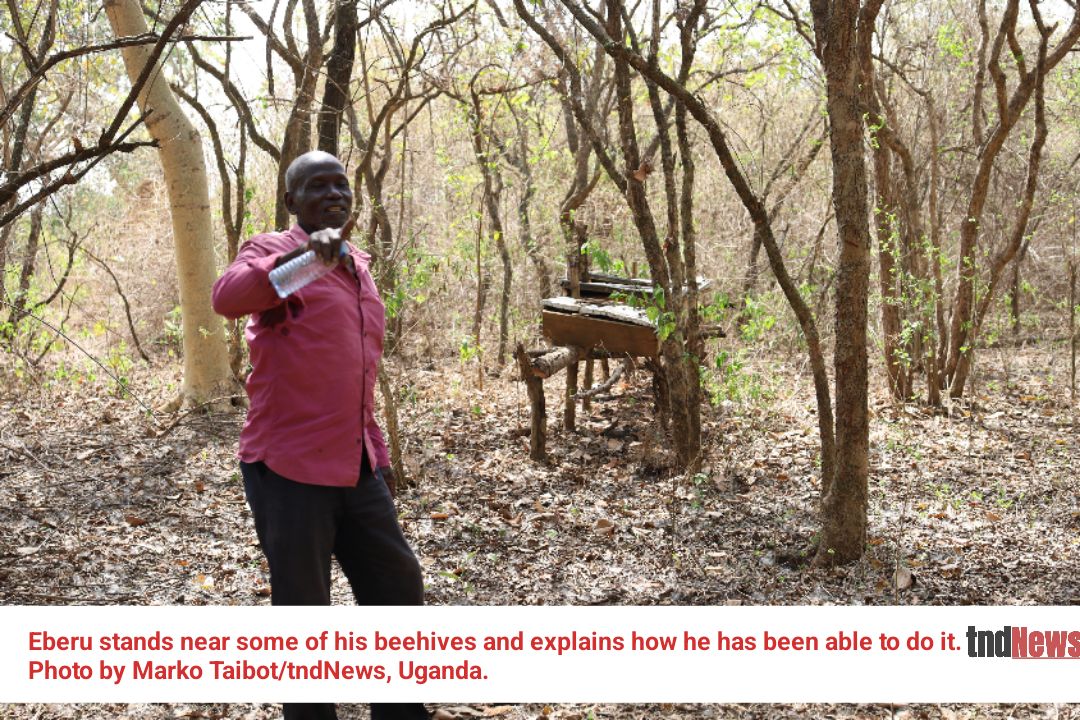
From those humble beginnings, Eberu has grown into a skilled apiarist who now produces a range of honey-based products. Beyond selling raw and processed honey, he makes propolis tincture and comb honey, locally referred to as “cenom.”
He says his next target is to venture into bee venom production once he acquires the necessary equipment.
“I started small after the training, but with time I realised beekeeping had great potential,” Eberu says.
Today, he is recognised as a lead farmer under Friends of Zoka, where he champions environmental conservation through apiary farming. Around his homestead stands a mini forest thick with trees that he carefully protects because they are essential to his bees.
“When you enter the forest and start cutting down trees, I watch you. If you continue, it will be the bees to drive you out. That is how my trees have remained intact,” Eberu says with a smile.
For him, beekeeping is not only an income-generating activity but also a natural shield against deforestation. The presence of hives has discouraged illegal tree cutting, allowing vegetation around his home to flourish.
Eberu notes that the market for bee products is readily available both within the district and beyond. He sells a litre of processed honey at shs24,000, alongside other value-added products that attract steady demand. The returns have transformed his household.
“Right now, I own my own house as a result of beekeeping. I have no problem with food at home, and I pay school fees for my children,” he says.
Through determination and skills acquired over two decades, Eberu has turned api-culture into a profitable venture, one that not only supports his family but also safeguards the environment.
According to the team leader of Friends of Zoka, William Amanzuru Leslie, noted that Friends of Zoka, in partnership with Rural Initiative for Community Empowerment West Nile (RICE), Sustainable Plan and Action for Community Empowerment (SPACE) is implementing a three-and-a-half-years project called strengthening environmental accountability and climate action in West Nile.
“The project covers four West Nile districts of Adjumani, Zomobo, Madi Okollo, and Obong. Overall, the project seeks to achieve improved protection and sustainable utilization of natural resources among the communities in the West Nile sub-region,” he said.
Moses Apiliga, the parish chief working in Pakele sub-county reaffirms their commitment as a refugee-hosting sub-county to continue sensitizing the communities. He said Pakele sub-county has suffered environmental degradation as a result of hosting refugees.
“From the onset of the refugee influx, the sub-county experienced a lot of tree cutting, opening of land, and charcoal burning,” Apiliga said
According to the Global Forest Watch, in 2020, Adjumani had 99kha of natural forest, extending over 32% of its land area.
In 2024, it lost 3.3kha of natural forest, equivalent to 1.4mt of carbon emissions.