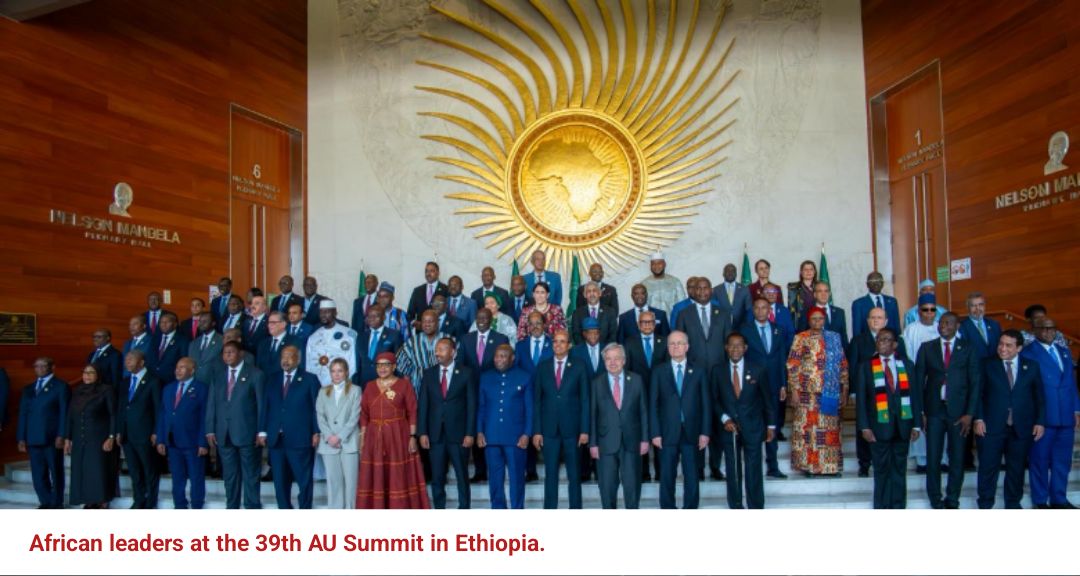
Addis Ababa, Ethiopia | African leaders have issued a renewed and urgent call for the full operationalisation of the African Medicines Agency (AMA).
They are pressing the 24 African Union (AU) Member States yet to ratify its founding Treaty to act without delay to secure access to quality, safe and efficacious medical products across the continent.
The appeal was made during a High-Level Presidential Breakfast convened by the AMA on the margins of the 39th Ordinary Session of the Assembly of Heads of State and Government of the African Union in Addis Ababa.
The gathering brought together Heads of State and Government, AU leadership, and senior officials from the AMA, the Africa Centres for Disease Control and Prevention (Africa CDC), and the African Continental Free Trade Area Secretariat (AfCFTA) to accelerate universal ratification, sustainable financing, and the Agency’s full implementation.
While 31 of the AU’s 55 Member States have ratified the AMA Treaty, leaders warned that the remaining 24 countries risk undermining Africa’s collective health security by delaying accession and domestication of the Treaty.
Without universal participation, regulatory gaps persist leaving countries vulnerable to substandard and falsified medicines and limiting the benefits of a unified African regulatory framework.
The AMA, headquartered in Kigali, Rwanda, has made notable progress since the Treaty’s adoption in 2019. Yet leaders stressed that operational gains must now be matched with broader political commitment and financial backing.
“Africa’s health sovereignty depends on regulatory sovereignty,” said Tunisia’s Minister of Health, Dr. Mustapha Ferjani, in a pointed appeal to fellow leaders.
He urged Member States to not only ratify the Treaty but to equip the Agency with adequate resources, technical capacity, and governance structures.
“Our people deserve it, our health security demands it, and our sovereignty depends on it,” he said.
Demonstrating tangible commitment, Seychelles’ Vice President, H.E. Mr. Sebastien Pillay, reaffirmed his country’s political and financial support, announcing a contribution of USD 200,000 double the USD 100,000 seed funding required of State Parties.
He challenged larger economies to match or exceed Seychelles’ contribution to ensure the Agency’s sustainability.
The AMA’s Director General, H.E. Dr. Delese Mimi Darko, outlined the Agency’s strategic vision: universal ratification, attainment of World Health Organization Listed Authority status, and financial self-reliance by 2030.
“Over the past five years, we have moved from a Treaty on paper to a living institution,” she said, noting that the Agency is already working closely with ratifying Member States to strengthen national regulatory systems, streamline joint product assessments, and promote reliance on shared scientific expertise.
In her closing remarks, H.E. Amb. Amma Twum-Amoah, Commissioner for Health, Humanitarian Affairs and Social Development at the AU Commission, described the AMA as a “shared continental asset” central to achieving the continent’s broader health and development ambitions.
She linked the Agency’s work to the African Health Strategy 2030 and Agenda 2063, underscoring its role in protecting citizens’ wellbeing while advancing Africa’s industrialization and trade objectives.
“The Commission firmly believes that universal ratification, full implementation and sustainable financing of the African Medicines Agency are achievable within this political cycle,” she said.
Leaders at the Assembly framed the moment as decisive for Africa’s pharmaceutical future positioning the AMA as both a health security instrument and a catalyst for local manufacturing and intra-African trade under the AfCFTA framework.
Adopted on 11 February 2019 during the AU’s 32nd Ordinary Session in Addis Ababa, the AMA Treaty marked a milestone in Africa’s push to harmonize medicines regulation across Member States.
The Agency builds on the African Medicines Regulatory Harmonization initiative launched in 2009 under the AU Development Agency.
Once fully operational and universally ratified, the AMA is expected to strengthen oversight of medical products, reduce duplication in regulatory processes, and accelerate patient access to life-saving treatments.
As the 39th AU Assembly concludes, the message from Addis Ababa is clear: Africa’s health sovereignty and its economic future may well hinge on how swiftly the remaining Member States move to ratify and empower the continent’s medicines watchdog.
Discover more from tndNews, Uganda
Subscribe to get the latest posts sent to your email.