Lira | In Starch Factory B, Lira City East Division, widows face crushing hardship; loneliness, grief, and financial instability.
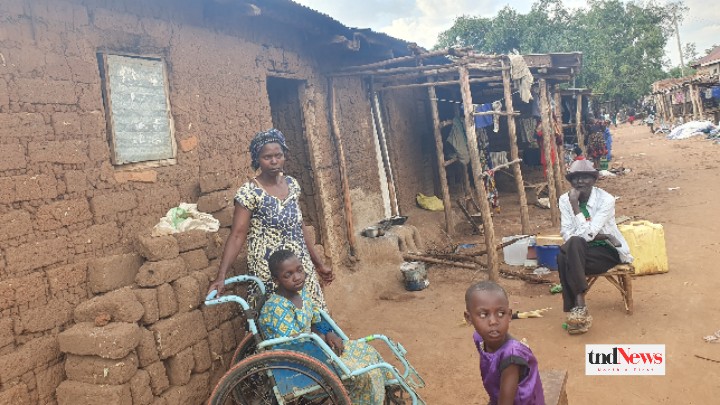
Among them is Awino Florence, a mother of three who is fighting to support her 12-year-old daughter, Margarita Awino, who lives with both a physical disability and sickle cell disease.
With no stable source of income, Florence is unable to afford school fees or adequate medical care for her children. Her daughter’s worn-out wheelchair needs urgent replacement, and Margarita has dropped out of school due to financial constraints.
“Raising children alone is emotionally and practically demanding. My late husband was the main provider. Now, I have nothing and no one to help me,” Florence said.
Florence survives by begging on the streets while carrying Margarita. She lives in a small, leaking house and pleads for support from the government and well-wishers to start a small business, pay rent, and educate her children.
Matthew Omara, chairperson of Persons with Disabilities (PWDs) in Lira, expressed deep concern over the recent suspension of U.S. government aid, which had supported vital mobility and health projects.
“The withdrawal of USAID has left a huge gap. We used to get wheelchairs and crutches through an organization called RELAB. Now, nothing is coming in,” Omara said.
He revealed that physical disabilities make up 70% of the total PWD population in Lira, which stood at 60,707 in 2010. In the 2022/23 financial year, the special grant for PWDs was shs53 million but was slashed to shs25 million in 2023/24, a cut he says is unsustainable.
Despite the challenges, Community Focus International (CFI) in Lira continues to operate. Project Officer Christopher Atworo said they have not been affected by the USAID cut because they receive support from individual donors, local Ugandans, and World Vision.
“The most affected are school-going children who need assistive devices. We must stop depending solely on foreign aid and build local capacity,” Atworo said.
CFI manufactures wheelchairs locally and has so far distributed 15 in the first phase, 79 in the second, and plans to distribute 100 more. However, the need far exceeds supply.
Ponsiano Coda, CFI’s Program Head, added that the workload has significantly increased as fewer NGOs remain operational. He called on the government to create a local funding scheme for NGOs.
“We can learn from countries like Singapore that focused on home-grown policies and achieved self-reliance,” he said.
Maxwell Akora, MP for Maruzi County in Apac District, emphasized that access to mobility services is a basic right.
“We must ensure ramps in public and private buildings and provide mobility devices locally,” Akora urged.
He expressed hope that the U.S. aid suspension will be lifted after the 90-day review period but stressed the importance of internal resource allocation in the meantime.
The 2024 National Population and Housing Census by UBOS reported a national disability rate of 5.7%. However, disability rights advocates, including the National Union of Disabled Persons of Uganda (NUDIPU), dispute this figure.
The 2014 census reported a 12.4% disability rate, despite excluding key groups such as persons with albinism, epilepsy, and hearing impairments.
Minister for Persons with Disabilities, Asamo Hellen Grace, questioned the accuracy of the current statistics and called for improved data collection to ensure fair policy-making and funding allocation.
“We need reliable data to plan effectively for the needs of people with disabilities,” she said.
As widows like Florence and thousands of PWDs in Uganda face growing uncertainty, urgent action is needed.
A collaborative effort from the government, development partners, and local innovators is vital to creating a more inclusive and sustainable future.
Discover more from tndNews, Uganda
Subscribe to get the latest posts sent to your email.