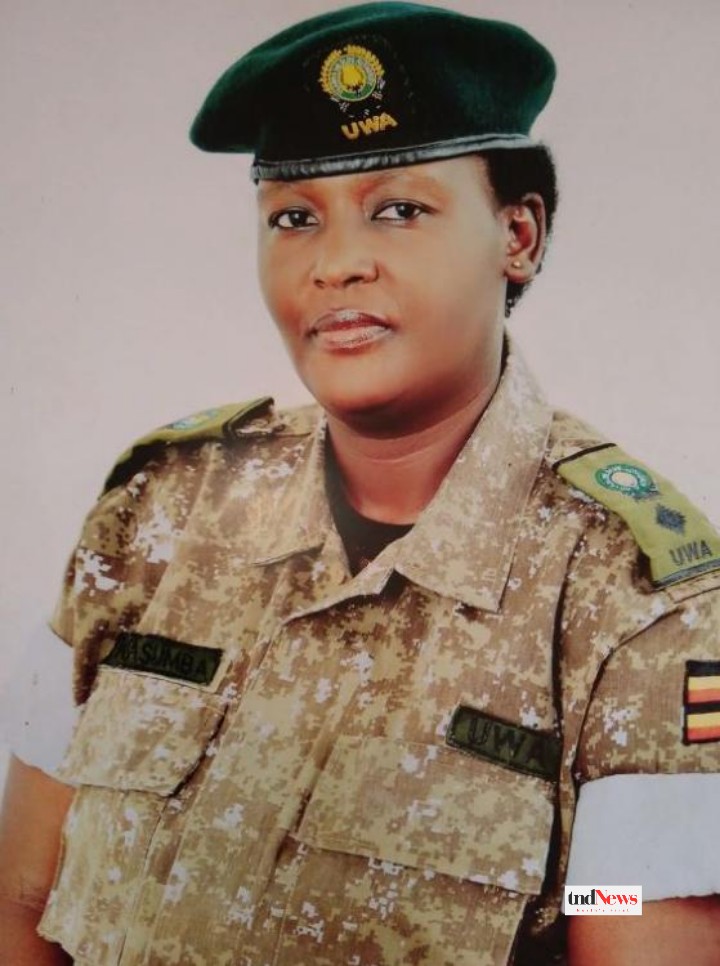
Margaret Kasumba stands at the edge of Uganda’s Murchison Falls National Park, her eyes scanning the tree line with the precision of someone who has spent most of her life listening to the forest.
The dawn lights cut through the mist, revealing her silhouette against the expanse of acacia and savannah, a lion’s distant roar echoes in the early eight and she does not flinch.
Born in Kabarole District in Western Uganda, Margaret’s upbringing in the scenic village of Buheesi, nestled in Bunyangabu district, was where her passion for wildlife first took root.
As a young girl, she marveled at the various wildlife that occasionally roamed her family’s farm and, with a curious heart, questioned her father about the possibility of raising them alongside the family’s livestock; and when he assured her that these animals were wild and had their own caretakers, her young mind was ignited with a dream-one that would come full circle years later.
To many, she is simply known as Kasumba of the Wild-a fierce protector of Uganda’s threatened wildlife, a voice for the voiceless in the country’s escalating battle against poaching and environmental destruction.
However, to those who know her best, she is Kasumba, mother, activist and a woman who walked away from a promising corporate career to stand on the frontline of Uganda’s conservation fight.

Margaret is the first woman to lead the law enforcement division at the Uganda Wildlife Authority (UWA). Her journey from a passionate wildlife enthusiast to a formidable force against poaching and trafficking is a testament to resilience, vision and an unwavering commitment to preserving Uganda’s natural heritage.
“I hold a bachelor’s degree in law from Makerere University and Master of Laws from Cavendish University-Uganda. At the moment, I am pursuing a postgraduate diploma in legal practice at the Law Development Centre in Kampala,” Margaret revealed.
Margaret’s love for wildlife began in her childhood, inspired by her father’s stories of their family. This early fascination led her to become an active member of her school’s wildlife club and, determined to make a tangible impact, she pursued a law degree, aiming to combine her passion for animals with the power of legal enforcement.
In 2004, she joined UWA, embarking on a path that would see her rise through the ranks and her journey was not without challenges, including in her early days, where she underwent rigorous paramilitary training.
“There were times when I wanted to run away; it was so harsh, but I would not change it for the world. This experience, though grueling, forged my character and prepared me for the demanding role I am now playing in wildlife conservation,” she recalls.
Adding that, “I was later enrolled in the law enforcement unit working as a warden in the unit; by then, responsible for intelligence collection, investigations of wildlife crime inside and outside protected areas as well as operations all over the country within the protected areas.”
Breaking barriers in conservation leadership
Margaret’s ascent within UWA is a beacon of progress in a field traditionally dominated by men and, as the head of the law enforcement division, she oversees the entire ranger force, manages operations to combat wildlife crime, and supervises the special wildlife crimes unit.
Her leadership is not just administrative, and she actively participates in field operations often leading from the front, and her presence has inspired many, especially women, to take up roles in conservation.
“When new rangers graduate from training, I am one of the parade leaders. My example has encouraged many other female officers to take up leading the parade, citing me as their inspiration,” Margaret said.
Margaret’s role took a pivotal turn in 2021 when she was appointed to lead the Uganda Wildlife Crime Unit (UWCU), a role made possible through the collaborative efforts of Focused Conservation and the Uganda Wildlife Authority (UWA).
With the strong backing and mentorship from Focused Conservation, the UWCU has become a critical force in the country’s fight against wildlife crime; with Margaret alongside her deputy, AmossAijuka, leading the team to notable successes in intelligence gathering, operations, investigations and prosecutions of wildlife criminals.

“This is the role I am holding now, which I have so far held for about six years; but before that, I was transferred to the legal unit and was appointed a prosecutor to prosecute wildlife crimes as appointed by the DPP and worked for sometimes before I was again transferred back to law enforcement units to act as manager law enforcement,” Margaret explained.
Under her leadership, the UWCU has made significant strides in protecting Uganda’s most vulnerable species, including elephants and the endangered pangolin, Margaret’s favorite animal.
Graph showing the numbers of implements used in wildlife crimes recovered by UWA from 2021-2023.
“On March 26, 2025, in our operation dubbed Operation Coach, the intelligence-led operation resulted in the arrest of four suspected traffickers and the recovery of two full tusks, weighing 41.7 kilograms of elephant ivory,” Margaret explains.
In addition, UWCU led a multi-agency law enforcement operation in Kampala on March 19, 2025, following intelligence that a resident of Kanungu district was attempting to sell elephant ivory and it culminated in the interception of the trafficker at a bus station in Kampala.
Margaret further explained that UWCU also manages to conduct Operation Appendix which led to the arrest of two wildlife traffickers and rescue of a live pangolin on January 25, 2025 in Kitgum district with another seizure of two live pangolins – a mother and her pup and arrest of two suspects on January 27, 2025.
Margaret emphasizes the importance of intelligence and inter-agency collaboration in tackling wildlife crimes and as a member of Uganda’s National Anti-Wildlife Crime Coordination Task Force, Margaret extends her leadership beyond the UWCU, collaborating with conservation organizations, law enforcement agencies and local communities to safeguard Uganda’s wildlife on a national level.
“Wildlife crime is a serious offence which needs to be combated and there is need for a coordinated approach involving various stakeholders,” she asserts.
Statistics from UWA indicate that between 2021 and 2023, the authority recovered 2,410 kilograms of ivory and 1,901 kilograms of pangolin scales and additionally, rescued 37 live pangolins and recovered 57 pangolins skins.
Graph showing the trend in the recovery of wildlife products for the financial year 2022/23.

A heart for conservation and future impact
Beyond her professional achievements, Margaret’s empathy for wildlife is profound and one of the poignant memories is the rescue of a mother and baby tree pangolin from traffickers.
“Tragically, the baby died during their release back into the wild; when her baby died, I saw the mother pangolin cry tears, real tears flowing her eyes. It was too much for me, I cried along with her,” she recalls, her voice tinged with emotion.
Margaret’s journey from a curious village girl dreaming of caring for wildlife to a pioneering leader safeguarding Uganda’s natural heritage is inspiring and her story is one of resilience, unwavering commitment and a deep-rooted love for wildlife, especially for the vulnerable pangolin which she admires for its gentle and delicate nature.
“Wild animals are part of God’s creation; we found them here, and it is our responsibility to protect them for the benefit of our country and all Ugandans,” she states.
In addition, her influence extends beyond her immediate role; she is a staunch advocate for women’s involvement in conservation, believing that they play a crucial role in shaping attitudes towards wildlife protection.
Margaret’s commitment to conservation is mirrored in her family life, raising four children, she instills in them the values of wildlife protection, hoping they will continue the legacy of safeguarding Uganda’s rich biodiversity.
“Women have a huge role to play in wildlife conservation and you do not have to be part of UWA to be part of the movement either; we can influence our children, our husbands, and our wider families and community to see things differently,” Margaret explained.
Therefore, her journey is more than a personal triumph but rather a symbol of the evolving landscape of conservation in Uganda and her leadership challenges stereotypes along with her compassion which bridges the gap between humans and animals and her actions inspire a nation to take pride in its natural heritage.
As Uganda continues to grapple with the challenges of wildlife crime, leaders like Margaret offer hope and, through dedication, innovation and a deep-seated love for nature, she is not just fighting against wildlife crime; she is paving the way for a future where both people and wildlife can thrive in harmony.
“Those who were here before us protected wildlife, so now we have to carry on the responsibility before we hand it over to the incoming generation,” she asserts.
Thus, her legacy is a call to action for all to join in the fight to protect Uganda’s wildlife for generations to come.
Discover more from tndNews, Uganda
Subscribe to get the latest posts sent to your email.