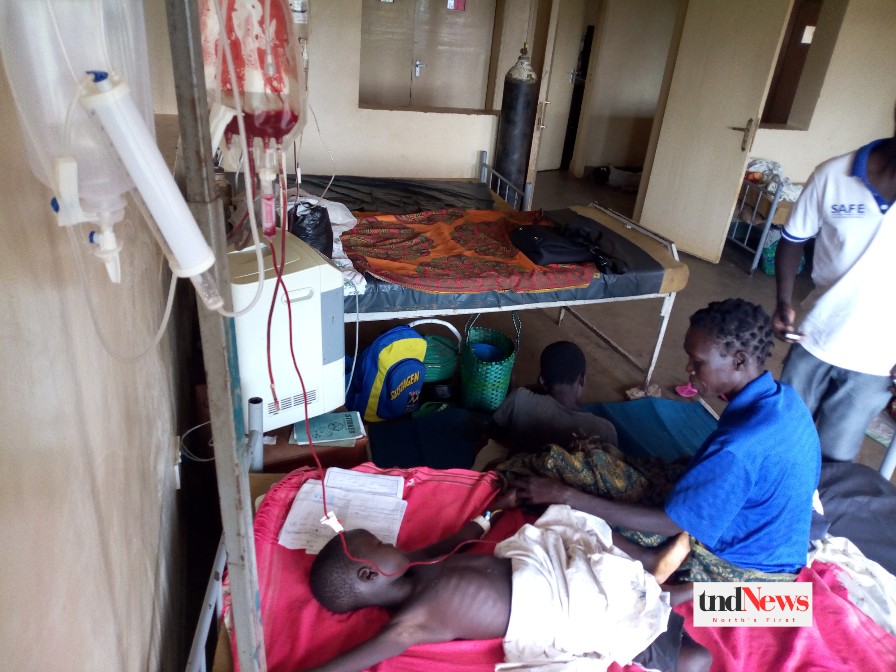
Two key hospitals in Kitgum district, the government-owned General Hospital and St. Joseph Hospital, are currently experiencing severe blood shortages.
The shortage has stranded many patients in critical need of transfusions.
Thomas Ojok, the Hospital Administrator at Kitgum General Hospital, made the revelation on Friday, April 18, 2025. Ojok stated that the crisis, exacerbated by a resurgence of malaria in the district, has put enormous strain on blood transfusion services.
According to facility statistics, it receives only 5 to 10 units of blood per week from the Gulu Regional Blood Bank, which falls far short of the 40 to 50 units required to meet patient demand.
Ojok revealed that the most affected patients include children, pregnant mothers, individuals with sickle cell disease, road crash victims, malaria-induced anemic patients, and those requiring surgical operations.
“There is an overwhelming number of children currently admitted to health facilities across the region in urgent need of blood transfusions, especially those suffering from malaria-induced anemia, sickle cell complications, and those undergoing complex surgeries,” Ojok stated.
He added that the Hospital receives over 500 patients in the Outpatient Department each day, with approximately 250 to 300 of those presenting with malaria, many of whom require blood transfusions.
The situation at St. Joseph Hospital is similarly dire. Dr. Pamela Atim Okot, the hospital’s Medical Director and Superintendent, said the facility receives only 15 to 20 units of blood per week from the Gulu Regional Blood Bank—insufficient to meet rising demand.
Aketowanga Winnifred, a mother whose daughter was critically ill with malaria, shared her experience.
“My daughter nearly died due to the shortage of blood. She was only saved after good Samaritans donated blood locally, allowing her to receive a transfusion just in time.”
Dr. Simon Komakech, the in-charge of the Maternal Care Unit at St. Joseph Hospital, noted that the hospital has sometimes resorted to organizing local donations. However, he added that the process can be delayed due to the steps involved in screening and transfusion.
“I appeal to local leaders, institutions, and the general public to launch blood donation drives and raise awareness about the importance of blood in saving lives,” Dr. Komakech urged.
Charles New Kidega, Uganda Red Cross Society Kitgum Branch Manager, echoed the call, urging the public to embrace the culture of regular blood donation to help replenish the overburdened regional blood bank.
The Gulu Regional Blood Bank currently distributes more than 200 units of blood per day to 45 health facilities in the Acholi and Lango subregions, as well as the districts of Abim, Kiryandongo, and Adjumani.
Over the past six financial years, Kitgum District has recorded 14 maternal deaths due to lack of blood. In the 2018/2019 financial year, St. Joseph Hospital registered five maternal deaths—four from hemorrhage and one from sepsis out of 1,146 deliveries.
In 2017/2018, there were three maternal deaths due to hemorrhage out of 774 deliveries.
Similarly, three maternal deaths from hemorrhage were reported each year in 2016/2017 and 2015/2016, out of 605 and 714 deliveries, respectively.
Dr. Atim identified the leading causes of maternal death as obstructed labor, bleeding before, during, and after delivery, high blood pressure during pregnancy, abortion complications, and prolonged labor.
These factors remain among the top five causes of Uganda’s maternal mortality rate of 336 deaths per 100,000 live births.
Discover more from tndNews, Uganda
Subscribe to get the latest posts sent to your email.