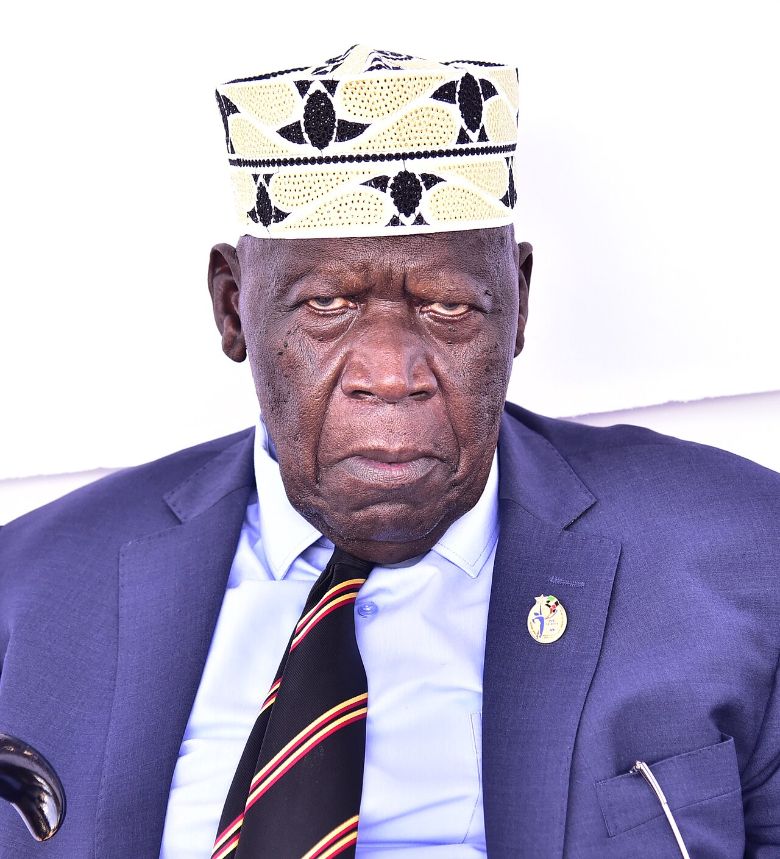
Adjumani | The passing of Gen. Moses Ali marks the end of an era in Uganda’s political and military history, a chapter written with resilience, controversy, patriotism, and an unyielding devotion to public service.
For decades, Gen. Moses Ali stood as one of the towering figures in Uganda’s leadership landscape. From the battlefields in the 1980s of turbulent political transitions to the corridors of government power, he carried himself with the calm authority of a man shaped by history itself.
To many in West Nile and across Uganda, he was more than a general or politician: he was a symbol of endurance, unity, and survival through some of the nation’s most defining moments.
The tough-talking, bully General, nicknamed himself “Cock,” because he said he was the father of West Nile; just like when a Cock crows at home, the chicken or chicks feel secure at home.
As a result, the once darling of the people of Madi was looked at as a formidable force and source of security, so much so that he should be the only one to be listened to.
But that analogy of the Cock, however, acted as a scarecrow to some of the locals, who feared to question his authority, but now to whatever he said for fear of reprisal.
Born in Adjumani district, he rose from humble beginnings to become one of Uganda’s most recognisable statesmen.
His life mirrored the journey of Uganda itself-marked by conflict, rebuilding, reconciliation, and hope.
Throughout his distinguished career, he served in various capacities, including as a senior military commander, cabinet minister, and Member of Parliament who served diligently in Adjumani, leaving an indelible imprint on national governance.
Even those who differed with him politically often acknowledged his strategic mind, discipline, and remarkable longevity in public life.
He was among the few leaders whose influence stretched across generations, serving under different political eras while remaining deeply rooted in the aspirations of his people.
To the people of West Nile, Gen. Moses Ali was a son of the soil who never forgot his roots. Ali, who was born on April 5, 1939, at Pakele in Adjumani district, started his political career in 1970.
In 1973-1975, he was appointed minister in charge of administration. He served in various ministries.
He championed development initiatives, advocated for peace and stability, and remained a steadfast voice for northern Uganda during times when the region sought healing and recognition.
His presence commanded respect — not merely because of rank, but because of experience earned through decades of sacrifice and service.
Friends and colleagues remember him as firm yet approachable, disciplined yet deeply humane.
Just like during the May 26 ministerial appointments, Dr. Anzo William Adiga, Lecturer in Obstetrics and Gynaecology; Former Branch Chairperson, Uganda Medical Association (UMA) West Nile, recognises the contributions made by Moses Ali.
“The NRM government has historically balanced the national boat with considerable skill, yet our own cornerstone—the long-serving Second Deputy Prime Minister, Gen Moses Ali—has been dropped from the Cabinet.”
Dr Anzo said: “We recognise that he appeared tired, and his retirement from active Cabinet duty is not itself the deepest concern. For decades, Ali was not merely a minister; he was the senior Cabinet face of West Nile. He carried the hopes, the voice, and the representation of over 3.7 million people of West Nile.”
He added: “When General Ali sat in Cabinet, the sub-region had a heartbeat at the highest table of national decision‑making. That heartbeat has now gone silent.”
Beneath the military uniform and political stature was a man who valued loyalty, community, and family. His wisdom often reflected the perspective of a leader who had witnessed Uganda’s highest triumphs and darkest storms.
In his evenings of age, during the 2026 Parliamentary campaigns, each day, Gen. Moses Ali’s day began at 6:00 am with morning prayers at the Abirichaku village mosque, as he sought divine intervention.
After prayers, a few locals often seize the chance to engage him in brief discussions while at the mosque.
By 7:00 am, he would return home to prepare for the day’s tasks ahead. By 7:30 am, he would be meeting visitors ranging from ordinary residents to his key campaign strategists to discuss personal matters or plan daily campaign activities.
Known for his generosity, the 86-year-old incumbent MP for Adjumani West Constituency in Adjumani district, Ali, typically meets 20 to 30 people every morning before 8:00 am.
Around 8:30 am, he had breakfast with early visitors, then resumes attending to more guests until lunchtime, depending on how many people seek his audience.
By 11:00 am, he was off to campaign across his constituency. Rather than focusing on larger parish gatherings, he preferred addressing voters at the village level, where his presence was met with excitement and celebration.
His campaign rallies typically attracted between 200 and 250 people at each stop, drawn in by his signature campaign songs that help mobilise the crowds.
At each village, he addressed residents briefly, often speaking for five to ten minutes before handing over to his campaign team to elaborate on his manifesto.
His speeches typically would begin with personal reassurances: “I am here. They wanted to bury me alive, but that cannot happen. They told you I am dead, but I am standing here. They said I can’t speak, but listen to my voice.”
Due to his age, he struggled to speak and gasp for oxygen.
He opted to campaign independently. His arrival often moved villagers emotionally, with some crying, others kneeling to pray for him, believing his presence defies rumours of his incapacity. He would urge voters to reject propaganda by re-electing him.
Sometimes, he would speak to his voters while seated. But as he stood up to speak, the DJs would intone his popular song to draw the crowd. As he started dancing to the tunes, his aides would come close to him to support him in case of any collapse.
He managed to cover all the 99 villages in his constituency, reportedly offering financial support of shs700,000 to shs800,000 in each village.
Throughout his campaigns, both Ali and his campaign managers highlighted several projects like: district status for Adjumani, major roads like Atyak-Omi and Laropi-Afoji, a World Bank-funded water project, and ongoing works on the Moyo-Yumbe-Koboko road.
He also outlined unfinished priorities, such as constructing a bridge over the River Nile, securing municipality status for Adjumani town, and upgrading local trading centres to town councils.
Many of those listed were government priorities and planned in the national budget. But the managers claim Ali had a hand in lobbying for them.
Moses Ali, the household name
Moses Ali was born on 5th April 1939 at Meliaderi, Atabo parish in Pakele division in Adjumani district.
Education and army role
Upon completing his Ordinary Level Certificate at Old Kampala Senior Secondary School in 1966, Ali undertook a number of military training courses as a Cadet officer, Paratrooper Instructor in Uganda and Company Commanders Course in Israel.
He was commissioned in 1969 to the rank of 2nd Lieutenant and appointed Officer-in-Charge of Training in the Uganda Paratrooper School.
Due to his passion for the army, in 1971, he was promoted to the rank of Major and appointed Commandant of the Paratrooper School. Later in 1972, he was promoted to the rank of Colonel.
Being in the army did not deter him from studies. That same year of promotion, in 1972, he enrolled in Staff College at Camberley in the UK, where he earned a Degree in Military Science.
Consequently, in 1973, he was appointed Minister of Provincial Administration, and in 1974, he was promoted to the rank of Brigadier. He was then decorated with three medals.
When Amin’s regime was toppled during the Uganda–Tanzania War of 1978–1979, Ali fled to exile in Southern Sudan, at that time under Sudan, finding refuge in Nimule in neighbouring South Sudan.
He formed a rebel group, the Uganda National Rescue Front, in 1980 after the fall of President Idi Amin, fighting the Obote II regime. After the fall of Obote in July 1984/5, over 1,000 cadres of the UNRF joined Yoweri Museveni.
In April 1990, he was arrested on treason charges and incarcerated until June 1992, when he was released and acquitted. This did not prevent his appointment as Minister of Internal Affairs, Minister for Disaster Preparedness, and Deputy Prime Minister.
He was a dynamic educationist; between 1998 and 1999, he studied at Holborn College in London.
Service above self
He was awarded the Distinguished Service Order, Military Cross, Operational and Republic.
He also served as Minister of Youth, Culture and Sports. He was also the Chairman of the Central Economic Committee, Minister of Tourism, Wildlife and Antiquities, and Chairman of the Central Tender Board.
He also served as Governor of the African Development Bank and Chairman of the Islamic Development Bank Governors. He was also a member of the Islamic University in Uganda Council.
Apart from that, he also served as Chairman of the Federation of Uganda Football Association, Member of the National Resistance Council for Moyo district and Constituent Assembly Delegate for East Moyo County.
The political career
He has served in the Ugandan Parliament since 2001.
In 2006, he lost both his parliamentary seat and his ministerial appointment.
He then went back to the political drawing board, where in 2011, he returned like a first-season rain with power and regained his position in parliament.
In 2016, following his re-election to parliament, he was again appointed First Deputy Prime Minister.
In the 2026 elections, he was elected in the Adjumani West constituency. Due to his health condition, he was sworn in the Parliamentary Chambers on May 13.
The lawyer
He held a Bachelor of Laws (LLB) from Makerere University and a Diploma in Legal Practice from the Law Development Centre in Kampala.
As Uganda mourns his passing, the nation also celebrates a life devoted to duty. His legacy will endure in the institutions he helped shape, the leaders he mentored, and the countless citizens whose lives were touched by his work.
Gen. Moses Ali leaves behind a grieving family, friends, comrades, and a nation indebted to his years of service. Though his voice has fallen silent, his story remains etched into the history of Uganda.
Discover more from tndNews, Uganda
Subscribe to get the latest posts sent to your email.