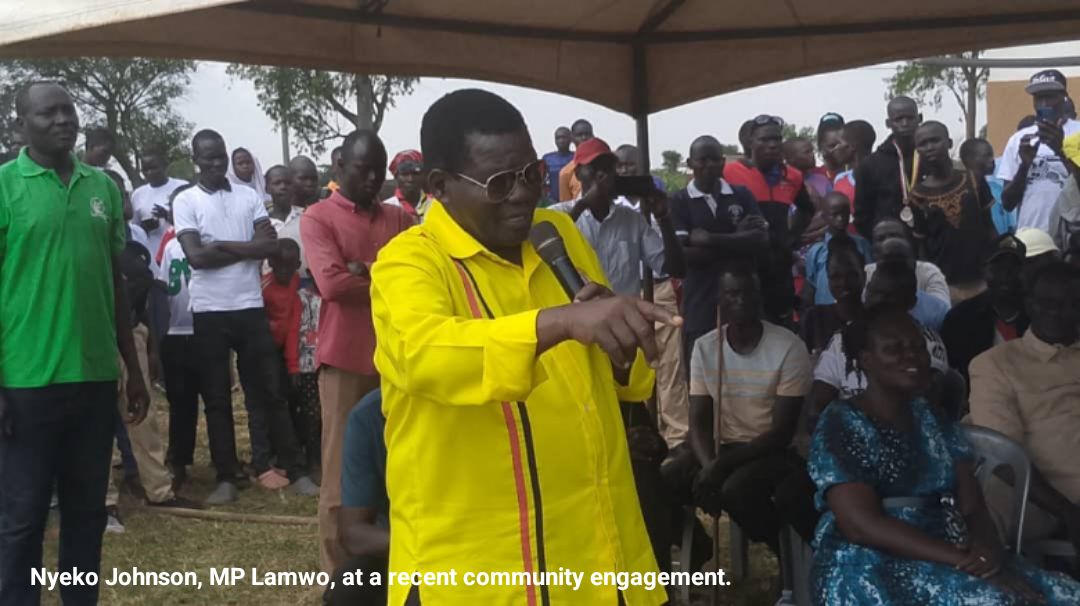
Lamwo | When Lamwo County Member of Parliament Nyeko Johnson Kezikia recently warned individuals accused of illegally benefiting from government programmes to return public resources or face arrest, his message resonated far beyond the political arena.
For many residents in rural communities, the legislator’s warning touched on a long-standing concern: whether government programs intended to uplift poor households are actually reaching those most in need.
Speaking during a community engagement in Padibe town council, Nyeko issued a stern warning against corruption, saying individuals involved in the misuse of government resources risk arrest under the government’s intensified anti-corruption campaign.
“I come with the power of arrest, but that is not why I want to begin,” Nyeko told residents. “There is amnesty for mistakes. Within two weeks, anyone who has taken something illegally or bribed somebody should return the money.”
The legislator said the government remains committed to ensuring that public programs designed to improve livelihoods benefit their rightful beneficiaries.
His remarks come amid growing public concern over alleged irregularities in some government-supported interventions, including livestock restocking programs and other poverty alleviation initiatives.
For residents like Ocen Geoffrey, a subsistence farmer in northern Uganda, such programs often represent hope for a better future.
Like many rural households, Ocen had hoped government support would help him rebuild his livelihood after years of hardship. Yet many communities continue to report cases where intended beneficiaries are allegedly left out while resources end up in the hands of undeserving individuals.
Development experts argue that corruption in rural development programmes has far-reaching consequences. “When resources meant for vulnerable households are diverted, it is the poor who suffer most,” says Nyeko.
“Corruption delays development, deepens poverty and erodes public trust.”
Nyeko echoed similar concerns, warning that corruption directly undermines service delivery and slows development, especially in rural areas where communities heavily depend on government interventions.
Across Uganda, programs focusing on agriculture, social protection, education and household income improvement are intended to transform livelihoods and reduce poverty.
However, experts say the success of these interventions depends largely on transparency, accountability and effective oversight.
Anywar James, a resident of Padibe town council, said many villagers often do not know how beneficiaries of government programs are selected.
“Sometimes we hear that animals, seedlings or other support have been brought, but ordinary community members do not know who received them,” he said. “The government should make beneficiary lists public so that everyone can know who is supposed to benefit.”
Another resident, Onekalit David said corruption discourages vulnerable households from participating in government programs.
“People lose trust when they see the same individuals benefiting repeatedly while others are left out,” he said. “We need fairness and transparency if these programs are to change people’s lives.”
Otema Wilfred, the urban Chairperson of Padibe town council, welcomed the legislator’s call, saying communities should actively monitor government interventions.
“Fighting corruption should not be left to government officials alone. Community members also have a responsibility to report any irregularities they witness,” Otema said.
Even seemingly minor acts of corruption can have devastating effects. The diversion of livestock, seedlings, agricultural inputs or cash support may deny vulnerable families opportunities to improve food security, educate children or expand household incomes.
In communities where many families survive on subsistence farming, losing access to such support can reinforce cycles of poverty.
Nyeko urged residents to actively participate in fighting corruption by reporting suspected cases and monitoring government programs in their communities. He says citizen involvement remains one of the strongest safeguards against misuse of public resources.
“When communities understand what they are entitled to receive, it becomes harder for resources to be diverted,” notes Nyeko.
The legislator further warned that government officials, security personnel and members of the public found culpable in corrupt practices would face legal action if they fail to voluntarily comply with the directive.
His message reflects a broader national push to strengthen accountability and ensure that public resources achieve their intended purpose.
As Uganda continues implementing programs aimed at improving household incomes and promoting socio-economic transformation, many stakeholders agree that combating corruption must remain a collective responsibility.
It is about ensuring that a cow reaches the farmer it was intended for, that agricultural inputs reach struggling households, and that public resources improve lives rather than enrich a few individuals.
Discover more from tndNews, Uganda
Subscribe to get the latest posts sent to your email.