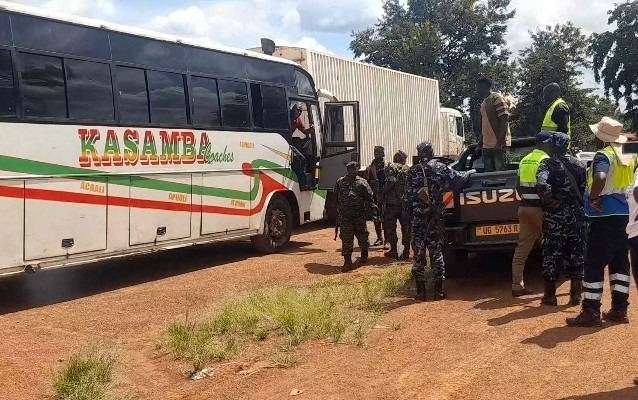
A trade order operation on wetlands encroachment in Hoima City has left the Kasamba bus coach company on the spot for supporting illegal motor vehicle washing bays in wetlands within Hoima City premises.
The company bus was impounded and driven to Hoima Central Police Station (CPS). A bus with registration number UAL 333L was impounded together with nine other cars, ten motorcycles.
Eight vehicle owners were also arrested and detained at Hoima CPS during Thursday’s full-day trade order enforcement by Hoima City authorities, NEMA and security agencies.
Those arrested face accusations of fueling wetlands encroachment by encouraging car washing in wetlands.
Some other impounded vehicles included a Fuso Lorry UBM 776L, Premio 20 UAW 051N, Toyota Wish UBQ 138H, among others.
The motorcycles include CT motorcycle UAM 551GX, Bajaj boxers, UMA 483HR, UMA 610DQ, Senke, among others.
The operation was implemented at over 10 spots in Bujumbura East, Buhaga, Kiganda, Kigaragara, Kiryabana, and Katasiya cells.
It not only targeted illegal mobile washing bays along wetlands, but also people who encroached on wetlands with different human activities including brick laying, building and agriculture.
Robert Byaruhanga, a Hoima City official, said the trade order implementation follows presidential directives on evicting wetland encroachers who have become threats across the city.
He said that city authorities started by implementing the directives through community awareness using both public address systems and media channels including radio talk shows and announcements.
“We are focusing on different categories of people including those practising agriculture, brick laying, automobile washing and building within wetlands,” Byaruhanga revealed.
“However, after implementation, all the affected individuals will be charged by NEMA according to the National Environmental Policy,” he continued.
Milton Asiimwe, the assistant deputy clerk said that the operation will remain continuous until the trade order policy is fully implemented across the city.
“We see that these people encroaching wetlands can still live well financially if they apply for government financial programs and use the funds to venture into other business ideas which do not make them law violators,” he advised.
Speaking before the operations, the Bunyoro regional investigation officer for NEMA, Mpala Christopher Lubega, said that the operation which will continue in phases will involve impounding vehicles and motorcycles found at illegal washing bays, destroying encroachers’ plants, but also arrest the law violators.
Kusiima Januarious, environmental police leader for the Albertine region, said security remains committed to implementing the law by arresting the law violators during the implementation.
Bizibu Jonan, the city environment officer wonders why communities remain deaf to all the national environmental conservation policies put in place.
Bizibu noted that encroachment on wetlands has affected the water tables of the city, noting that as a result, the city is faced with an inadequate water supply given the growing population.
Bizibu called for continued joint efforts in implementing the policy to restore the degraded ecosystems.
Community actions toward implementation
Although the authorities say there has been a sensitisation, communities continue to complain that some of them depend on those wetlands for either agriculture, brick laying and automobile washing.
Rojas Abitegeka and others in the Wambabya area condemned the implementation, saying it has stepped on their livelihoods’ source of survival.
“Really, you cannot come and chase us from where I get my survival. This is a routine job for some of us and where we get what to feed, educate, and also pay medical bills for our households.”
Rojas Abitegaka, a car washer on River Wambabya in Katasiya, claims that they are disturbed for nothing. He added that they have committed no offence despite operating on the river banks.
Andrew Kemigisa, one of the affected car owners, condemned the authorities against the implementation, saying it was selective.
Henry Kajura, a boda boda rider, blames authorities for the implementation. “Some of the riders will not be able to afford modern washing bays.”
Discover more from tndNews, Uganda
Subscribe to get the latest posts sent to your email.