For many smallholder farmers in Uganda, the hardest part is no longer growing food and it is meeting market standards.
Across the country, farmers are discovering that survival in modern markets depends less on individual effort and more on collective strength. In northern Uganda, especially in Gulu, cooperatives are becoming the bridge between small farms and demanding buyers.
For young farmers and small-scale entrepreneurs, meeting product standards whether for local markets, supermarkets, or export—is often overwhelming. Certification is costly, time-consuming, and poorly understood, leaving many locked out of lucrative opportunities.
Latim Paul, an agricultural officer at West Acholi Cooperative Union, says pooling resources is giving farmers a fighting chance.
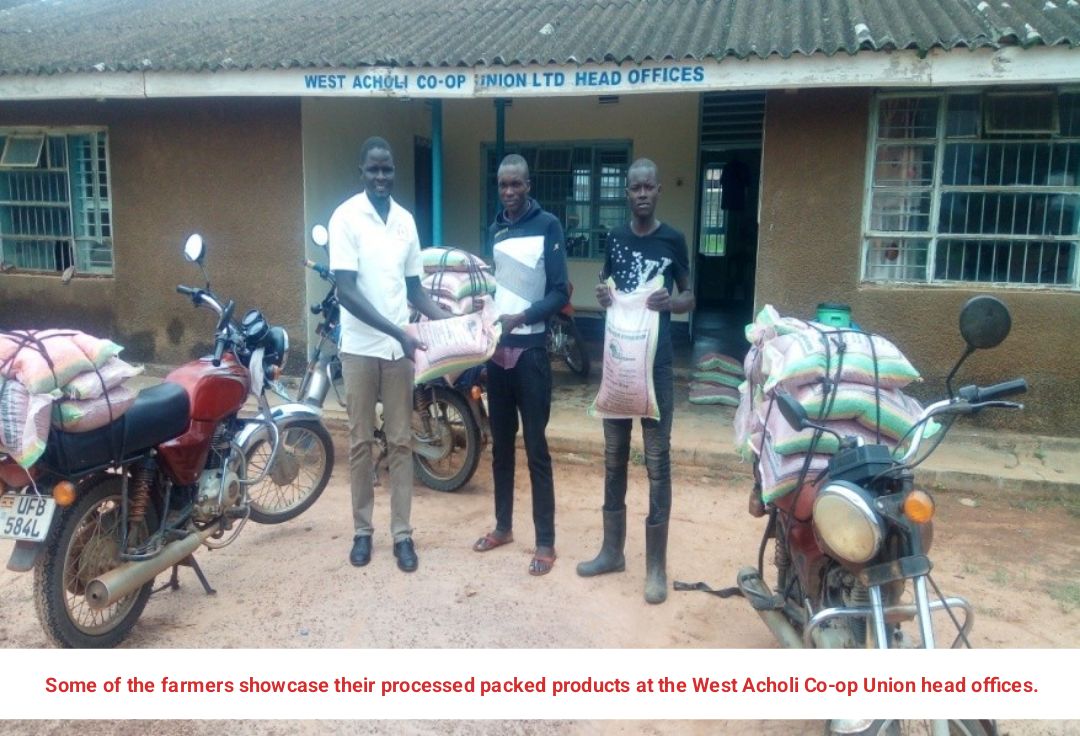
“If farmers bring their produce together, we handle quality testing, processing, branding, and packaging before it reaches the market,” he explains.
For individual farmers, certification is often out of reach with many either cannot afford it or underestimate its importance and through the union, however, farmers receive training in good agronomic practices, climate-smart agriculture, and financial literacy, alongside access to subsidized inputs and small loans.
“We also manage agro-processing, rice handling, and maize milling under our union brand and certification has been challenging, especially in the off-season, but we are close to completing the process,” Latim adds.
Since the cooperative’s revival, production has surged in some areas like soybean yields have doubled from 150 kg to 300 kg, while rice production has increased from 800 kg to 1.2 tonnes per acre.
“This is because farmers now have access to quality seeds and fertilizers with the results already being visible,” Latim says.
Collective power, real gains
For Genesis Odong, a member of the Pabbo Rice Cooperative Union, the impact of collective farming is undeniable.
“At the end of every year, the union sets targets for smaller cooperatives to guide training programmes, for example, a cooperative may be tasked to identify up to 500 farmers for a specific project,” he says.
The union has also strengthened quality assurance through better post-harvest handling.
“We now use proper drying methods and improved storage facilities, which have significantly improved our harvests,” Odong explains.
“We established a grinding machine for processing, branding, packaging, and labeling, hence this has opened up bigger markets because buyers trust our products more,” he added.
According to Odong, they still lack a rice grading machine, which limits our ability to export consistently and this is a very challenging gap.
Despite these challenges, Odong says livelihoods have improved significantly and working together has changed everything compared to when we operated individually.
Mark Sunday, another farmer, says cooperatives are transforming productivity by equipping farmers with practical skills.
“They train us on pest and disease control and advice on the right pesticides during outbreaks,” he says.
Extension workers are also deployed to monitor farms throughout the production cycle from planting to harvest ensuring quality yields and timely harvesting.
For farmers without post-harvest equipment, cooperatives provide basic support like tarpaulins to prevent contamination during drying citing its importance in maintaining clean produce without contact with dust.
However, Sunday revealed that unpredictable weather is a very big challenge since they cannot accurately predict weather patterns and this affects planting seasons.
“We also need advance payments so that farmers can handle urgent needs before selling their produce and that would greatly improve our livelihoods,” he disclosed.
Certification: The gatekeeper to bigger markets
Makalu Antonio, a senior metrologist at the Uganda National Bureau of Standards (UNBS), urges traders to prioritize compliance.
“Certification is key to accessing bigger markets and without it, traders limit their own opportunities,” he says.
He warns that focusing on the cost of certification while ignoring its benefits exposes consumers to substandard and counterfeit products.
“Failure to comply poses serious health risks, especially to vulnerable groups like school-going children,” Antonio adds.
Uncertified goods also struggle to cross borders.
He added that uncertified goods struggle to cross borders and also products that are not standardized or lack traceable origin cannot compete in regional trade.
While demand for agricultural products remains high, quality issues continue to hold farmers back.
Kidega George Nicolas, senior commercial officer of Gulu City, says demand actually exceeds supply but adulteration is a major problem.
“Many products are tampered with, contaminated, or diluted, making them uncompetitive,” he says.
“Traders add water to increase volume, but this compromises quality and destroys customer trust and milk adulteration is a common example,” he added.
OOrganisedfarmer groups, however, are showing what works with groups like the Waribe Farmers Group in Koro produce in bulk, process, brand, label, and certify their products. These are reliable and safe for consumers.
Kidega also raises concerns about food safety in local markets, noting that many products lack expiry dates despite having no preservatives.
“Farmers and traders must work in groups and even government programmes are designed to support organized cooperatives because they are easier to regulate and support,” Kidega noted.
Cooperative unions in Northern Uganda play a critical role in agricultural development, value addition, and financial inclusion. The West Acholi Cooperative Union (WACU), established in 1960, serves as a key umbrella body for cotton and food production, as well as financial services.
Today, WACU supports over 11,000 farmers through 78 primary cooperatives across Gulu, Amuru, Nwoya, and Omoro districts.
Discover more from tndNews, Uganda
Subscribe to get the latest posts sent to your email.