Adjumani District Local Government has approved a budget worth shs46,786,015,144 for the Financial Year 2026/2027, reflecting a significant reduction compared to shs72,644,601,862 approved in the previous financial year.
District leaders attributed the decline to several factors, including the completion of major donor-funded projects such as UCIMID-AF, DRDIP, Prelionor, and USSF, whose conclusion has left noticeable funding gaps.
The leaders warned that this reduction may affect service delivery, especially amid the rising population of both nationals and refugees in the district. Currently, Adjumani hosts 528,885 people, including 300,590 nationals and 228,295 refugees.
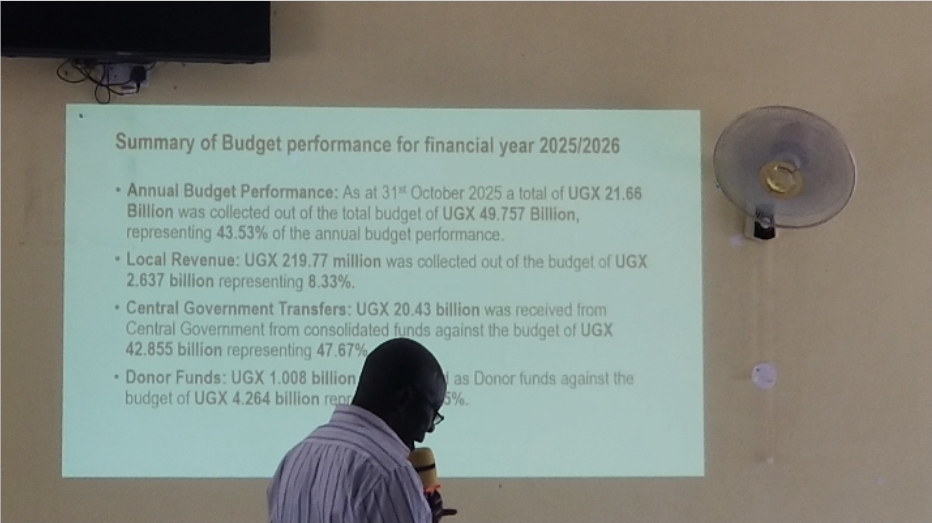
According to the Senior Commercial Officer, Samson Soma, the district’s annual budget performance for FY 2025/2026 showed mixed results.
“We have so far realised shs21.6 billion that was collected out of the budget of shs49.7 billion, representing the 3rd quarter 5th grade of the annual budget performance,” he said.
Soma added that local revenue performance stood at shs 290.77 million out of shs2.6 billion budget, representing 8.3%.
“Central government transfers to the SEFA were shs20.43 billion out of the total budget of shs42.855 billion, which is 47.67%. Donors’ funds or donors’ support, we have so far received shs1.8 million out of the total of shs4.264 million representing 23.6%. That is the current financial year performance up to 31st October 2025,” he explained.
He further noted that revenue performance continues to decline.
“From the above analysis, revenue continues to perform forward a reduction by 6%. That is shs2.9 billion. It was reduced from shs49.7 billion to 46.7 billion,” Soma stated.
To improve revenue performance, Soma highlighted several strategies drawn from the District Development Plan Four (DDP4), including:
● Electronic evaluation, assessment, and collection through the Revenue and Social System.
● Enforcement of local revenue mobilization and collection by both political and technical teams.
● Strengthening internal control systems using electronic receipting.
● Regular tax coding, consultations, and reviews
● Reviewing reserve prices for all revenue sources.
● Enhancing supervision and enforcement at all local government levels.
The Chief Finance Officer (CFO) Leku Samuel acknowledged that the budget trend has shifted over time.
“Where are we heading? This is the first five years before history. As you can see here, the trend is coming down. For the last five years, we were doing well. It started from shs25 billion to shs72 billion during COVID time.
“Then you can see the trend has been the positive one. Now we have moved to shs46 billion. Today we are gathered here for shs46 billion,” he said.
The CFO presented the summary of budget performance for FY 2025/ 2027.
Chief Administrative Officer (CAO) Ocen Andrew James emphasised that the budget preparation process was conducted in accordance with the Public Finance and Management Regulations (2026).
“This budget conference is prepared in accordance with section 7 subsection 1 and 2 (b) of the Public Finance and Management Regulations 2026 for the preparation of the budget framework paper for FY 2026/2027,” he explained.
“All the sub-counties and town councils held their budget conferences and submitted their inputs to the district for the financial year 2026/2027,” Ocen added.
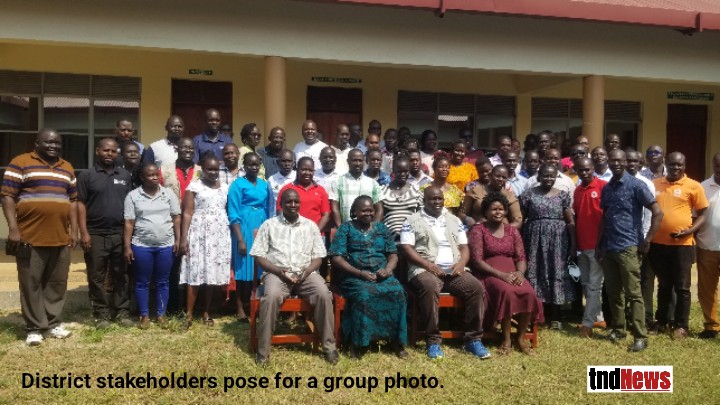
Speaking during the district budget conference, vice LC5 chairperson Kaijoka Richard Arthur highlighted the importance of transitioning from subsistence to commercial agriculture to stimulate income growth.
“Uganda’s economy and most of our people are employed in agriculture. But we must move away from subsistence farming to commercial so that money comes in our pocket,” he said.
On the issue of the budget reduction, Kaijoka noted that the decline is not unique to Adjumani.
“Concerning the reduction in our budget, I think everyone is aware that it’s not only in Adjumani but the whole nation is affected. But specifically, for Adjumani, most of the government projects have ended like UCIMID-AF, DRDIP and many more.
“I want to request our partners that though most donors have withdrawn, let’s continue supporting the little we are having because the population of refugees in Adjumani is almost the same as the host community,” Kaijoka appealed.
Despite the funding cuts and donor withdrawal, district leaders expressed commitment to strengthening local revenue mobilisation, enhancing efficiency, and ensuring that the limited resources are optimally utilised to meet the growing demands of both the host and refugee communities.
Discover more from tndNews, Uganda
Subscribe to get the latest posts sent to your email.