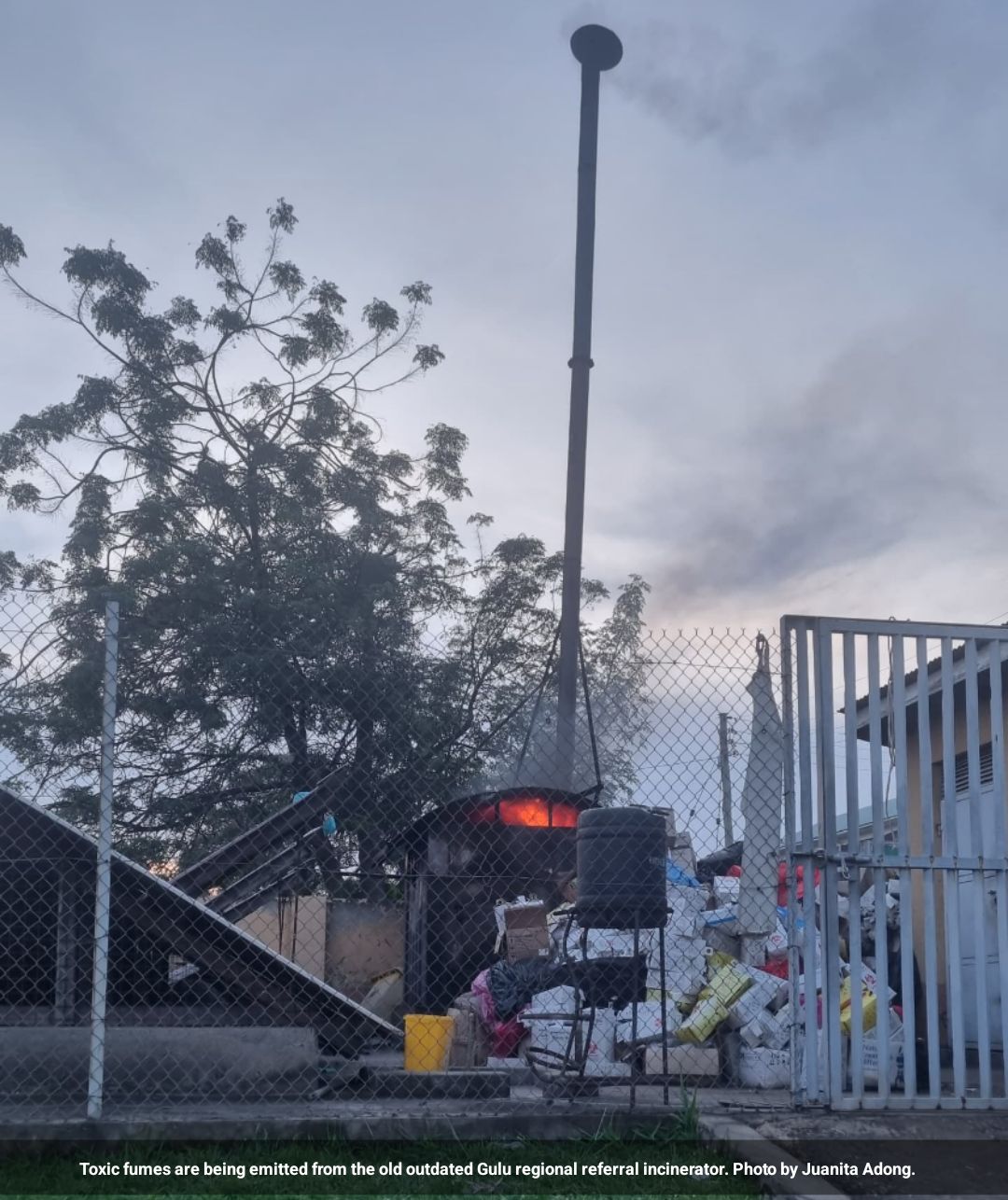
A shs19 billion (approx. USD 5 million) medical waste incinerator project intended to modernise healthcare waste disposal in northern Uganda remains incomplete five years after its launch. This has left Gulu residents exposed to toxic smoke and worsening public health risks.
Financed by the World Bank under Uganda’s healthcare infrastructure expansion program, the incinerator was meant to replace the outdated and overstretched waste burner at Gulu Regional Referral Hospital, which serves multiple districts including Kitgum, Pader, Amuru, Omoro, Nwoya, Lamwo, and Agago.
But since its commissioning in 2020, the project has faced repeated delays—caused by land disputes, mismanagement, and equipment misplacement. Today, as blame continues to circulate among officials, the community breathes in the toxic consequences of the government’s broken promise.
Ojok Samuel, a boda boda rider in Gulu City, is among the many who feel abandoned.
“I don’t know how this can be such a big government hospital serving thousands of patients and still fail to solve this smell which has been here for years,” he says. “I am not a doctor, but I know the dangers. It’s like passive smoking — over time, it causes lung cancer.”
Ojok recalls one evening when he brought his sick mother to the hospital: “The smell was terrible, worse after it had just rained. Next to the incinerator was a heap of waste that had piled up for I don’t know how long.”
For food vendors near the hospital, the impact has been equally devastating. A 37-year-old single mother who once sold chapattis by the roadside abandoned her stall after smoke drove away customers.
“The hospital is supposed to heal patients, but people are silently getting sick from this toxic smoke,” she says. “Every evening I see boda boda riders and pedestrians covering their mouths as they pass by.”
Another vendor, who asked not to be named, says her livelihood is at stake:
“We literally choke on smoke every day. Even customers complain that they cannot trust our food. Sometimes I wear a mask when the smell is too much.”
Hospital staff also admit the facility is overwhelmed. Komakech Paul Ochaya, the incinerator waste manager, says the current burner is too small to handle the 500 kilograms of waste produced daily.
“We can only burn 250–300 kilograms a day. About 150 kilograms remain, and some types of waste like needles and bottles cannot be burned at all,” he explains.
 According to him, waste once collected by Green Label Company for disposal in Luweero district has been piling up since March when the company stopped coming. To reduce smoke, staff now burn only 20 kilograms at a time but complaints persist.
According to reports from the hospital, the total collection of medical waste annually is 1260 tons, but the current incinerator is only able to burn 60% (756 tonnes) of the waste. The big question now is what happens to the 40% balance?
Expert warning
Gulu District Health Educator, William Onyai explained that incineration is only the final stage in a long chain of waste management that should begin at the point of generation.
He noted that while several health centre IIIs in the district operate small-scale incinerator facilities.
“That single incinerator, however, is now forced to absorb waste from numerous health units across the Acholi sub-region, pushing it far beyond its designed capacity”.
Onyai warned that poor waste handling carries direct public health risks. He pointed out that the hospital’s incinerator was poorly constructed, with a low chimney that fails to release smoke at a safe altitude. As a result, surrounding communities are constantly exposed to toxic fumes.
“This exposes people to airborne diseases,” he said, adding that during rainfall, the stench worsens and becomes unbearable.
He also cautioned against unsafe domestic practices. Many households, he noted, use polythene bags to light fires, not realising that the smoke releases carcinogenic substances linked to cancer. “This is the hidden cost of poor waste management,” Onyai emphasised.
Emmanuel Ainebyoona admits that the project has taken a long time but is already at its final stage and expects that it will be commissioned soon.
Delays rooted in land compensation dispute
Dr Cana Kenneth said land problems caused the first delay. A government-funded incinerator meant to help manage medical waste in northern Uganda has been delayed for over two years instead of the planned three months.
The community first agreed to give land for free, but later they changed their minds and stopped the work till the district shared the burden with the Ministry of Health and paid them. He recalls.
More delays came when the equipment for the incinerator was sent to another district, leaving the site empty for over a year. “The right equipment only arrived just last month, installation has started and we hope it will be ready by the end of this year or early next year,” Dr Cana added.
The project is run by Bygone Company Limited and will serve the whole district and the nearby areas.
In the meantime, medical waste is still a problem as many private clinics and hospitals without incinerators dump waste carelessly, sometimes mixing it with market trash.
He says that they have resorted to allowing most of these wastes to be taken to Gulu regional referral hospital which now is also overwhelmed.
The new incinerator stalled for years over a shs35 million compensation dispute with landowner Uma Labeja. Though the amount represents just 0.15% of the project’s budget, the disagreement halted progress.
Uma says he stopped contractors from continuing until promises were fulfilled.
“They agreed to give me shs35 million and to educate two of my children, but nothing was done. That’s why I blocked them,” he explains.
There was a service provider called Green Label Services Ltd contracted by the Health Ministry to transport hazardous waste from Gulu to Nakasongola. That arrangement was terminated when external funding was suspended.
Local leaders admit mistakes were made. Justin Kidega, LC3 chairperson of Unyama Sub-county, says the project was launched before enough land was secured.
“This incinerator is a central government project, but poor planning led to delays. If the district had honoured its commitments, we would not be here,” he says.
While he acknowledges that construction is now in its final stages, Kidega calls for more transparency and community engagement. He also warns that without responsible management, the facility could expose residents to more health risks.
Public health emergency
For more than a decade, Gulu Regional Referral Hospital has relied on an old, broken-down incinerator that is both overstretched and unsafe. Since at least 2014, when the main burner failed.
The facility has continued to emit toxic fumes and handle far more waste than it was designed for, serving the entire Acholi sub-region. Residents around the hospital have lived with the stench and health risks of poorly burnt medical waste, while patients and staff remain exposed to the dangers of improper disposal.
A recent NEMA audit in 2025 confirmed that emissions from the old hospital incinerator exceed safe thresholds for particulate matter and dioxin, a chemical known to cause cancer, respiratory illness, and liver damage.
With only a handful of functional medical waste incinerators in the region, many districts resort to open burning, worsening public health dangers. For Gulu residents, the long-awaited shs19 billion project was more than an infrastructure upgrade; it was an urgent lifeline.
Yet five years on, smoke still chokes the hospital, vendors still lose their customers, and patients still suffer. For now, Gulu waits for its health to hang in the balance of an unfinished promise.
This story was produced with a grant from the African Centre for Media Excellence (ACME).