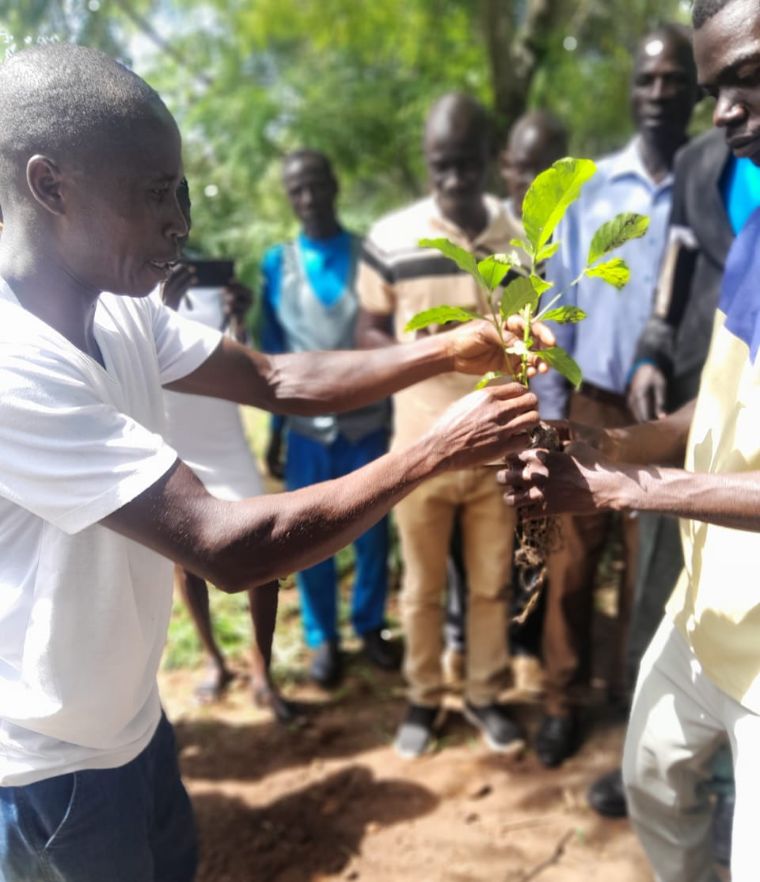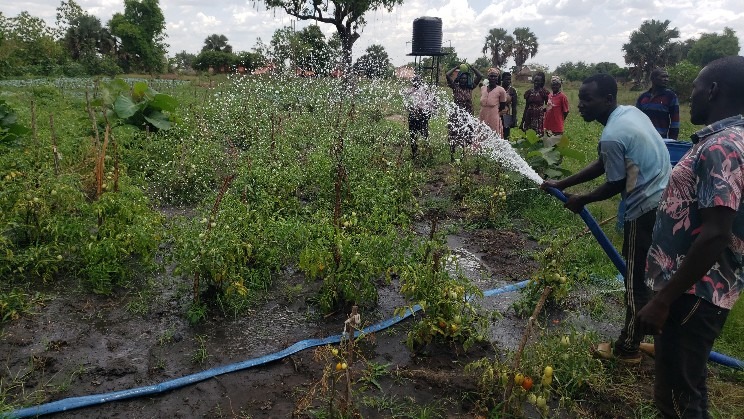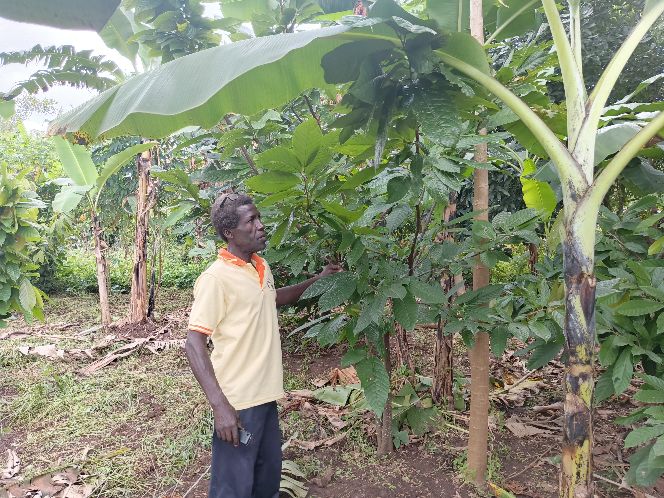
Ongako, Omoro district | July 25, 2025 remains a memorable day for many farmers in Ongako sub-county, Omoro district.
Located over 350 kilometres north of Uganda’s capital Kampala, Omoro’s Pida village in Ongako sub-county hosted a photo exhibition organized by InfoNile with support from Palladium under the Climate-Smart Agriculture project. The exhibition also featured business communities like agro input dealers.
To many farmers like Kennedy Lakony – a resident of Aboka village, Ongako sub-county, this was more than just a mere photo exhibition. “It was a learning experience. It was an opportunity to learn and network with other farmers,” Lakony reveals.
The journey to the exhibition and mindset change.
The exhibition at Pida was preceded by well-structured journalists’ training on climate-smart agriculture. The training by InfoNile with support from Palladium targeted a group of carefully selected journalists from Gulu. After the training, the journalists were supported to produce stories on climate smart agriculture. It is these stories that were taken back to the community on the exhibition day.
“We undertook this approach of taking the stories back to the community to inspire and motivate smallholder farmers to adopt climate smart agriculture practices and technologies,” Racheal Pakrwoth, a Project Lead with InfoNile explains
Climate Smart Jobs (CSJ) aims to economically transform the agricultural sector by working with a wide range of partners, including private agricultural companies, media houses, and academic institutions.
The primary goal, as stated by Matthew Rupanga, Team Lead Climate Smart Jobs, intends to help smallholder farmers adapt by “improving delivery of inputs and services.”
According to Rupanga, there is a collaborative effort underway to address the challenges facing smallholder farmers in northern Uganda, particularly those exacerbated by climate change.
“Climate Smart Jobs is seeking to have economic transformation in the agricultural sector, and specifically, smallholder farmers. We are seeking to work with the private sector (agricultural companies that sell agricultural inputs, insurance, tractors), and anything that you need to produce your crop yields and livestock. We are trying to work with them to adapt the way they work with smallholder farmers,” said Rupanga.
He further mentioned that the program focuses on ensuring farmers get the “lowest price as much as possible” for inputs like seeds and fertilizers while also helping them sell their produce “at the highest price possible.”
“We want you to buy and pay as low as possible, and on the opposite side, we are very interested in you selling your produce at the highest price possible from the market because your cost of production is meant to be low, and you are paid a lot more for what you produce,” he stated.
Christine Akello, a farmer in Pida village was one of the farmers who attended the exhibition that day. At that time, she was tending to two acres of local maize, two acres of beans intercropped with millet and simsim, 12 goats and local chicken. She does not regret the time spent at the exhibition on that chilly day on Friday.
“The exhibition opened my eyes. I am resorting to planting hybrid seeds in the next season (next year) alongside the traditional seeds– among other climate smart agriculture practices,” Akello narrated during an interview with this publication.

“Our local seeds are resistant to drought and floods, but they don’t yield much compared to hybrid seeds which also have a short maturity period”
According to Akello, for next season, she plans to plant hybrid maize for commercial purposes and local seed varieties for home consumption.
Last season, Akello earned Uganda shillings 1.4 million (about 378 USD) from one acre of beans and Uganda shillings 542,400 (about 146 USD) from one acre of maize.

“From the exhibition, I was inspired and I committed to buy hybrid seeds and goats because I believe this will help me get more from my farm and take care of my family,” Lakony said.
By the time this publication visited his farm in September, Lakony had an acre of maize, half an acre of beans and some local goats but promised to adopt hybrid maize the next planting season.
He, however, noted that much as he was inspired and willing to practice climate smart agriculture, the biggest setback is inadequate finances to buy the seedlings.

William Otim, also a resident of Pida village has two acres of coffee and half an acre of cocoa intercropped with bananas. He is also into local goat rearing and poultry.
After the exhibition, he promised himself to save some money to buy hybrid goats as he keeps the local ones too.
Davidson Ojok, the LC1 of Onyona pida village where the exhibition took place discloses that over 20 farmers have so far shown interest in adopting new practices and technologies.
“Immediately after the exhibition, I received more than 20 farmers who were interested in putting into practice what was exhibited by journalists. I have registered them just in case some well-wishers are interested in giving them support,” Ojok notes.
He says most of them have an interest in goat rearing, poultry, cocoa, maize and coffee growing.
Dr Alfred Obia, a soil scientist, a researcher and a lecturer at Gulu University advises farmers to adopt climate smart practices to increase productivity and to mitigate extreme effects of climate change.
“We need to do something to live. Climate change is here to stay; it will not go away anytime soon. Farmers should consider doing local seed businesses to have some money,” Obia explains, adding: “We should consider growing both long and short term crops to increase our income and for the purpose of food security at homes.”
Dr Obia calls upon different stakeholders to engage in accurate and timely dissemination of climate-smart agriculture messages to inspire farmers and trigger action.
Discover more from tndNews, Uganda
Subscribe to get the latest posts sent to your email.