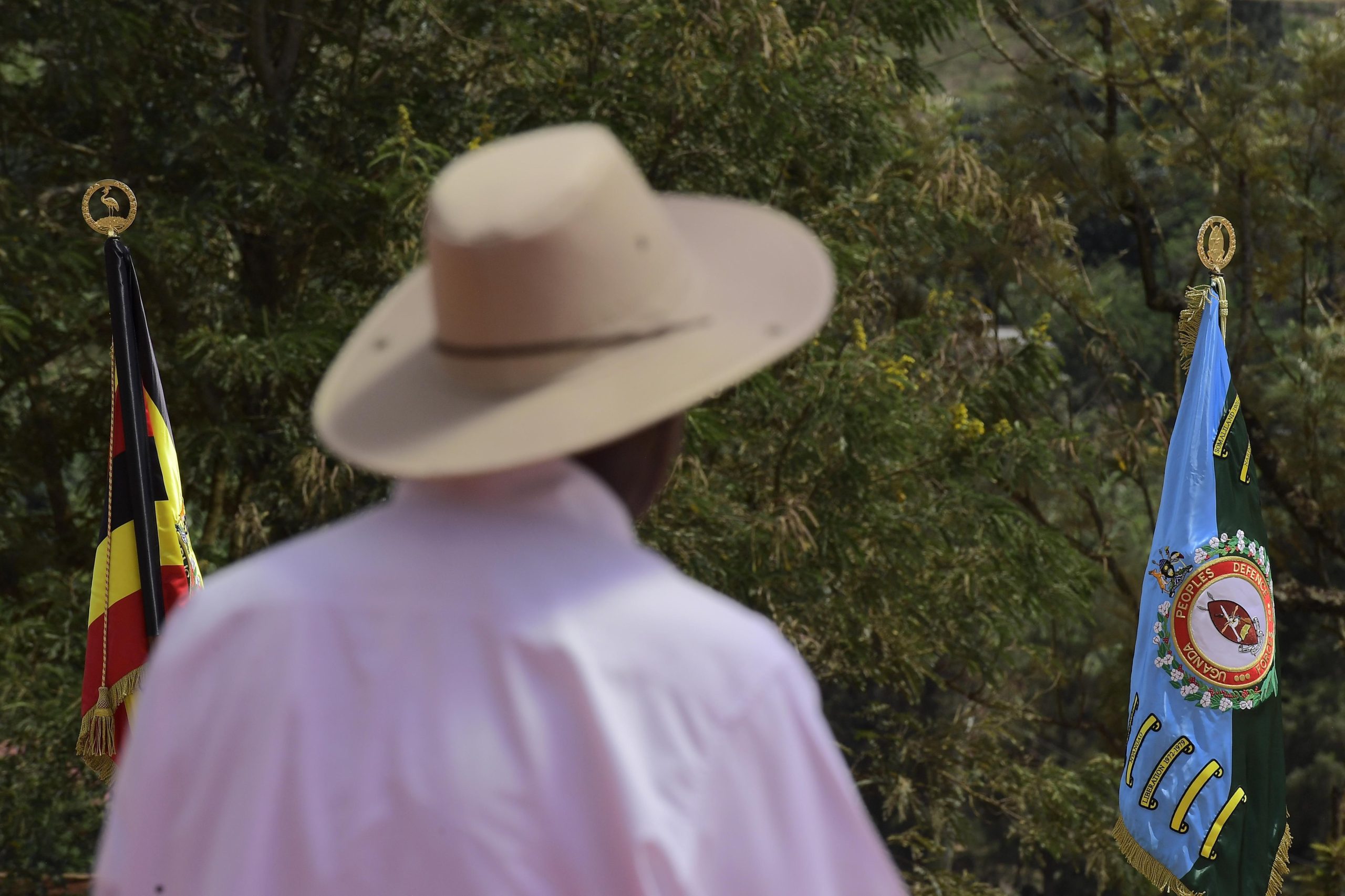
Every year on June 9, Uganda pauses to honor its war veterans and other citizens, who, through sacrifice and service, contributed to the country’s political liberation and stability.
Known as Heroes’ Day, the national holiday has traditionally served as a symbol of pride, patriotism, and remembrance.
However, this year’s commemoration, held in Lyantonde district, has reignited deep public debates and political criticism about the true meaning and relevance of honoring Uganda’s veterans in the current political climate.
Some citizens gathered at Lyantonde Technical Institute playgrounds in a ceremony that was politically charged, particularly because it focused on remembering the legacy of Eddidian Babumba Mukiibi Luttamaguzi, one of the early fighters of the National Resistance Army (NRA) who lost his life during the 1981 Bush War in Kikandwa, Luwero district.

He died fighting alongside the now-president, Yoweri Kaguta Museveni, who led a guerrilla campaign to oust the President of the time, Dr Apollo Milton Obote.
President Museveni has repeatedly emphasized the importance of remembering those who contributed to the country’s liberation.
In many of his public addresses since 2001, Museveni has described such commemorations as essential acts of gratitude and nation-building. This year’s event was no different, echoing familiar narratives of heroism and national struggle.
But his message, though historically rooted, did not go unchallenged.
The 2025 Heroes’ Day celebration became a national flashpoint for disagreement, particularly among opposition politicians and civil society advocates who questioned the criteria used to define and celebrate Uganda’s “heroes.”
To many, the ceremony in Lyantonde was another reminder that the country’s system has become skewed, and politically for a few.
Ibrahim Ssemujju Nganda, Member of Parliament for Kira Municipality, and acting spokesperson for the opposition People’s Front for Freedom (PFF), expressed open frustration during a televised appearance.
Nganda said Heroes’ Day is the third national event to remember how Yoweri Museveni Tibuhaburwa launched, fought, and won a war that brought him to power nearly 40 years ago.
“ …as you recall, we began the year in Mubende celebrating the so-called Liberation Day on January 26th, the day Museveni captured power. Eleven days after Mubende, we went to Kyotera where Museveni and his son and wife were presiding over. You must have seen the son addressing Muzee and Maama as if they were in a family meeting.
“You saw that journalist…….. Today June 9th, the country again is trekking to Lyantonde to mark another holiday and third national event about the same thing, ‘The Luwero War’.”
“That today, the country is celebrating heroes, remember they have written so much about this. The beginning in 1989 was in memory of Luttamaguzi Mukiibi who refused to disclose the hideout of Museveni and got killed by soldiers of the Obote government. So since 1989, today, I have been told that we are celebrating the 36th Heroes’ Day in memory of Luttamaguzi and others who died in Luwero.
“Of course, progressively they have been picking everybody, including from the streets. So don’t get surprised if you hear that Buchaman is going to be a hero today. They may have exhausted the list of Luwero so they keep picking from anywhere……,” said Ssemujju.
According to him, Uganda celebrates three days in a year to remember how Museveni launched, fought and captured power describing them as useless public holidays that become expensive for the country.
“This year in the budget alone, shs5 billion was provided that in addition to giving medals, that they should also need now to be giving some money yet in the same budget, Museveni did not provide for Sven billion which is the las instalment in development of the curriculum for A Level students.
“So the Uganda curriculum Development Center lacks shs7 billion to develop a curriculum for Senior 5 students, about a million of them but the country has money to organize an event and on average, these events are costing us between shs3-7 billion or even more. There is a cost in staging these events, but there is also a bigger cost to the country,” he added.
He also hailed Dr. Kizza Besigye, the former President of FDC, describes him as a true hero who abandoned his flourishing career (medical person) at Nairobi Hospital to instead join the Luwero team in fighting.
“We are not just celebrating just his going to Luweero, but we are celebrating because Dr. Besigye has lived the ideals for which they went to Luwero. I don’t know of anyone in the world who has been imprisoned the number of times as Dr. Kizza Besigye,” Ssemujju added.
Besigye, who is held back in Luzira prison, has long been a controversial figure, praised for his activism and resistance to dictatorship, yet sidelined in national recognition because of his opposition to the ruling regime.
While the government maintains that Heroes Day celebrations are meant to foster unity and national pride, critics argue that such commemorations have become empty rituals that gloss over pressing societal issues.
Dr. Gilbert Olanya, Member of Parliament for Kilak South in Amuru district, echoed this sentiment during an interview with tndNews desk.
“These ceremonies for political showmanship no longer have meaning to Ugandans. If you truly want to honor heroes, start by fighting for justice, fairness, and equal governance,” Olanya said.
According to Olanya, opposition politicians are being arrested up to date including those who served the government diligently like Dr. Kizz Besigye who, he said, is occasionally arrested and tried in the military court.
“Our fallen heroes from northern Uganda worked and served the government and up to date, we don’t know what killed them including among others; former Speaker Jacob Oulanya, Lt. Gen. Paul Lokech, Gen. Julius Oketa, Col. Walter Ocora, among others. These people died mysteriously,” Olanya added.
He called on the government to release political prisoners, many of whom are opposition supporters detained without trial in military barracks and police cells across Uganda. “Real heroism includes defending the rights of all citizens, not just those loyal to the ruling party,” he emphasized.
Olanya’s remarks struck a chord with many Ugandans who feel disillusioned by a system that seems to elevate loyalty to the regime above actual merit or national impact.
The controversy surrounding this year’s commemoration extended beyond political speeches into the public sphere, with former politicians and commentators weighing in on the relevance and integrity of Heroes Day.
Isaah Otoo Amiza, a former Member of Parliament for Oyam South, offered a blistering critique. “Who tells you that being a hero is determined by your allegiance to a particular regime? In Uganda, rebels who killed people during the Bush War are called heroes, while people who served the country legally and democratically are forgotten,” Amiza said.
He added that a true hero must have a “remarkable contribution shared and felt by a wide section of the population” regardless of political affiliation or military background. “Unfortunately, the managers of the NRM government don’t understand this concept,” he concluded.
Newton Noble Odongo, a respected political commentator and human rights activist, emphasized the importance of maintaining Heroes’ Day, but called for urgent reforms in how it is conducted.
“Heroes’ Day is undeniably an important event for any country. It’s meant to be a day of national unity and gratitude,” Odongo told tndNews. “But in Uganda, we tend to do things in an arbitrary and politically biased manner.”
Odongo criticized the selection process for national honors as opaque and exclusionary. “It’s the same pattern every year: the so-called heroes are mostly people tied to the NRA bush war. Yes, their contributions are notable but what about teachers, doctors, innovators, and community activists who have transformed lives but are never recognized?”
He argued that the current approach to Heroes’ Day perpetuates a narrow and outdated definition of heroism that ignores the broader needs of a modern Uganda. “We need to celebrate all spheres of contribution: education, arts, health, environment, science. Otherwise, Heroes’ Day becomes a partisan event instead of a national one,” he concluded.
One of the recurring critiques of Heroes’ Day is the continued glorification of the NRA Bush War as the sole basis for national liberation. This narrative, deeply embedded in Uganda’s post-1986 history, is increasingly being questioned, especially by younger Ugandans who didn’t live through the war but are grappling with present-day challenges.
For many, the question is not whether the bush war veterans made sacrifices, it’s whether those sacrifices translated into a better Uganda. Critics argue that corruption, nepotism, youth unemployment, insecurity in northern and eastern Uganda, and the shrinking civic space point to a betrayal of the very ideals the NRA claimed to fight for.
Some even argue that today’s political elite, many of whom are former bush war fighters or their allies, have built a system that rewards loyalty over competence and punishes dissent.
The 2025 Heroes’ Day commemoration has stirred a national conversation that goes beyond the event itself. At the core is a deeper question: What defines a hero in today’s Uganda?
Is heroism solely about fighting in a war over four decades ago, or does it also include teachers who build schools in remote areas, nurses who serve during epidemics and pandemics, and youth leaders who advocate for mental health, innovation, and climate justice?
Uganda, a country of over 45 million people, is rich with untold stories of courage and transformation yet many of these stories remain in the shadows of the bush war narrative.
Discover more from tndNews, Uganda
Subscribe to get the latest posts sent to your email.