By Okello Jesus Ojara & Dramadri Frederick
Northern Uganda | Adriko Jamal [not his real name], an 11-year-old primary 5 student at Arua Public Primary School in Arua City, has abandoned his education due to early exposure to cheap money.
Adriko is constantly seen at events, places, funerals, and other large gatherings collecting emptied plastics.
Adriko, who is accompanied by several other colleagues of the same age, explains that he has been in the same business for two years because his parents are unable to pay school fees.
He stated that his father left for business in South Sudan’s capital, Juba, but his mother is only involved in the plastic business.
Adriko also mentioned that his mother, Driciru Amina, who resides in Oli A cell in Tanganyika Ward Arua Central division in Arua city, used to work as a cleaner in a hotel before returning home with empty bottles of mineral water and jik, which she would then sell to other company agents who purchased the same bottles in bulk in the city.
According to the 11-year-old Adriko, his mother Amin Driciru introduced him to the business when he was nine years old, shortly after his father Juruga Muhamad left for an unknown job in Juba, after which he dropped out of school to support the family.
Adriko painstakingly narrated his story, explaining that he and his mother all move to look for plastics in the environment on a daily basis in order to compact pollution.

“Sometimes we would go to bed hungry, and my mother would say it was because we were not bringing home money; mum could not afford to pay my tuition, and dad’s numbers were always off. I left school, and at least we can now get money to buy food,” the Minor explained
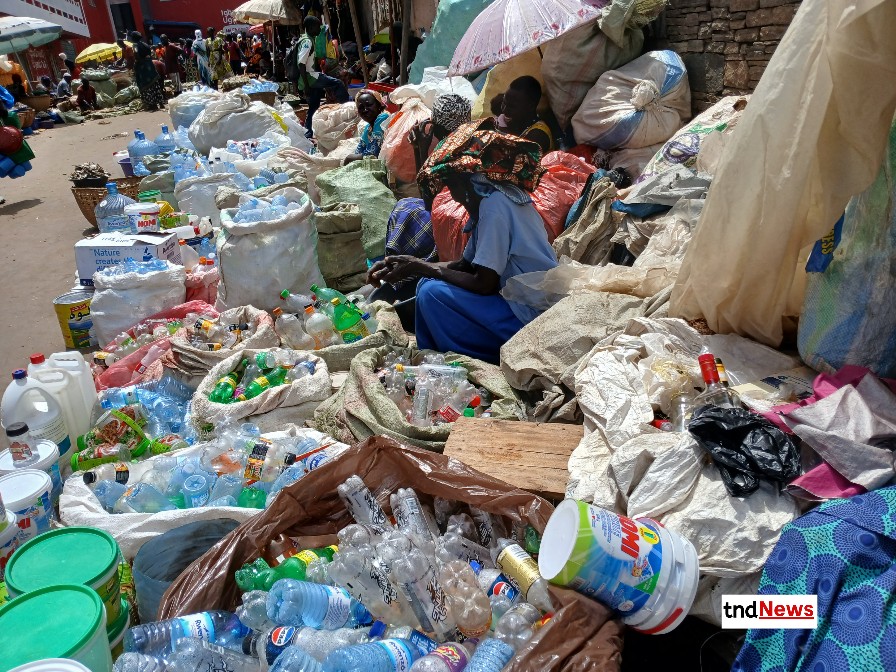
We asked Jamal Adriko to take us to the mother, and we were surprised to see so many more women doing business at Arua Main Market. Arua City Council has provided them with space to conduct their business.
Amin Driciru, Adriko’s mother, welcomed us and told us that the only hot cake business she and the kids can start is using plastic waste because of the ready market it has created.
According to Amina, the husband’s (Juruga Muhamad) whereabouts are unknown because there is no clear information about what he does, where he is, or if he is alive.
“I married my husband (Juruga Muhamad) at the age of 17 years, and we have only had two children since then; he left me with a two-month pregnancy of my second child, and the baby is now four years old; all of them are at home because I do not have money; we do not talk to him; I do not know if he is dead or not, but this is what we do for a living,” Driciru revealed.
Driciru, who has been in the plastic business for at least five years, says she earns at least Shs300,000 per month depending on how many plastic bottles she and her child Adriko can collect.
“The market is ready, I send my boy to collect in different gathering places and when he brings them I give him the money to go and relax with his friends, as I keep selling. He is now used to the business, if I send him back to school, who will help me? “At least what I earn here is better than working for someone else,” Adriciru added.
His mother sees this as a lucrative business because of the high volume of profits from Jamal Adriko’s increased collection of plastic waste, which is destroying this young boy’s future and causing him to drop out of school.
Jamal Adriko is one of 72% of Arua city’s students who are unable to complete the Primary Leaving Examination due to the burden of child labor and families’ inability to pay for their education.
According to Uganda’s Ministry of Water and Environment, plastic waste is wreaking havoc on urban and rural areas as a result of poor disposal practices; all store purchases are packaged in polythene bags, and without proper disposal, plastic garbage can be found everywhere, prompting children like Adriko to collect it.
Dr Barirega Akankwash, Executive Director of the National Environment Management Authority (NEMA), revealed that NEMA has launched a campaign to raise awareness about the dangers of single-use plastics and the importance of avoiding them.
According to research conducted by the World Climate School’s Uganda chapter, more than 75% of used plastic bottles end up in landfills, lakes, and rivers, causing significant harm to the environment and humans, particularly children like Adriko.
However, NEMA data show that plastics account for the majority of waste, with over 600 tonnes produced every day across the country. While 40% of this waste is collected and disposed of properly, the remaining 60% finds its way into the environment, causing a number of problems.
The International Labour Organization notes that UN member states have obligations to end child labour and ensure inclusive and equitable quality education for all (Sustainable Development Goal No. 4), which are inextricably linked.
This means that there is widespread agreement that the single most effective way to reduce the flow of school-aged children into child labor is to improve access to and quality of education, so that families can invest in their children’s education and reap greater returns than those associated with putting children to work.
In contrast, when the expected returns on education are low or education costs are prohibitively expensive, households are likely to view schooling as a less appealing or viable alternative to work for children like Adriko.
In the recently concluded Arua City Mock Examinations 2024, set by the Arua City Academic Board for Primary Seven Candidates, at least 4, 815 pupils out of a total of 7435 failed the examination, accounting for 64.8%.
According to the data provided in the result analysis document, only 2, 620 pupils passed, accounting for 35.2% of the total, with 269 excelling in division one, 1397 in division two, and 954 in division three, while the remainder failed in other grades.
Kalsum Fadimula, Secretary of the Arua City Council’s Social Services Committee (which investigates issues of education, health, and other community services), observes that the majority of these children who collect plastics are encouraged by their parents, who are unconcerned about their children’s education.

Kalsum reveals that Arua City’s primary school completion rate is currently at 28%, which is being driven by an increase in demand for plastic waste from recycling companies that have established purchase centers on every corner of town.
“Government must come in, we need to regulate this business, it is affecting us so much not only the education of the children even many people are reporting theft of their utensils, since these children go and pick these things from homes, even though we are fighting for the environmental conservation, it is a big insecurity in the city,” the secretary added.
According to the secretary, they have been working as a council with partners to encourage students to attend school, particularly girls, who are the largest customers of the plastic waste industry.
“We are supposed to enforce the labour laws, parents are supposed to ensure that their children are in class and those who are dealing in the business are not supposed to buy these things from children but this is the opposite and it is killing the future of our children,” Kalsum noted.
Child labor is defined by the Ugandan government as children aged 5-11 years who engage in any economic activity; children 12-13 years who do work other than light work for more than 14 hours per week; or children 14-17 years who engage in hazardous forms of labour or work for 43 hours or more per week.
Hunger for Education Ordinance.
Since 2023, the city council has enacted eight ordinances to help address child-related offenses, poverty, and drug and substance abuse, including the Arua City Education Bill, which prohibits parents from using their children as laborers during school hours.
Counsel Henry Odama, the Arua City Senior Legal Officer, explains that the ordinances are intended to address pressing community issues, including the fight for children’s rights.
Odama, on the other hand, stated that the ordinances have not been gazetted because of financial constraints.
“The City council has been fighting hard to address the legal loopholes through coming up with ordinances which eight of them are awaiting to be gazetted but they require Shs80,000,000 (Eighty Million Shillings) for their gazettment and thereafter they will be enforced other than that we a bound to face these challenges,” Odama stated.
The United Nations International Children’s Education Fund (UNICEF) stated in 2017 that the introduction of Universal Primary Education (UPE) in Uganda in 1997, followed by Universal Secondary Education (USE) in 2007, significantly improved access but did not improve educational quality. It goes on to say that between 1997 and 2014, the student population tripled, and an increasing number of children dropped out.
However, widespread teacher absenteeism and many teachers’ lack of qualifications spell disaster for students. Less than half of children are literate by the end of primary school. In secondary school, only 15% of students excel in biology, 43% in English, and 47% in mathematics.
Sub-Saharan Africa has the highest educational exclusion rates of any region. More than one-fifth of children aged 6 to 11 are not in school, followed by one-third of youth aged 12 to 14. According to UIS data, nearly 60% of youth between the ages of 15 and 17 do not attend school.
The Uganda National Child Labour Policy of 2006 requires the Ministry of Gender, Labour, and Social Development to establish the Child Labour Unit to coordinate all activities aimed at eliminating child labor in the country, with the Ministry providing office space, furniture, and staff to run the Unit.
The ILO/ACCEL Africa Project has provided the Ministry with equipment such as laptops, printers, and cameras to help with day-to-day operations, but the office lacks a budget and finances to support its activities, with staff available on temporary contracts facilitated by other projects, a strategy that has proven unsustainable.
The government has revealed that it is working on a strategy to provide a budget, facilitation, staff, and other requirements to make the unit fully operational and capable of conducting activities that will support the process of eliminating child labor in Uganda, but this has yet to bear fruit.
Though the plastic industry expects to double production by 2050, plastic production has increased from 2.3 million metric tons in 1950 to 448 million metric tons in 2015.
Almost all plastics, up to 99 percent, are made from fossil fuels such as oil, gas, and coal extracted from multinational petrochemical companies’ oil fields and fracking drilling pads.
Currently, the plastic sector consumes 6% of total oil production, with projections of up to 20% by 2050.
It is important to note that plastics are the new coal because their production and use are increasing, and children in poor countries like Uganda will continue to drop out of school in search of plastic waste money.
Currently, these emissions could total 1.34 gigatons per year, which is equivalent to the emissions produced by more than 295 new megawatt coal-fired power plants.
Corporations’ continued reliance on producing massive amounts of single-use plastic packaging not only results in massive amounts of carbon emissions, catalyzing the climate crisis, but also increases the number of children working for plastic waste money and abandoning school.
In 2020, the Coca-Cola Company produced 2,981,421 metric tons of plastic, equivalent to 14,907,105 metric tons of carbon emissions.
Actions being taken to end child labour
The Ugandan government launched the ILO Social Finance Model in November 2022 to support the National Action Plan’s implementation. The model will remain operational in Uganda until 2028.
The Social Finance Model is a comprehensive package of services designed and delivered with backstops in place to mitigate unintended social risks associated with financial services, such as child labor.
However, business models have been designed to mitigate social risks in product design by including operational structures, field agent training, incentive schemes, communication with farmers, digital solutions, and raising awareness about child labor among service providers, such as those in the financial sector.
Furthermore, child labor programs in Uganda have been guided by the child labor policy, but the policy has outlived its usefulness, necessitating a review; the current policy has been under review since 2022.
In March 2023, a multi-sectoral National Steering Committee on Child Labor reviewed and approved the revised Child Labor Policy of 2006. The approval process appears to be moving steadily forward.
Thus, the policy is based on the recognition that all humans, including children, have rights, and that children, due to their age and needs, are entitled to specific rights such as education, health, survival, development, protection, and participation.
The policy also recognizes that the impact of action against child labor will be driven by a multi-sectoral and comprehensive approach that creates opportunities for information gathering, knowledge sharing, and activity coordination, so actions will be taken at various levels in a phased manner.
The policy’s overall goal is to guide and promote long-term action aimed at gradually eliminating child labor, beginning with the worst forms, with specific goals of incorporating child labor concerns into national, district, and community programs, as well as plans to establish a legislative and institutional framework to initiate, coordinate, monitor, and evaluate child labor programs.
The World Day Against Child Labour was observed on June 12, 2024, by the International Labour Organization (ILO) and human rights advocates around the world.
Between 2000 and 2020, significant progress was made in the global effort to eliminate child labor, with the number of children engaged in child labor falling by 85.5 million, or from 16% to 9.6%. However, since 2020, conflicts and various crises, including the COVID-19 pandemic, have driven families into poverty and forced children into child labor.
According to recent ILO and UNICEF statistics, approximately 160 million children worldwide engage in child labor, accounting for roughly one out of every ten children. These statistics also show that Africa has the highest percentage (1 in 5) and the largest number of children (72 million) currently engaged in child labor.
Thus, it is critical to eradicate child labor in Uganda and around the world because it harms children’s physical and mental health, obstructs their access to education, and stifles their social and economic growth, perpetuating the cycle of poverty.
As a result, as with many other forms of human rights violations, girls are disproportionately affected because they bear the triple burden of school, work, and household chores, increasing their chances of falling behind in school and making them more vulnerable to academic exclusion and poverty.
Discover more from tndNews, Uganda
Subscribe to get the latest posts sent to your email.