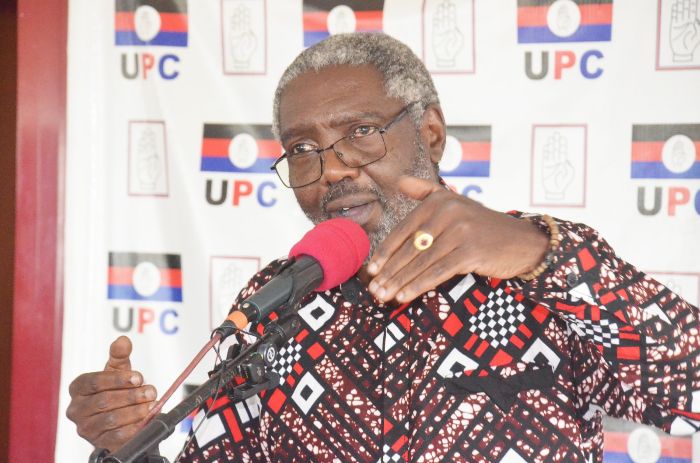
Addressing other party leaders and the press at Uganda House, Kampala, on Wednesday, Jimmy James Michael Akena Obote spoke about people, education and health issues affecting the country.
On education, he said this examination season should cause us to ask a much bigger question: what are we preparing the Ugandan child for, and what Uganda are we preparing that child to build?
“We (UPC) have been undertaking a detailed examination of our education system, just as we have been doing with health. That work is continuing, but the direction is becoming increasingly clear,” Akena, the UPC party president, said.
He added: “Our starting point is simple: Uganda’s greatest asset is its people. Our national development programme must therefore begin with developing the Ugandan citizen – healthy, educated, capable, skilled and productive.”
The investment begins before school, he said: “Education does not begin at P1.”
Akena cited the 2022 Uganda Demographic and Health Survey which found that approximately 26% of children under five were stunted.
Also read: UPC’s NC recognises Akena as party president
“Applied to the present population of young children, we are speaking about approximately 1.9 million children — or, as I have consistently described it, approximately two million Ugandan children.”
Behind that national figure are enormous regional differences, he said, adding, “Stunting was approximately 44% in Karamoja, 42% in Kigezi and 39% in Tooro.”
These differences, Akena notes, also tell us that the problem is not simply whether food exists. “Karamoja faces severe food-security challenges. But Kigezi and Tooro remind us that even productive agricultural areas can have very high levels of childhood malnutrition.”
Diet, dietary diversity, maternal nutrition, infant feeding, disease, sanitation and household practices all matter, he noted. “We therefore have to start with the mother during pregnancy.”

Collectively, he said we must monitor maternal nutrition, low birth weight and the first 1,000 days of life. “We must intensively monitor development through the first two years and continue meaningful monitoring through age five.”
By the time that child arrives at P1, considerable human development has already taken place — or has already been lost, noted the UPC leader.
Health, nutrition and education are therefore not separate missions, according to him. “They are parts of one mission: developing the human being.”
What is happening to public education?
UPC’s examination of education raises equally serious questions. In 2025, Uganda had approximately 11.8 million primary-school learners.
About 9.1 million, Akena said on Wednesday, were in public schools, compared with approximately 2.7 million in private schools.
Government therefore carries the overwhelming majority of children at primary level, he noted, yet as we move through the examination system, an important pattern emerges.
What are his facts?
At the 2025 PLE, he said 36.2% of candidates were non-UPE, at UCE, approximately 64.2% were non-USE.
At UACE, approximately 74.6% were outside UPOLET. “These are not the same cohort, and UPE, USE and UPOLET are financing classifications rather than exact measures of public and private ownership.
“We must therefore be careful not to draw conclusions the figures cannot support. But neither can we ignore the direction.
“The further we travel through the education system, the greater the proportion of candidates appearing outside the universal government programmes.”
Interested in supporting our journalism and work? We would love to hear from you or kindly DONATE HERE.
Discover more from tndNews, Uganda
Subscribe to get the latest posts sent to your email.