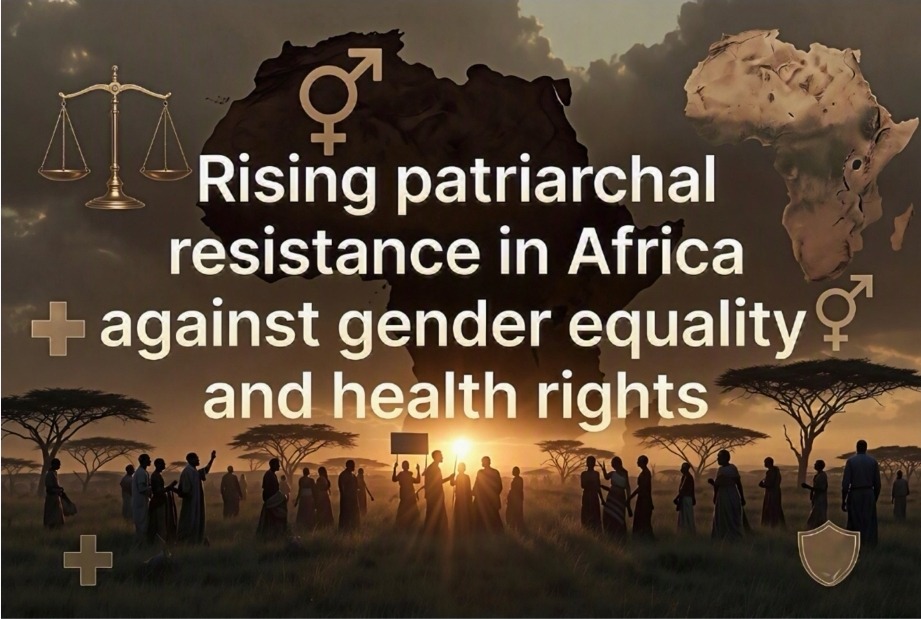
Only 54 months are left to deliver on the promise of gender equality (SDG-5) and health and well-being (SDG-3) by 2030. But the sense of urgency and purpose is acutely missing, and instead of going forward, in many instances, we are slipping backwards.
Growing anti-rights and anti-gender pushbacks are trying to reverse whatever progress has been made on gender and health rights, especially for girls and women and gender diverse communities.
The latest attack on gender rights came in the form of a draft ‘African Charter on Family, Sovereignty and Values’ that was endorsed by 20 African countries at the 4th African Inter-Parliamentary Conference on Family, Sovereignty and Values held in Ghana in early June 2026.
This controversial draft emphasises the so-called ‘African values’, ‘traditional family structures’ (marriage defined as between a man and a woman), ‘sovereignty’ against ‘foreign ideologies’, and calls for withdrawing from international agreements like the legally binding Maputo Protocol on women’s rights. It is intended for eventual consideration by the African Union in February 2027.
In the words of Dr Tlaleng Mofokeng, United Nations Special Rapporteur on the Human Right to Health, “This regressive draft Charter is the first African continent-wide patriarchal push to dislodge human rights and replace them with so-called ‘moralistic’ viewpoints.
More importantly, it urges African governments to withdraw from progressive, rights- and evidence-based agreements, including the historic and legally binding Maputo Protocol of 2003, which has played a defining role in promoting gender equality and protecting the reproductive and health rights of women and girls in Africa.
Such a regressive attempt will also wrongfully firewall families from accountability in situations such as violence, coercion or discrimination, making it impossible for vulnerable girls, women and gender diverse people to seek justice where needed.”
Dr Mofokeng was delivering her opening remarks at a SHE & Rights session hosted by the Global Centre for Health Diplomacy and Inclusion (CeHDI), International Planned Parenthood Federation (IPPF), Asian-Pacific Resource and Research Centre for Women (ARROW), Asia Pacific Media Alliance for Health, Gender and Development Justice (APCAT Media) and CNS.
UN Special Rapporteur on the Right to Health, Dr Mofokeng, urged governments to disengage from this draft Charter and instead honour and deliver on the promises they have made regarding gender equality and the right to health, where no one is left behind.
An analysis of this draft Charter done by ISLA (Initiative for Strategic Litigation in Africa) shows that the draft Charter is not merely conservative, but it constitutes a restructuring of rights through legal distortion. Sovereignty is used to resist accountability, and family protection is used to justify exclusion.
Culture is invoked to limit equality protections, and human rights are reframed as a ‘foreign ideology.’ A family is defined as a marriage through the lens of a marriage between a man and a woman. There is a shift from rights-based governance to ‘values’-based regulation.
Distorted definition of family
The draft Charter defines family through the lens of a marriage between a man and a woman. “This directly conflicts with established international and regional human rights laws and jurisprudence. The draft Charter frames the family as a primary unit for policy design, governance and service delivery.
“It prioritises family welfare, family cohesion and family authority above individual consideration. This becomes especially dangerous when families themselves are sites of violence, coercion, discrimination or unequal power relations.
The draft Charter provides no safeguards to ensure that prioritising family cohesion cannot override women’s rights, children’s rights, bodily autonomy, or protection from abuse,” said Sibongile Ndashe, Executive Director, Initiative for Strategic Litigation in Africa (ISLA).
Sovereignty versus the individual
Sibongile Ndashe rightly points out that the draft Charter expands sovereignty to justify extensive government control over morality, health, education, sexuality and family life.
Agrees Famia Nkansa, Communications Lead, at Purposeful – a feminist hub rooted in Sierra Leone. “According to the draft Charter, the woman is not the primary political actor. She is not even a survivor. The family and the government run everything.
“And particularly in the African continent where the family is very rarely a site of safety or a sight of protection or a site of nurturing and growth, but oftentimes for women it is a site of violence, and a sight of shame.”
For Nkansa, the draft Charter wants to reframe human rights protections as ‘foreign impositions’ rather than African aspirations. It is an attempt to substitute a frame from autonomy, equality, dignity, and bodily integrity to ‘sovereignty’, ‘parental authority’, ‘tradition’, and ‘cultural preservation.’
Is the draft Charter a wolf in sheep’s clothing?
Letlhogonolo Mokgoroane, South African legal practitioner, calls it a draft Charter in sheep’s clothing, as it “…uses rights language to strip rights. It speaks of ‘protecting the family’ while removing protections from families that do not conform to its narrow definition. It speaks of African values while promoting values that were designed in Arizona and incubated in Washington DC.”
Mokgoroane, who is a non-binary person, is distraught because “the draft charter defines gender as limited to male and female, erasing the existence of intersex and gender diverse persons. It defines family exclusively through heterosexual marriage and biological parenthood, excluding same-sex families, single-parent families, gender diverse parents or gender diverse children. In the ‘world’ of the draft Charter, these people do not exist, and when the law says you do not exist, the consequences are not abstract.”
“The draft Charter also rejects comprehensive sexuality education – the very education that evidence has shown leads to better sexual and reproductive health outcomes, lower rates of HIV transmission, lower rates of unintended pregnancies, and lower rates of gender-based violence.
“The draft Charter replaces evidence with ideology. It replaces public health with moralism and invokes sovereignty as a basis for non-compliance with international human rights obligations.”
Mokgoroane contends that the African Inter-Parliamentary Conferences on Family, Sovereignty and Values that have developed this draft charter are supported, funded and shaped by US-based conservative organisations, like Family Watch International, which is an anti-LGBTI organisation that has been channelling resources into Africa to change laws and shift policies.
Not surprisingly, “This is legislative capture dressed as deliberation. The draft Charter was incubated in conferences funded by US-based organisations whose presence has no mandate for many African people. It has deployed the language of African authenticity while importing an agenda that serves American conservative Christianity.
“It speaks of protecting the African family while removing protections from families that do not conform to its narrow definition. It speaks of African values, but its ideologies originate in an American evangelist movement.”
Global repercussions
Dr Pam Rajput, former Chairperson of the Government of India’s High-Level Committee on the Status of Women, warns that this anti-rights pushback is not only regressive but also contagious. It is not an issue for Africa alone.
“The question is what it means for the future of women’s rights everywhere. Rollback of rights in one region can become a precedent elsewhere.”
How do we counter the anti-rights pushes and advance gender equality and the right to health?
Human rights and gender justice activists unanimously call for fighting tooth and nail to defeat the draft Charter and to uphold the Maputo Protocol of 2003, which is a legally binding human rights treaty that commits to ending gender-based discrimination across Africa and was ratified by 46 of the 55 African Union member countries.
It is one of the most widely accepted and most progressive human rights instruments on the African continent. It prohibits discrimination against women and gender diverse people; guarantees rights to health, including sexual and reproductive health; guarantees the right to dignity, and protection from all forms of violence; and calls for the elimination of harmful practices, including female genital mutilation and forced marriages.
Nkansa argues that “Maputo Protocol is significant not only because of its legal protections, but because it demonstrates that gender equality and women’s rights are not external concepts that were imposed on Africa, but they are principles that African governments themselves negotiated and adopted. African women activists, policymakers, legal experts, and governments played a central role in shaping the Protocol.”
For Mokgoroane, “We must insist with every tool available to us – legal, political, moral – that gender equality and the right to health are not negotiable and not reversible. They are constitutional. They are human rights, and they are ours.”
Rajput calls for adding all global voices in favour of the Maputo Protocol and against the proposed draft African Charter. “We must resist collectively, and the feminist solidarity must be global. Human dignity and human rights are not divisible by geography. They cannot be selectively applied or culturally withdrawn at the will of some people. We need to challenge anti-rights narratives and build cross-regional alliances to reaffirm the universality of rights.”
Writer Shobha Shukla is a feminist, health and development justice advocate, and an award-winning founding Managing Editor and Executive Director of Citizen News Service. She serves as Chairperson of Global AMR Media Alliance (GAMA), Host and Coordinator of SHE & Rights (Sexual Health with Equity & Rights), among other roles.
Discover more from tndNews, Uganda
Subscribe to get the latest posts sent to your email.