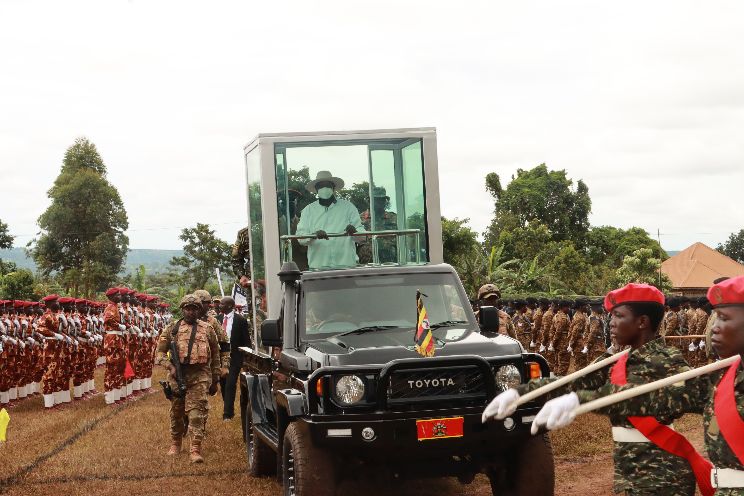
President Yoweri Kaguta Museveni on May 1 presided over celebrations to mark International Labour Day at Nkoyoyo Boarding Primary School Grounds in Matale, Buikwe district.
The event was held under the theme “Safeguarding Uganda’s Progress: Empowering the Workforce and Promoting a Decent Workforce for Competitive Enterprises.”
Museveni commended Ugandans for marking the day and advised them to continue working hard to eliminate poverty by taking full advantage of the four-acre model and prioritising investment.
“The problem is not jobs. The problem is people sleeping,” he said.
He noted that Uganda still has many investment opportunities, most especially in agriculture, fishing, and the proper use of wetlands.
Museveni advised the public to become beneficiaries of the Parish Development Model (PDM) funds and to avoid borrowing from commercial banks that charge high interest rates, urging them instead to borrow from the Uganda Development Bank, which offers lower rates. He wondered why people borrow at such exorbitant interest rates.
“PDM will soon phase out money lenders and commercial banks,” he said. He promised to inject more money into PDM to the tune of shs200 million per parish and cautioned village chiefs to ensure that everyone is involved since the money is a revolving fund.
He added that proper planning is required before one engages in any income-generating activity.
On the issue of accommodation for workers in industrial parks to improve their safety, given that most leave work late, the President promised to make it a policy that every industrial park be allocated nearby land for housing.
“We shall get investors to build low-cost houses nearby on land provided by the government,” he stressed, further advising the National Housing Corporation to become the lead agency to that effect.
On students pursuing courses that are not in tandem with available jobs, the President directed the Ministry of Education to issue guidelines on what to study. “Carefully select courses,” he advised.
On the mushrooming factories across the country, the President explained that this is a result of existing peace and security, an improved road network and electricity. “Once power and transport are fine, then jobs will be created,” he observed.
Museveni advised fishing communities to practise good fishing methods to ensure continuity, urging them to stop overloading water bodies.
“We should all know that water bodies should not be overwhelmed by numbers,” he warned, adding that wetlands should be used appropriately.
He further implored communities to establish fishponds alongside wetlands, so that they can access water for irrigation and fish for both food and income.
He illustrated this by citing the example of the Limoto wetland. He said fish farming would be a priority for the government in 2027.
“I want both wetlands and upland areas to maximally benefit communities,” he noted, promising a campaign against wetland degradation.
He concluded by advising organisations with substantial funds, such as NSSF, to invest in building toll roads where they can collect fees from road users, rather than investing in shares or bonds which yield smaller returns.
“You should invest that NSSF money in toll roads, although the government will continue building roads,” he promised.
Minister of State for Gender, Labour and Social Development, Betty Amongi Ongom, commended the existing macro and micro economic policies, saying they have created jobs in Uganda.
She noted that labour remains Uganda’s biggest factor of production. “Without labour there is no progress,” she emphasised.
She said skilling centres, the Occupational Safety Act, Presidential hubs, the NSSF Amendment Act, apprenticeship programmes and the externalisation of labour have raised opportunities for improving workers’ welfare and strategies that enhance workforce productivity and competitiveness.
Amongi noted that requiring shs100 million as a mandatory capital base for any company before it engages in labour export has helped curb problems associated with labour externalisation.
She called for dialogue between workers and employers to curb the casualisation of labour, and decried the high interest rates charged by commercial banks.
Diana Mutasingwa, Woman MP for Buikwe, praised the President for the existing government welfare programmes in the district and requested the building of a vocational school in Kitaka to create more skilling opportunities.
The Master of Ceremonies, representing the Chancellery and Chief of Formal Education, Sports and Culture, Brig Gen Richard Karemire, on behalf of the President, awarded 50 medals — 11 of which went to women — to security officers and civilians in recognition of their outstanding contribution to the growth and safety of Uganda.
Brig Gen Paul Namawa and Brig Gen Ernest Nuwagaba were among the medalists.
Discover more from tndNews, Uganda
Subscribe to get the latest posts sent to your email.