I was the first scientist to use dendrochronology in East and Central Africa and most likely in Africa South of the Sahara, 44 years ago. I call on Uganda to revive this simple, powerful tool for understanding vegetation change.
Dendrochronogy is the scientific method of dating tree rings (growth rings) to the exact year they were formed. Often called tree-ring dating, the technique analyses patterns in tree rings todayrold wood, archaeological artifacts and study past climates (Dendroclimatology).
In 1982, I completed my Master’s thesis at the University of Nairobi. The title was Vegetation Changes in Tsavo National Park (East), Kenya. Under the guidance of Professor K.H. Seppala (of Finland), I had learned a technique called dendrochronology – the science of dating tree rings.
I applied it to study how woody vegetation in Tsavo National Park (East), Kenya had changed over time, especially under the pressure of elephants and fire.
That thesis was the first time dendrochronology had been used in East or Central Africa, and most likely in Africa South of the Sahara. It showed that tree rings in savannah species could record environmental and ecological history – droughts, fire intervals, and even animal impacts.
For years, I thought my work had disappeared. My personal copy of my thesis was burned in an arson attack on my father’s house in 1985, along with many of my books. Only recently, with the help of digital archives, I rediscovered that my thesis still exists at the University of Nairobi.
More importantly, I found that a few researchers had cited it – not to use the method themselves, but to acknowledge my observations.
That silence tells me something important: dendrochronology remains almost unused in East African savannahs, and completely unused in Uganda. This is a missed opportunity.
Every year, a tree in a seasonal climate adds a new growth ring. In wet years, the ring is wide; in dry years, it is narrow. By taking a small core from a living tree (or a slice from dead wood), we can count backwards in time – like reading a history book written in wood.
In temperate forests, dendrochronology is routine. In tropical savannahs, it has been considered difficult because rings are less distinct. But my 1982 work proved that several woody species in Tsavo do produce visible annual rings.
With careful preparation, they can tell us: when a severe drought killed trees or slowed growth; how often fire burned through an area; whether elephant browsing and debarking caused long-term damage; and how vegetation recovered after changes in park management.
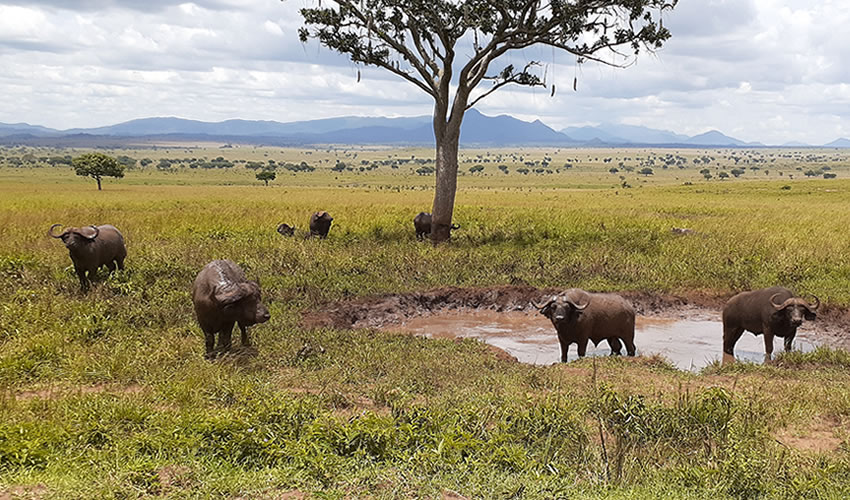
For Uganda, with its magnificent savannah parks – Queen Elizabeth, Murchison Falls, Kidepo Valley – no such tree-ring history exists. Yet these parks face serious challenges: expanding human populations, changing fire regimes, recovering elephant populations, and climate shifts. Without a long-term perspective, managers are flying blind.
Imagine a simple research project. A Ugandan graduate student collects small cores from five common tree species in Queen Elizabeth National Park – for example, Acacia sieberiana, Terminalia glaucescens, or Combretum species.
Back in the laboratory, the cores are mounted, sanded, and examined under a microscope. Within weeks, that student could answer: How old are the largest trees in the park? Was there a region-wide drought in the 1970s or 1990s that killed many trees? Do fire frequencies match management records, or are there hidden fires?
Have elephants selectively damaged certain size classes of trees over time? This is not expensive science. A simple increment borer costs a few hundred dollars. A good stereomicroscope is available in any biology department. The expertise exists – and I am willing to share what I learned 44 years ago.
Why has this method been ignored? There are three reasons, and each can be overcome. First, the myth of difficulty: many ecologists believe tropical trees do not form annual rings.
My Tsavo work, and more recent studies in Zimbabwe and South Africa, show that many savannah species do form rings, especially where there is a distinct dry season. Second, lack of training: no one after me taught dendrochronology in East Africa.
Professor Seppala’s short course at Kabete Campus was never repeated. But today, online resources and low-cost workshops can fill that gap. Third, academic silos: foresters use dendrochronology; wildlife ecologists often do not.
In Uganda, the Faculty of Forestry and the wildlife authorities rarely collaborate on vegetation history. This must change.
To the Ministry of Water and Environment and the Uganda Wildlife Authority: you manage millions of hectares of savannah. You have management plans that talk about “vegetation trends” without data older than a decade. I urge you to include dendrochronology as a standard tool in ecological monitoring. It is cheap, repeatable, and gives century-scale answers.
To academics at Makerere University, Gulu University, and Mbarara University of Science and Technology: let this article be a rediscovery. Assign a Master’s student to take the first cores from Kidepo or Queen Elizabeth.
Cite my 1982 work not as history, but as a starting point. You will be the first in Uganda to use this technique – just as I was the first in East Africa.
To conservation NGOs such as WWF, IUCN, and The Nature Conservancy: support a small grant for dendrochronology equipment and a regional workshop.
The investment is tiny compared to satellite imagery, yet it answers questions that satellites cannot: How fast did trees grow during the 1983 drought? Did fire exclude trees from a grassland for fifty years?
For those who wish to follow up, here are the studies that cited my 1982 thesis. They provide a useful entry point into the literature on Tsavo and East African savannah ecology. Note that none of them actually used dendrochronology – which is precisely why a new effort is needed.
By Oweyegha-Afunaduula | Conservation Biologist, Center for Critical thinking and Alternative Analysis.
Discover more from tndNews, Uganda
Subscribe to get the latest posts sent to your email.