Gulu, Uganda | The war on corruption in Uganda has taken a new turn not through arrests or political purges but through computers, automation and digital receipts.
In a country where billions of shillings are lost annually to leakages in local revenue systems, the Ministry of Finance, Planning and Economic Development (MoFPED) is calling on local governments to fight corruption not with words but with technology.
Speaking at the Local Government Regional Consultative Workshop for Northern Uganda held in Gulu City recently, the Finance Minister Matia Kasaija urged district and city leaders to fully embrace digitization and automation in managing public funds.
“Local governments must improve their efficiency in fighting corruption; we are moving towards a future where manual handling of revenue will be phased out completely,” read Kasaija’s keynote speech, presented by Paul Patrick Mwanja, the Principal Economist in the ministry.

Uganda’s economy continues to expand but so does its debt burden. According to the Finance Ministry, preliminary domestic revenue was projected to have raised slightly to shs29.96 trillion in FY2024/2025 up from shs29.67 trillion this financial year.
However, the cost of servicing the national debt is swallowing a growing share of the budget with the total resource envelope for FY2024/2025 stood at shs52.7 trillion but the resources available for allocation had dropped sharply from shs25.2 trillion in 2023/24 to shs21.7 trillion.
According to officials, the decline leaves limited room for discretionary spending and corruption especially in local governments which only worsens the squeeze.
“Every shilling lost to corruption is a service denied to the people and if we digitize revenue collection, we eliminate the temptation of human interference in money handling; hence the money will go automatically into the system,” Mwanja said.
Digitising governance: From manual books to mobile apps
Uganda’s shift towards digital governance is already visible in several sectors; the Integrated Revenue Administration System (IRAS)-and online and mobile platform developed by the Local Government Finance Commission (LGFC) allows municipalities and districts to register taxpayers, bill clients and receive payments electronically.
IRAS, which has been rolled out in over 120 local governments, was expected to be adopted by all districts and cities in the 2024/25 financial year.
“This marks the end of manual collection of local revenues. Local governments should make adequate preparations as they begin the budgeting and planning process for FY2024/25,” Kasaija said last year.
The system is designed to plug the loopholes that have long enabled corruption from market dues that vanish before reaching the treasury to property rates that are never officially receipted.
“Digitisation means there is no middleman between the taxpayer and the government; no cash is handled by revenue officers, everything is paid through mobile money or banks. That alone cuts off a major source of corruption,” explained Mwanja.
In Gulu City, Lira and Arua, local leaders say they welcome the digital shift but they also warn that the transition will not be seamless.
Speaking on anonymity, a city revenue officer noted: “It is a good idea but the technology cannot fight corruption alone. You can automate the system but you still have human beings to manage it; if those people are not accountable, the system will still be manipulated.”
She further revealed that IRAS has improved transparency in tracking collections, delays in remittance. However, delays in remittance from the central government continue to affect service delivery- a concern echoed by many city mayors across the north.
Francis Ocaka, the Deputy Mayor of Kitgum Municipality noted that taxpayers are expecting services immediately but even when the money is collected digitally, it goes to the central system before being sent back to the local governments.
“By the time it returns, garbage is piling up and roads are impassable,” he added. Ocaka believes that while digital tools are important, fiscal decentralization must accompany digitization for it to work effectively.
“We need both technology and autonomy; otherwise, we are just watching our money move on screens,” Ocaka noted.
Corruption’s local anatomy
Corruption at the local level in Uganda often takes subtle but devastating forms like under declaration of collections, forged receipts, ghost projects and kickbacks in procurement.
According to a 2023 report by the Inspectorate of Government, local governments account for nearly 40% of all corruption complaints received annually and the most common cases involve embezzlement of locally generated revenue and mismanagement of service delivery funds.
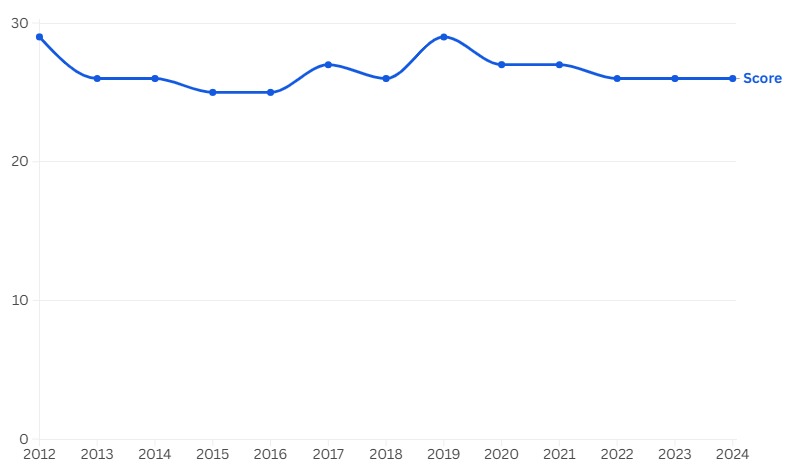
Uganda’s corruption changes over time
 Robert Roy Apegu, Senior Financial Analyst at the Local Government Finance Commission (LGFC) revealed that local governments currently collect about shs256 billion in local revenue annually-far below their potential and with full automation, he projects that figure could rise to shs1 trillion by FY2025/26.
“The biggest leakages are not in Kampala; they are in towns and sub counties. When you automate revenue, you make corruption harder because every coin can be traced,” Apegu said.
“We are not just automating to fight corruption; we are automating to grow local economies but the first step is transparency,” he added.
Beyond automation, the Ministry of Finance emphasizes data-driven governance ensuring that every local government maintains a complete database of taxpayers, property owners and businesses.
This is not optional because Article 196 (a) of Uganda’s 1995 Constitution and Section 80 (1) of the Local Governments Act (CAP 243) mandate local governments to compile comprehensive data on all collectable revenue sources.
“You cannot plan or account for what you do not know. When we know who is supposed to pay, how much, and when, we can track compliance, detect fraud and plan service delivery more effectively,” Apegu explained.
He, however, warned that without active monitoring, automation becomes an empty shell and urged all local governments to appoint IRAS contact officers to coordinate system activities and ensure data accuracy.
On the other hand, among citizens, reactions to revenue digitisation are mixed with some seeing it as a positive step toward transparency while others fear it might become another bureaucratic burden.
Harriet Akullo, a vendor in Gulu main market revealed that if she can pay her market dues by phone, it is better since there is no bribes, no wasting time but sometimes the network is poor or the officers do not update her payments; with some still harassing them.
Additionally, Ronald Opige, a boda boda rider noted that it is not about the technology but it is more about trust in the system.
“We have seen so many systems come and go; they say money will be safe but services never improve, unless we see real change – better roads, clean markets-it is hard to believe,” Opige said.
These sentiments reveal a crucial truth and digital governance cannot succeed without citizen confidence; thus, transparency must translate into visible improvements in public services or digital reforms risk being dismissed as another government gimmick.
Technology is necessary but not sufficient
Economists and governance experts caution that while automation is a powerful anti-corruption tool, it must be accompanied by broader institutional reforms.
Walter Atiko, a senior economist in an interview suggests that a multi-pronged approach-combining automation with civic oversight, audit reforms, and performance-based budgeting is the way to go.
“Fighting corruption is not just about improving cash from hands; it is about changing behavior and expectations. Technology can seal loopholes but it cannot fix weak institutions,” Atiko explained.
“Without accountability mechanisms, even digital systems can be abused through data manipulation, delayed remittances or selective access,” he added.
According to the World Bank’s 2023 Uganda Economic Update, corruption costs Uganda between 2% and 4% of its GDP annually –equivalent to over UGX 4 trillion and most of these losses occur in public procurement, local service delivery and tax administration.
Digital systems like IRAS, IFMS (Integrated Financial Management System), and eCitie are designed to plug these fiscal holes but their success depends on consistent implementation, technical support and local buy-in.
“Digitisation will reduce leakages but local governments must invest in training and you cannot automate integrity- you must build it,” Mwanja noted.
He further emphasized that the Finance Ministry’s long-term goal is to create a fully automated revenue ecosystem where all payments- from property taxes to market dues are traceable, auditable and directly linked to service delivery.
At the heart of Uganda’s digital reform agenda lies a bigger vision-domestic revenue mobilisation and the government’s Domestic Revenue Mobilisation Strategy (DRMS) aims to raise the national tax – to- GDP ratio from 13.5% to 18% by 2026.
Therefore, local governments play a crucial role in this goal as they are responsible for collecting fees, taxes and licenses that directly fund community services.
“When people see that their taxes build roads and schools, they pay willingly and that is how you fight corruption, not just by catching thieves but by making honesty more rewarding than theft,” Apegu further explained.
To that end, the Finance Ministry is urging local leaders to link revenue collection to visible service delivery with each shilling collected, should produce a tangible result whether in garbage management, road maintenance or health services.
Challenges ahead
Despite the optimism, several challenges threaten the success of digital anti-corruption reforms with many local governments facing inadequate ICT infrastructure, unreliable internet connectivity and limited technical expertise.
“In some rural districts, even accessing electricity for computers is a struggle, we cannot talk about full automation when the basics are missing,” the revenue officer cited.
In addition, as financial transactions move online, so do risks of hacking and data breaches; with the National Information Technology Authority (NITA-U) tasked with ensuring data protection; experts warn that local level systems remain vulnerable.
“We are moving money electronically but we must also move security digitally; otherwise, corruption will just evolve into cyber-fraud,” Atiko warned.
However experts’ notes that the fight against corruption will not be won in courtrooms, rather it will be won in systems that make it impossible to steal, delay or mismanage public money.
In Northern Uganda, where communities have long endured underfunded services and unfulfilled promises, the hope is that digital transformation will finally turn the tide from corruption to accountability and from paperwork to progress.
Discover more from tndNews, Uganda
Subscribe to get the latest posts sent to your email.