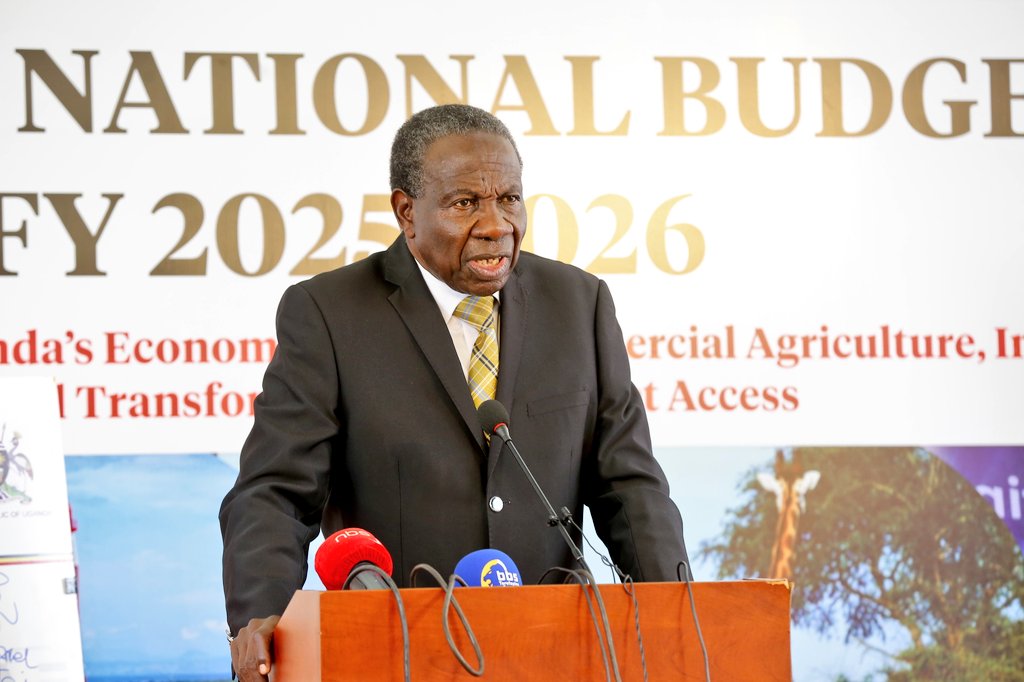
Uganda’s economy has maintained steady growth with stable inflation, according to the Performance of the Economy Report for September 2025 presented by the Minister of Finance, Planning, and Economic Development, Matia Kasaija.
The report indicates that the country’s Gross Domestic Product (GDP) grew by 6.3 per cent in the financial year 2024/25, up from 6.1 per cent in 2023/24, driven by increased aggregate demand, investment, and exports.
Minister Kasaija attributed the growth to strong performance in the agriculture, industry, and services sectors, supported by government programs such as the Parish Development Model (PDM) and Emyooga, favourable weather conditions, and a stable macroeconomic environment that boosted production and private sector productivity.
Uganda’s economy expanded to shs227.9 trillion in nominal terms, up from shs203.7 trillion the previous year. The services sector remained the largest contributor with 42.1 per cent of total output, followed by agriculture at 26.1 per cent and industry at 24.3 per cent.
High-frequency indicators also reflected improvement in business activity, with the Purchasing Managers’ Index (PMI) at 54.0, signalling private sector growth, and the Business Tendency Index (BTI) at 59.2, showing increased investor confidence.
On price stability, annual headline inflation rose slightly to 4.0 per cent in September from 3.8 per cent in August, mainly due to higher food prices. Core inflation stood at 4.0 per cent, while inflation for energy, fuel, and utilities fell to- -0.1 per cent, reflecting reduced fuel and charcoal costs. Inflation remained within the Bank of Uganda’s 5 per cent target.
The Ugandan shilling appreciated by 1.8 per cent against the US dollar, trading at shs3,507.79 per USD in September, up from shs3,573.13 in August. The appreciation was supported by foreign inflows from coffee and mineral exports, offshore investor activity, and strong remittances from the diaspora.
The Central Bank Rate (CBR) remained at 9.75 per cent, while lending rates eased, with shilling-denominated loans averaging 18.46 per cent, down from 19.65 per cent in July.
Private sector credit grew by 1.1 per cent to shs 24.05 trillion, reflecting higher borrowing in transport, communication, and services. The government raised shs 1.96 trillion through Treasury Bills and Bonds in September, with half used to finance the budget and half to refinance maturing debt. Treasury Bill yields slightly declined, and all auctions were oversubscribed, showing strong investor confidence.
In external trade, Uganda’s merchandise trade deficit widened to USD 336.16 million in August 2025, up from USD 197.64 million a year earlier, due to faster import growth. Export earnings fell by 15.4 per cent to USD 1.06 billion, mainly from lower receipts in coffee, cocoa, tea, flowers, and base metals.
Coffee export earnings dropped by 18.9 per cent to USD 202.75 million, while imports rose by 7.9 per cent to USD 1.39 billion, mainly from petroleum products and machinery. The Middle East remains Uganda’s largest export destination at 41.6 per cent, followed by the East African Community (23.5 per cent) and the European Union (13.9 per cent).
Fiscal operations showed a budget deficit of shs 968.52 billion, exceeding the programmed shs 569.95 billion as expenditure outpaced revenue. Total collections and grants amounted to shs 2.62 trillion against a target of shs 2.98 trillion, resulting in a shortfall of shs 361.7 billion. Tax revenues contributed shs 2.37 trillion, while non-tax revenues stood at shs 150.68 billion.
Government spending totalled shs 3.12 trillion, slightly above target due to increased first-quarter activities.
Across the region, inflation among East African Community (EAC) states remained stable. Uganda and Kenya recorded modest increases to 4.0 and 4.6 per cent, while Rwanda’s inflation eased to 6.2 per cent and Tanzania’s remained at 3.4 per cent.
The Ugandan and Tanzanian shillings appreciated, while the Rwandan and Burundian francs weakened. Uganda’s trade deficit with EAC partners widened to USD 156.71 million, mainly due to reduced exports to Kenya caused by non-tariff barriers.
Minister Kasaija noted that Uganda’s economic outlook for FY2025/26 remains positive, driven by strong domestic demand, private investment, and steady export performance. He said that stable inflation, a firm exchange rate, and ongoing infrastructure projects will reinforce growth.
The report concludes that Uganda’s macroeconomic fundamentals remain sound, with priorities focused on sustaining inclusive recovery, supporting the private sector, and maintaining fiscal and monetary stability.
Discover more from tndNews, Uganda
Subscribe to get the latest posts sent to your email.