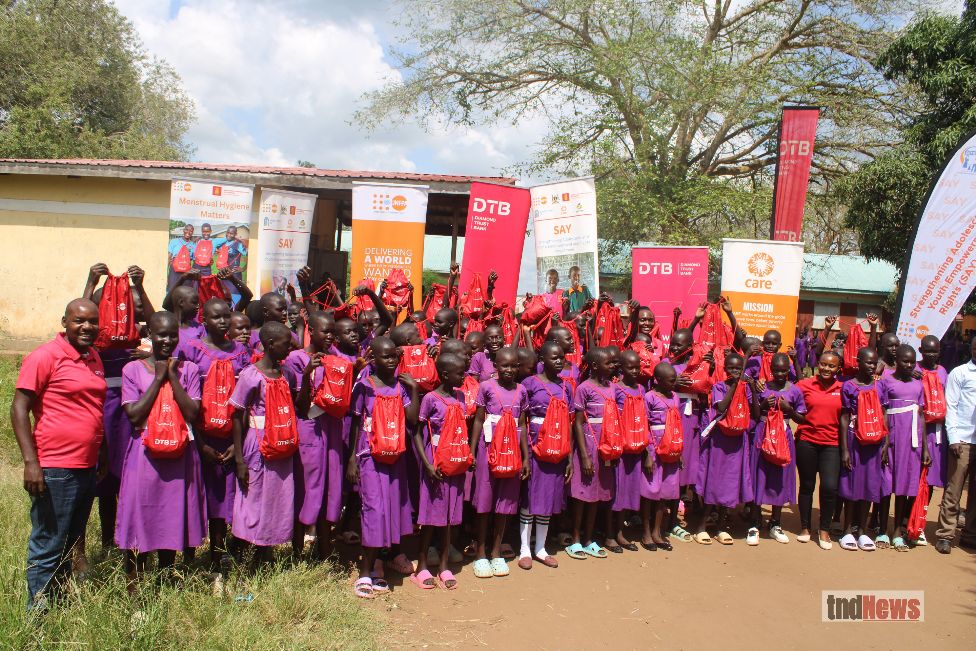
More than 200 schoolgirls in Adjumani district have received reusable sanitary pads to help them manage their menstrual cycles without missing classes.
The support, delivered to learners at Mungula Secondary School and Mungula Primary School, was provided under the Strengthening Adolescent and Youth (SAY) programme of the United Nations Population Fund (UNFPA) in partnership with Diamond Trust Bank (DTB).
Robert Dima, the Adjumani District Education Officer, said the initiative is addressing challenges that have long undermined girls’ education in the area.
“The teenage pregnancy rate in the district stands at 15.7 percent, including girls who are out of school, while 14.3 percent is among those still in school.
This year we have managed to re-enroll 158 child mothers, with 78 returning to primary schools and 117 to secondary schools. This is a significant improvement compared to previous years,” Dima said.
For the girls, the intervention has brought both relief and hope. Aber Gladys, a student at Mungula Secondary School, said lack of sanitary pads and changing facilities previously forced many of them to miss classes.
“Through the SAY programme, we have been trained on how to make reusable pads. This has helped me stay in school, and I can even share some pads with members of the community,” she said.
Her schoolmate, Mary Aciek Ayuen, said she has also gained confidence in managing her menstrual health. “Now I can track my cycle better and concentrate in class. I have also learnt to make reusable pads locally, which is very helpful,” she added.
Justine Edema Thomas, the head teacher of Mungula Secondary School, said the support comes at a critical time for rural schools serving vulnerable learners.
“We have 716 students here, the majority of them girls from needy host and refugee communities. Access to sanitary pads is essential to keep them in school and focused on learning,” he said.
According to Kristine Blockhus, UNFPA’s Representative in Uganda, menstrual health remains a major barrier to girls’ education across the country.
“For many adolescent girls, lack of sanitary products, private facilities, and accurate information results in missed classes, embarrassment, and in some cases dropping out of school altogether. These barriers limit their education and their ability to thrive within their communities,” she said.
The SAY programme is a multi-year initiative supported by the Royal Danish Embassy, targeting refugee-hosting and underserved regions of Uganda.
Maja Hansen, UNFPA Kampala and SAY programme coordinator, said it also aims to improve sexual and reproductive health, address gender-based violence, and empower adolescents.
DTB Head of Sustainability, Cassius Musasira, said supporting menstrual health is an investment in both education and equality.
“At DTB, we believe menstrual health is a fundamental right. By keeping girls in school, we are not only securing their future but also building stronger communities,” he said.
In 2024, UNFPA and DTB distributed 303 reusable sanitary kits to adolescent girls in schools and community structures across Moyo, Obongi and Lamwo districts.