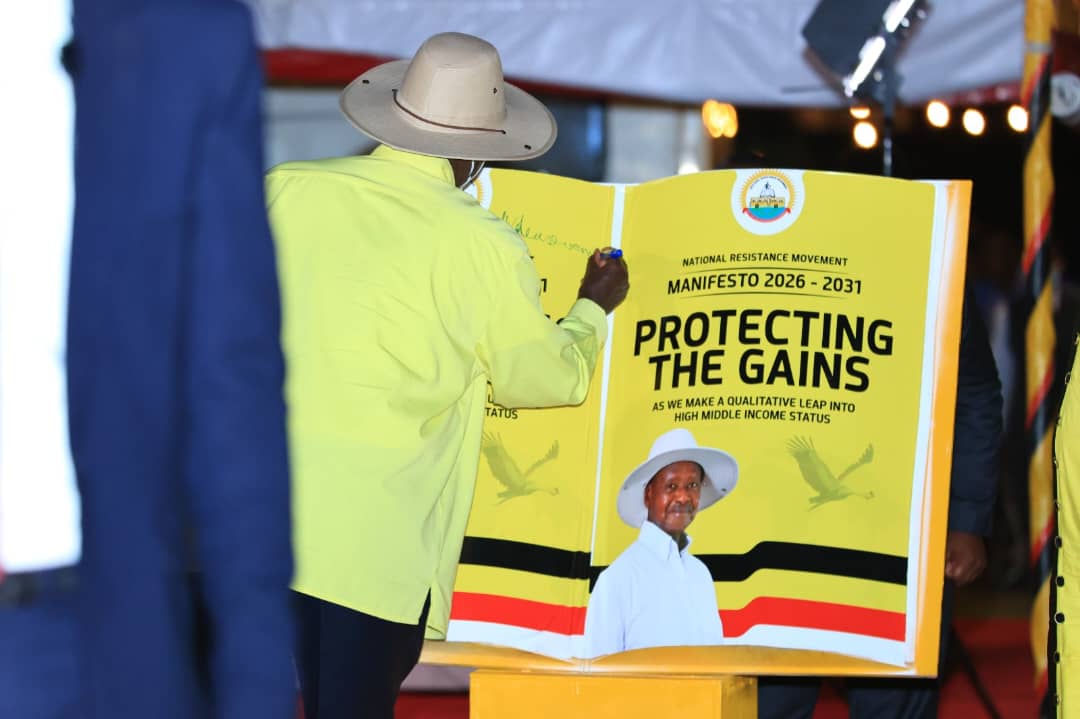
President Yoweri Museveni, the NRM presidential candidate on Monday, officially unveiled his party’s manifesto for the next five years.
The launch was held at Speke Resort Munyonyo, where thousands of NRM supporters and officials witnessed Museveni stress the importance of safeguarding what he described as “the gains” achieved over the past years under the ruling party.
Highlighting five key priorities in the 2026–2031 manifesto, Museveni began with peace and security, which he said, form the foundation for Uganda’s development. He noted that peace has been maintained by both the people and the UPDF, warning that anyone attempting to wage war against Uganda would regret it.
While he praised the army’s strength, Museveni acknowledged that crime remains a persistent challenge.
Museveni, 81, pointed to achievements in social infrastructure, including schools and health centres, as well as economic projects such as roads and railways, as evidence of the country’s stability. However, he emphasised that development without wealth is meaningless.
The president urged NRM leaders to prioritise household wealth creation, encouraging them to involve citizens in productive work, as he and his fellow student activists had done in the cattle corridor during the 1960s. He highlighted that wealth creation would generate employment and reduce unemployment.
As an example, he cited Transport State Minister Fred Byamukama, who earns shs700 million from egg production and employs 26 people, stressing that private wealth can create more jobs than public service.
Museveni dismissed labour migration to the Middle East as unnecessary, noting that Uganda can generate more jobs locally. He highlighted that of the country’s 40 million acres of arable land, using only seven million could create over 100 million jobs.
He also called for expanding markets for Ugandan products, pointing to East Africa as a natural extension beyond domestic demand. He linked economic patriotism and pan-Africanism to the country’s survival and prosperity.
On strategic security, Museveni underscored the importance of an East African federation for long-term stability, urging young people to support the initiative. He also encouraged investment in the knowledge economy, citing the Kiira EV plant in Jinja as an example, and called on Ugandans to establish factories once the government backs scientific innovation.
Looking ahead, Museveni promised to fight poverty and expand employment opportunities through initiatives like the Parish Development Model and Emyooga, with additional government funding aimed at transitioning Ugandans from subsistence living to the money economy.
At the same event, NRM Secretary General Richard Todwong reflected on the 2021–2025 manifesto, saying it had largely been achieved.
He noted that despite global disruptions such as COVID-19, the economy doubled, and by the 2025/26 financial year, it is projected to reach shs254 trillion.
Todwong added that poverty fell to 16.1 per cent by 2025, with more households moving away from subsistence farming. He attributed progress to the shilling’s stability and said the new manifesto will address remaining challenges, including land rights, agricultural value addition, irrigation, and tourism.
The 2026–2031 NRM manifesto is structured around seven pillars: peace, development, wealth, services, ICT, markets, and strategic security.
Discover more from tndNews, Uganda
Subscribe to get the latest posts sent to your email.