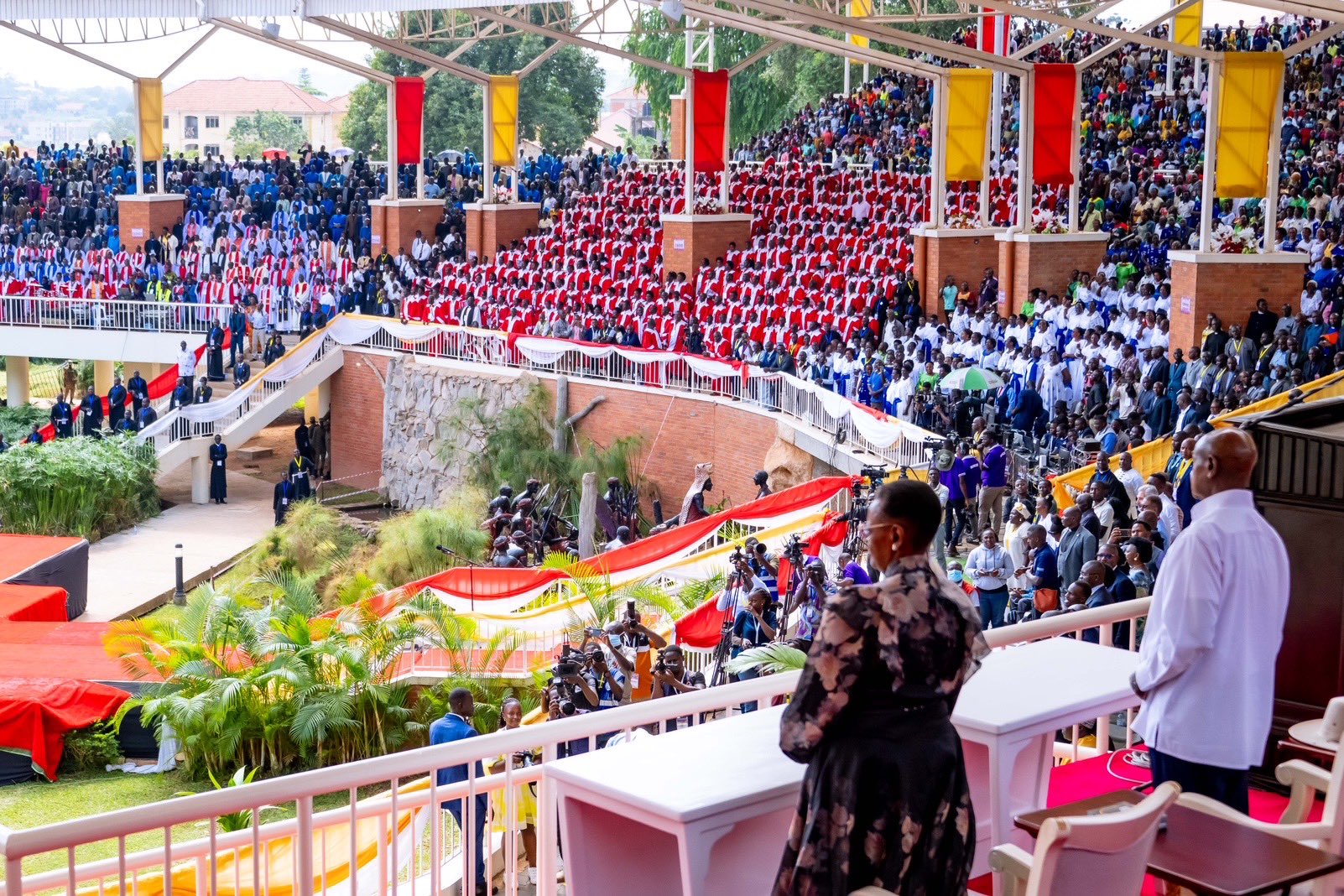
Namugongo | As millions of pilgrims thronged the Namugongo shrines on Tuesday for the 140th Uganda Martyrs Day, President Yoweri Kaguta Museveni and several high-ranking religious leaders used the occasion to call for religious tolerance, political humility, and national unity ahead of the 2026 general elections.
The annual celebration, one of Uganda’s most significant religious events, commemorates the martyrdom of 45 young Christian converts executed between 1885 and 1887 by Kabaka Mwanga II for refusing to renounce their faith.
This year’s observance came at a time when the country faces moral, political, and socio-economic crossroads.
At the Anglican church where he was the guest of honour, President Yoweri Kaguta Museveni used his Martyrs Day address at Namugongo to champion patriotism, Pan-Africanism, and religious harmony as critical pillars for Uganda’s continued prosperity and unity.
Referencing Biblical teachings from the books of Mark and Luke, the President reminded the multitudes gathered at both the Catholic and Anglican shrines that faith and civic duty can co-exist in harmony.
“Give unto Caesar what belongs to Caesar and to God what belongs to God,” he quoted from Mark 12:17, before contextualizing what “Caesar’s” issues are in contemporary Uganda development, economic transformation, and regional integration.
Museveni reaffirmed the National Resistance Movement (NRM)’s three historical missions: creating prosperity for all Ugandans through production, ensuring Africa’s strategic security, and leveraging African brotherhood (undugu) to achieve these goals.
He also highlighted the four guiding ideological principles: patriotism, Pan-Africanism, social-economic transformation, and democracy.
“Our advice to Ugandans is never to mix politics with denominational loyalties. Politics is about our welfare here on Earth. Religion is about our spirituality and eternity. Let each work in its proper sphere,” Museveni said.
The President used the Parable of the Good Samaritan from Luke 10:30-35 to promote compassion across tribal and religious boundaries. He warned against religious exclusivity and encouraged believers to preach by example, not hostility.

“In the bush, we united Catholics, Anglicans, Moslems, and traditional believers around science and common cause,” Museveni recalled. “A bullet does not fear magic horns.”
To underscore government commitment to religious freedom and heritage, Museveni announced that the state will now permanently include funding for Martyrs Day celebrations in its annual budget.
This year, the government contributed shs 2 billion each to the Catholic and Anglican churches, and shs 200 million to the Muslim community in recognition of their role in the event.
“The infrastructure you see today at both sites is a government investment,” he noted. “When the Muslim community is ready with their site, we shall support them too because we are one people, and I’m told some Muslims were also martyred by Mwanga.”
Concluding his address, Museveni invoked a Luganda proverb: “Lubaale mbeera, n’embiro kwotadde”- God helps those who help themselves. He called on all Ugandans to reject idleness and sectarianism, and instead work together to build a prosperous, united nation.
In his touching homily at the Anglican shrine, retired Archbishop Henry Luke Orombi delivered a powerful sermon that tackled the country’s moral decline.
Citing increasing rights abuses, political indifference, and bloodshed, Orombi expressed alarm over the erosion of conscience in Ugandan society.
“Do not conform to the patterns of this world. Be transformed by the renewing of your mind,” he said, quoting Romans 12:2.
He urged believers to “light the world” with truth and humility and warned leaders against pride and hypocrisy.
“The voters you ignore today are the very ones you need tomorrow,” Orombi cautioned, calling for leaders to associate with all citizens, especially the marginalized.
He invoked the legacy of Archbishop Janani Luwum, who was murdered under Idi Amin’s regime in 1977, as a modern-day martyr who stood firm in faith.
In a significant announcement, the Archbishop of the Church of Uganda, the Most Rev. Dr. Stephen Samuel Kaziimba Mugalu, revealed that Uganda Christian University (UCU) will lead the 2026 Uganda Martyrs Day celebrations. This marks the first time the institution, a provincial arm of the Church of Uganda, will take the helm of the national event.
“We have full confidence in UCU’s spiritual and academic leadership. They will bring a fresh perspective to this sacred commemoration,” Kaziimba said.
The decision was received with enthusiasm by clergy and laity alike, with expectations high that UCU will infuse the celebrations with youthful energy and scholarly insight.
Meanwhile, at the Catholic Martyrs’ Shrine in Namugongo, a vibrant atmosphere enveloped the holy grounds. Thousands of pilgrims from across Uganda and beyond gathered in prayer and devotion, many dressed in traditional attire.
The choir, clad in white and red, led the congregation with powerful hymns that echoed through the air, accompanied by drums and African instruments. The faithful, some barefoot, sang and danced creating a spirit-filled celebration.
In a rousing homily at the Catholic Shrine, Rt. Rev. Christopher Kakooza of Lugazi Diocese called on believers to emulate the Uganda Martyrs by living lives defined by courage, and unwavering faith.
Describing the martyrs as “pilgrims of hope,” Bishop Kakooza said their selfless sacrifice offers a model for Christians today. “Love is the foundation of service. Let us express this love through prayer, charity, and humility,” he said.
He acknowledged the presence of Pope Leo XIV and led prayers for the Pontiff’s success, encouraging unity in the Catholic Church and beyond.
Kakooza also reminded pilgrims that the essence of their journey to Namugongo was not just physical but spiritual, aimed at renewal and recommitment.
Archbishop Paul Ssemogerere of Kampala Archdiocese echoed the call for humility and reconciliation, especially in political life.
“We need a Uganda where political competition does not translate into enmity. The Martyrs’ wounds speak louder than words.”he said.
He encouraged servant leadership, urging those in positions of authority to lead with integrity and empathy.
“The Uganda Martyrs stood for truth and justice. We must ensure that our public life is a reflection of these values,” Ssemogerere added.
In a statement delivered by Vice President Maj. Rtd. Jessica Alupo at the Catholic Shrine, President Yoweri Kaguta Museveni urged Ugandans to rise above religious divisions and embrace a collective vision of national development.
“Do not attack other religions. Influence people by example,” Museveni advised, calling on religious leaders to preach compassion and focus on uplifting humanity.
Quoting Mark 12:17 “Give unto God what is God’s and unto Caesar what is Caesar’s” he emphasized the importance of separating religion from state affairs while still recognizing the moral authority faith holds in shaping society.
Expanding the definition of martyrdom beyond religion, Museveni drew a direct link to Uganda’s political history. He commemorated National Resistance Army (NRA) fighters like Luttamaguzi Edidian, who were killed during the bush war in 1981, and likened their sacrifice to that of the Uganda Martyrs.
“Africans of this area can sacrifice for the legitimate causes they believe in,” he said. “Even in our ancient cultures, it was more honorable to commit suicide (kuyiita) than to betray others or incur shame (kuhemuka).”
He urged citizens to practice self-reliance and avoid dependency, quoting a traditional proverb: “Lubaale mbeera, n’embiro kwotadde” God helps those who help themselves.
Museveni also reminded the faithful of Uganda’s rich religious history, tracing the introduction of Islam in 1841 through Ahmad Bin Ibrahim and the subsequent arrival of Christian missionaries.
He praised the courage of the early converts, saying, “The martyrs, both male and female, gave their lives for freedom of worship. Kabaka Mwanga was wrong to suppress new religious ideas.”
Pilgrims from across Uganda and abroad shared inspiring stories of spiritual breakthroughs, physical healing, and renewed faith, reaffirming Namugongo’s status as a holy site.
Security was tight across Namugongo, with heavy police and military presence ensuring order amid the large crowds.
Health workers and volunteers offered emergency services, water, and guidance to pilgrims navigating the shrine complex.
With a call to spiritual reawakening, the essence of June 3 is a challenge to believers to embody the radical commitment the martyrs demonstrated over 140 years ago.
Discover more from tndNews, Uganda
Subscribe to get the latest posts sent to your email.