

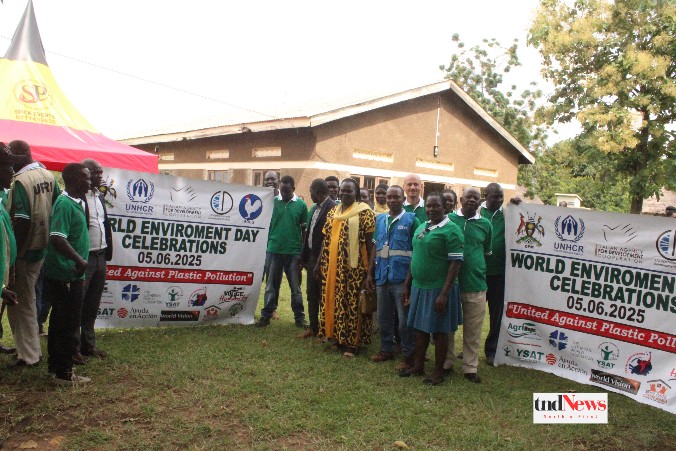
Adjumani district leaders have rallied communities to take decisive action against plastic pollution, calling for tree planting, environmental stewardship, and an urgent shift away from harmful plastic materials.
The call came during World Environment Day celebrations held at Ciforo sub-county headquarters on June 5.
Delivering a message on behalf of the district chairperson, Ben Anyama, officials emphasized that this year’s national theme “United Against Plastic Pollution” speaks directly to the escalating environmental crisis gripping the district.
“From the trading hubs of Adjumani town to the markets of Pakele, Dzaipi, and Ukusijoni, plastic waste is now a common and alarming sight,” Anyama noted.
“Our roadsides are littered with polythene bags, our fields with plastic bottles, and even our rivers, once clean sources of water, are choked with waste.”
He warned that plastic pollution is suffocating the ecosystem: harming animals, degrading soil fertility, and blocking drainage systems, worsening flood risks during rainy seasons.
The district chairperson urged unified action: “We must ask ourselves how we got here and, more importantly, how we get out. The solution lies in collective responsibility.
“We, as leaders, must enforce existing waste management laws and uphold the ban on polythene bags below 30 microns. But enforcement alone won’t solve this crisis.”
He called on the business sector to be part of the solution by providing environmentally friendly alternatives such as paper bags, reusable containers, and biodegradable packaging.
Anyama also highlighted positive efforts already taking root across the district, from plastic clean-up campaigns in Lewa and Pakele, to tree-planting initiatives near the River Nile and sustainable farming in Dzaipi.
Francis Ojja, the Adjumani district forest officer, underscored the health risks of plastic pollution, noting links to diseases like cancer.
“If we fail to protect our environment, we risk contaminating the very soil and water we rely on to survive. Polluted ecosystems cannot support a healthy economy.”
Ojja added: “As our towns expand, plastic use increases. A kavera takes 450 years to decompose. A soda straw takes 250 years. These materials contaminate our water bodies. Let’s choose to reuse, not discard.”
William Amanzuru Leslie, team leader of Friends of Zoka, a local environmental NGO, framed the fight against plastic as a generational responsibility.
“A plastic-free world is not optional—it’s essential. The biggest threat to our planet is believing someone else will save it. It’s on us to act.”
Korina Ondoa, district councillor for Pakele town council, made a passionate appeal to residents, especially women, to lead the way in sustainable practices.
“As women, we bear the brunt of environmental destruction. Let’s stop burning plastics and embrace waste sorting. No outsider will come to protect our environment, it starts with us. Let’s return to traditional crafts and use biodegradable materials,” she said.
With growing awareness and grassroots action, Adjumani district is taking critical steps to turn the tide on plastic pollution, protecting the land, water, and future for generations to come.
Discover more from tndNews, Uganda
Subscribe to get the latest posts sent to your email.


