Gulu | At 6:00 a.m., just before the first rays of sunlight reached my village in Bardege B Cell, Mego Matta, 104, like many PWDs in similar conditions, began her day struggling to move.
Her story reflects the routine life of many disabled persons in rural and urban Gulu, who tirelessly strive for survival.
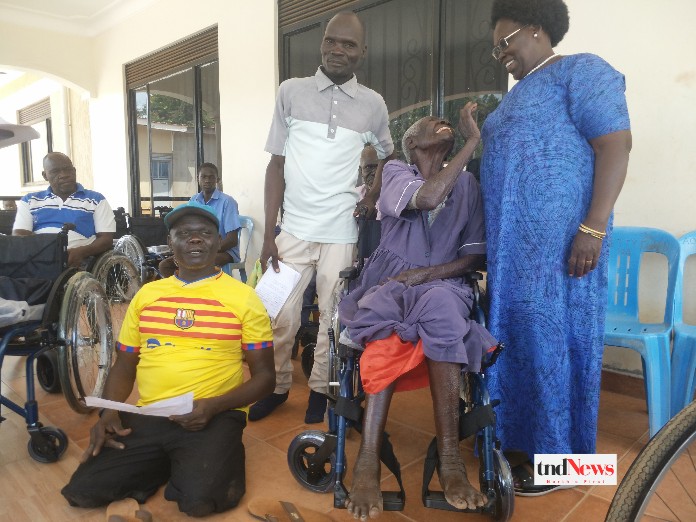
However, a wave of hope swept through Gulu City recently as 18 vulnerable persons with disabilities received mobility aids: 15 modern wheelchairs and 3 walking canes—donated by Gulu City Woman Member of Parliament Betty Aol Ocan.
The support came in partnership with The Church of Jesus Christ of Latter-day Saints and the Ministry of Health.
As persons with disabilities (PWDs) in rural and urban slum settings continue to rise above challenges, the need for accessible transport and healthcare remains critical to ensuring fair chances of survival and dignity within their communities.
The donation ceremony was held at the MP’s residence, where the beneficiaries could not hide their joy upon receiving what many described as “golden means of transport.”
“I thank the Woman MP, the Church, and the Ministry of Health for having the heart to support needy persons like me. For many years, I have struggled to move, but with this donation, I can now travel longer distances,” Matta expressed her joy.

Mego Marita Adira, 85, another beneficiary, from Obiya West in Gulu East Division, urged the MP to continue lobbying for support and expresses her gratitude for the timely assistance by the woman member of parliament.
“We have been abandoned by the government and left to struggle alone for survival. These donations give us hope,” Adira explained.
Stephen W.W. Opwonya, Chairperson for PWDs in Gulu City, welcomed the donation, noting its timely arrival ahead of the 2026 general elections.
“Mobility has always been a major challenge for disabled persons, especially during election campaigns. This support comes at a perfect time,” he said.
Opwonya, however, criticized the current parliamentary representatives for PWDs, saying they have done little to champion the needs of their constituents.
“We have about five MPs representing us, but we see no action. Local leaders like us are left to lobby for support on our own,” Opwonya noted.
He further estimated that Gulu City has approximately 10,000 persons with disabilities, although accurate data remains elusive due to the 25 years of insurgency in northern Uganda.
Betty Aol Ocan expressed her satisfaction with the success of the initiative and promised to continue lobbying for support so as to see that persons living with disabilities in Gulu city are supported.
“I’m truly happy to see at least 18 persons benefiting from these golden transport tools. I thank the Ministry of Health, the Church, and my office for making this possible. We will continue lobbying for more support, especially for people in rural and slum areas,” she said.
Aol also urged beneficiaries to take proper care of their mobility aids and protect them from theft especially by the street kids and scrap dealers who may sell them as scrap. She urged them to record and memorize their serial numbers for easier tracking if stolen.
“My investment as an MP focuses on education, health, agriculture, and social services, particularly in rural and slum areas where people suffer most when trying to access essential services,” Aol said.
She further encouraged PWDs to actively participate in government programs such as the Parish Development Model (PDM) and Special Grants so as to also be part of the population who are benefiting.
“Do not wait for handouts. Get involved in leadership—from LC1 to MP levels. This will strengthen your bargaining power and improve support systems,” she urged.
Seth Mafabi, an orthopedic technician at Mulago National Referral Hospital, advised recipients to use their wheelchairs appropriately to avoid secondary disabilities.
“These wheelchairs are meant to improve your lives. Treat them well so they continue to put smiles on your faces every day,” he said.
Mafabi also revealed that Mulago National Referral Hospital handles thousands of PWD cases annually and noted the high cost of standard wheelchairs—around shs1.5 million—making them unaffordable for most vulnerable families.
According to the Uganda Bureau of Statistics (UBOS) Census Report, about 12.4% of Uganda’s population lives with a disability.
The prevalence is higher among women (15%) than men (10%), and significantly more common in rural areas (15%) than in urban ones (12%).
Discover more from tndNews, Uganda
Subscribe to get the latest posts sent to your email.