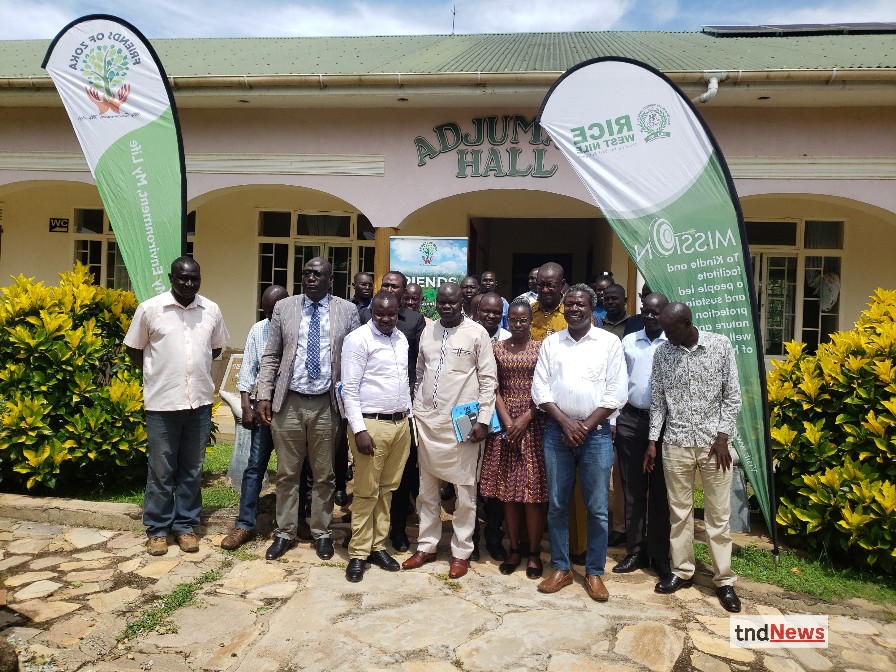
Adjumani is one of four West Nile districts set to benefit from a shs7 billion grant to improve environmental accountability and climate action. Other districts include Madi Okollo, Obongi, and Zombo.
The four-year project, funded by the Royal Danish Embassy, the Embassy of Ireland, the Netherlands Embassy, and the Embassy of Sweden, is being carried out by Rural Initiatives for Community Empowerment (RICE) as the lead partner.
Friends of Zoka and Sustainable Plan Action for Community Empowerment (SPACE) are additional implementing partners.
The project is solely focused on environmental governance, according to consortium project manager Jackson Olema. It is anticipated to benefit over 55,540 people from the four districts, of whom 48% are women, 36% are youths, 10% are people with disabilities, and 16% are men.
“We are advocating for the sustainable use of the environment, and I want to implore you to understand the project and own it since the environment has become an enemy to human beings because of the way we have destroyed it,” Olema said.
He also stated that West Nile is dealing with numerous climate challenges that are affecting people’s livelihoods, but there is no environmental justice or accountability. He added that this project will improve environmental accountability and climate action in the region.
The district natural resource officer of Adjumani Charles Giyaya observed that the district has suffered from so many forms of climate change such as floods and drought that have destroyed property and killed lives.
“Already climate change is having an impact, the Zoka central forest reserve which is a tropical forest has been destroyed, yet it is the one that has been responsible for rains in the region, because of this food security is a problem, this climate change is going to cause more impact, it is expected that by 2023 water in the Northern Uganda will become limited,” Giyaya said.
GIyaya further added that “this project has come timely, to promote accountability, adaptation and building resilience among our communities, as a district it is our mandate to ensure that we are accountable to the public”
Environmental abuse has persisted in the area, according to William Amanzuru, team leader of Friends of Zoka. He stated that between October 13, 2024, and October 20, 2024, 395 alerts were recorded by Global Forest Watch in Adjumani and Moyo, affecting 4.86 hectares of protected areas.
“With the coming of this project through the community dialogues, community awareness, we expect that some of the environmental impunity would be stopped,” Amanzuru revealed
Richard Edema, Adjumani’s principal chief administrative officer, stated that the district was chosen appropriately because it is prone to environmental disasters.
“We have environmental injustices which are caused by human activities in this district that calls for immediate climate actions, we must ensure we make good use of this taxpayer money to be able to address some of the challenges,” Edema said.
The Adjumani district LC5 chairman, Ben Anyama, appealed to the project’s implementation partners to be result-oriented in order to address the district’s environmental challenges.
He also urged collaboration with other implementing partners, district technical personnel, and other private-sector stakeholders, emphasizing the importance of investing in research to develop workable solutions to the challenges.
The project design states that by the end of the project period, 50% of women, people with disabilities, youths, and men will have access to alternative sources of income.
Discover more from tndNews, Uganda
Subscribe to get the latest posts sent to your email.