Gulu | Uganda Women Network, an umbrella organisation for women-led civil society organisations (CSOs), has urged the government to collaborate with the electoral commission to revise “policies” and allow women to participate in “quarterly leadership.”
This, they say, will “highlight some gaps that continue to exist” when women are ignored in high-level political positions.
These concerns arise ahead of the 2026 general elections, and women want to amplify their voices to prompt actions and decisions by the electoral commission before the next elections.
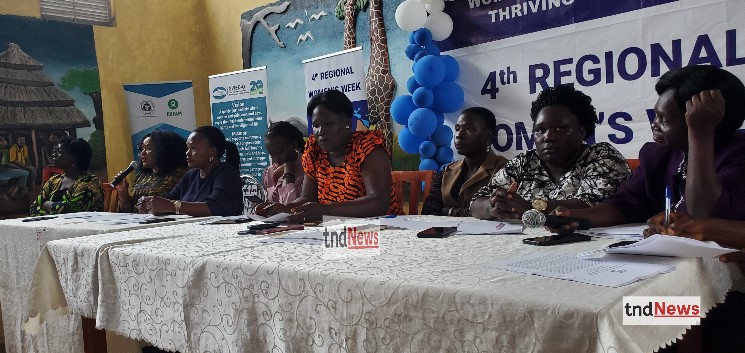
GWEDG, Mission Uganda, Gender Action Learning Systems (GALs), and other CSOs participated in the 4th Women’s Regional Week, which was held at the Golden Peace Hotel in Gulu City with the theme “Women’s organising: Re-imagined, thriving through adversity.”
The regional conference targeted the Acholi sub-region while also bringing together women’s organisations from across Uganda.
Esther Namboka, executive director of Gender Action Learning Systems (GALs), urged the government to create more electoral areas for women to participate in leadership. She stated that women are “left behind and in a dilemma in top positions.”
Namboka also urged the government to revisit and revise policies that affect women. “…it will allow others to come in and participate in leadership,” she said of introducing “quarterly leadership for women.”
She also urged men and entire households to rally behind women and support their participation in leadership, rather than leaving them to struggle alone while waiting for the government.
Women should expect to fill in and take about 80% of leadership positions, both lower and upper, as men, she said.
“This will improve gender equality and close the gender gap in leadership participation. However, the Ugandan government is making an effort to promote gender equality.
Lenia Charity Kevine, executive director of the Upright Inspired Youth Foundation, is also aspiring to run for Parliament in the Arua district. She stated that women continue to lag behind in leadership participation due to Uganda’s commercialised politics.
She claimed that commercialised politics has a negative impact on women that they cannot afford.
Women in Uganda frequently receive little support from political parties, which significantly limits their ability to participate effectively in politics, she said. “They (political parties) have ring-fenced certain positions, limiting our chances for leadership.
“…women are too involved in political participation at all levels. However, their representation in the executive, legislature, judiciary, and local government levels remains low in Uganda,” she stated.
Persistent negative social norms and attitudes towards female political leaders are also limiting women’s access to leadership positions, indicating widespread negative stereotypes of women in Uganda, she stated.
According to Shara Ocwee, executive director of Mission Uganda, women face sexual harassment and body shaming during electoral processes, limiting their ability to participate in leadership.
She stated that body shaming is used both online and offline to discourage active participation.
Ocwee continued, saying that even voter violence is directed towards them. These include physical assault, intimidation, and threats during campaigns and at polling stations, with no protection from the authorities.
She has urged Parliament and the Electoral Commission to regulate these “problems,” implement voter education and campaign financing methods, and address the high level of commercialisation of politics to benefit female candidates.
Agwang Shara Jesca, program director for Uganda Women Network (UWONET), revealed that, despite some challenges, their participation is increasing.
She cited challenges such as limited media access, in which some media portrays women as negative stereotypes, undermining their credibility.
Agwang also stated that women face limited protection from authority during election seasons. This further discourages women from actively participating in politics.
“Women face a significant burden of domestic work, which limits their ability to participate in civil processes as candidates. Women take care of their homes for roughly seven and a half hours a day, while men take care of them for only two hours, according to a 2018 UWONET study.
“Make women satisfied in life through empowerment; they should have knowledge or the wheel of life on financial independence in order to build freedom in their lives within the community or involvement in savings; it allows them to participate well in leadership,” she said.
She advised women to save at least 10% of their salaries, stating that it will help them at the end of the year. Agwang also encouraged women to diversify their investments rather than focussing solely on one.
According to UWONET, women make up approximately 46% of all elected representatives at the local government level, 34% in Parliament, 43% in cabinet, 4.1% as district chairpersons, 26.5% as district vice chairpersons, and 13.7% as district speakers.
Discover more from tndNews, Uganda
Subscribe to get the latest posts sent to your email.