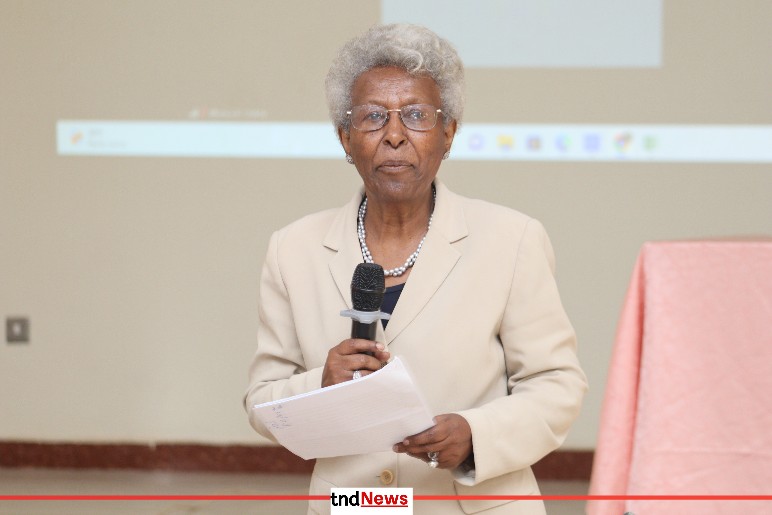
Gulu | Dr Gennet Zewide, former Ethiopian Ambassador and Minister of Education, has revealed that societal expectations of motherhood are causing women to fall behind in academics.
Dr Zewide made this revelation while addressing women leaders in the academic sector from the selected Universities within East Africa at Gulu City at the weekend.
“Claims of motherhood are keeping us [women] behind in the academic and higher spheres of leadership in the various universities and higher institutions of learning,” Dr Zewide explained.
According to Dr Zewide, women are very reluctant to take up leadership roles because most of them do not believe in their capacities coupled with the cultural beliefs and societal differences.
She further told tndNews that in 2019, UNESCO stated that there were only 24 women academic staff in the higher positions of chancellors and vice chancellors in sub Saharan Africa.
“Let us not be shy but take up our roles. We need to reject the patriarch gender roles that affect our development and leadership capacities,” Dr Zewide told the gathering.
“We have to be change agents and work hard to empower other women; remember you are already oppressed, you may be economically well but remember we are oppressed. Let us work for gender equality,” she added.
In recent years, Uganda’s political landscape has undergone significant changes in terms of women’s roles.
Historically, like in many parts of Africa, women are marginalised and relegated to domestic roles without much say in governance or decision making processes.
Therefore, societal norms dictated that women’s primary duties were within the household, and their value was often measured by their ability to serve their husbands and bear children.
Alfred Okwonga, the Gulu City Mayor, however, told tndNews that many women are at the disadvantaged especially the girl-child in the rural communities who have undergone sexual violence.
Okwonga also noted that some women in the higher leadership roles and positions do not put on their gender glasses thus leaving others to lag behind as they progress.
“We are aware that some women do not put on their gender glasses all the time; and most women are at a disadvantage because they are vulnerable,” Okwonga said.
Okwonga further called upon local leaders, government and civil society organisations to support young girls in pursuing their dreams and empowering them with the needed skills and knowledge to become better leaders tomorrow.
George Ladaah Openjuru, the Vice Chancellor of Gulu University, revealed that there is a need to rethink on women leadership for the 21st century since the world is evolving.
According to Openjuru, there is still work to be done in rethinking women because many women are still hesitant to take on roles and responsibilities when given the opportunity.
“Leadership is evolving and we recognize that diversity is essential; as Gulu University, we have supported more than 20 staff in their different training and empower them in different leadership roles in the university,” Openjuru said.
The government has also implemented the affirmative action strategy, which has seen female enrollment and graduation rates outnumbering their male counterparts.
Nevertheless, women in senior positions remain few, and there is a need to pay attention to the kind of support that enables those few female Vice Chancellors to succeed in their leadership positions.
Dr Naomi Lumutenga, the Co-founder and Executive Director, HERS-EA disclosed that women are very prime in the development of a society and they can do what men can do too.
According to Dr Lumutenga, there should be an increase in the participation of women in leadership beyond the 50 percent and women should be given the privilege to lead in bigger positions as men.
“We know there are other barriers that are hindering women participation in leadership but I urge you to take up the mantle and lead; men give us space, let us show you that what a man can do, a woman can do too,” Dr Lumutenga said.
In their joint statement by Lydia Zigoma, the UNFPA East and Southern Africa Regional Director and Ms Anne Githuku-Shongwe, Regional Director, UNAIDS Eastern and Southern Africa during the International Women’s Day 2024, they cited that gender inequalities and harmful gender norms contribute significantly to the ability of women and girls to claim their right to bodily autonomy.
“Only 55 percent of women reported having the freedom to determine if and when they want to start a family. Additionally, many women continue to experience gender-based violence daily,” their statement reads in part.
Beginning in the 1990s, more women began participating and making significant advances in leadership, allowing them to break the glass ceiling.
Discover more from tndNews, Uganda
Subscribe to get the latest posts sent to your email.