Summary:
- Previously encroached wetlands in Agweng sub-county, Lira district, are being restored through the Meaningful Empowerment For Change and Poverty Alleviation (MECPA) intervention.
- As documented in 2026, Lira district’s agricultural production in upland was no longer as productive as it had been in the 1980s and before, owing to the fact that many families had begun encroaching on wetlands to cultivate and settle.
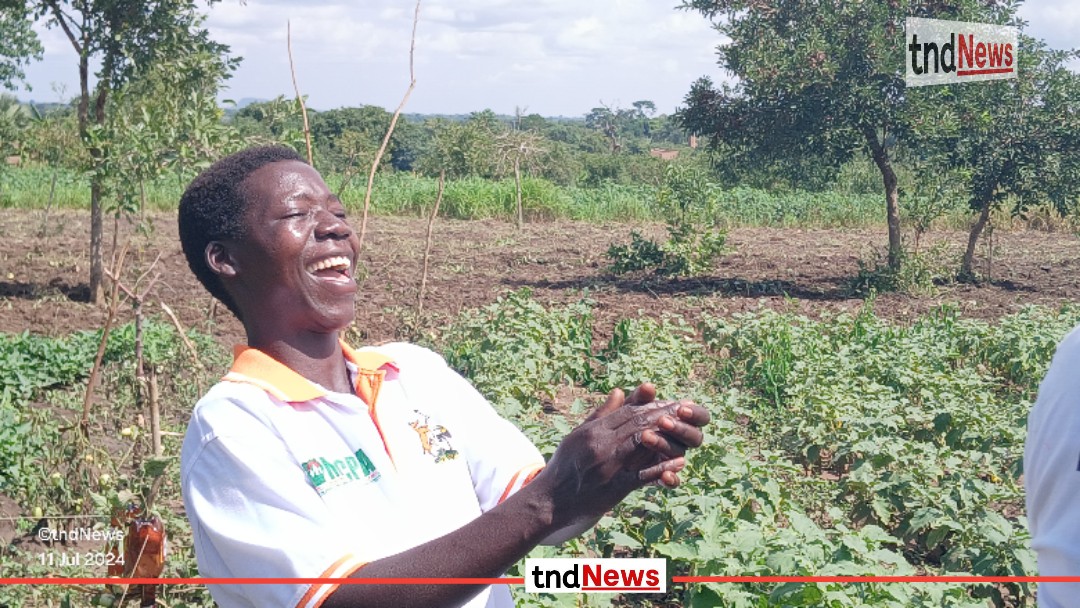
Agweng, Lira I Ketty Apili lives in Awiealem village, Orit parish, Agweng sub-county. She is among the community monitors that MECPA has trained to protect the environment and wetland areas. She now grows tomatoes upland. She says she used to farm tomatoes in the wetland and gets some money from it.
After she was told the importance of conserving wetland, she opted to start farming in the upland. “This tomato garden of mine, when there is no rain because it is far from the wetland, I do simple irrigation and it survives, and now I am harvesting it and making money.
“The money I make from my tomatoes makes me forget about farming in the wetland; I have shared the importance of wetland conservation with others, and when you leave it, you can still farm and make money; I have no desire to do so in the wetland.”
According to Apili, the proceeds from the sale of her tomatoes go towards her children’s fees. She expects to earn between Shs200,000 and Shs300,000 when she harvests and sells all of her ready tomatoes. Apili believes that increasing the size of her land will result in a bumper harvest in the future.
“If I grow on a small scale and make around shs300,000, I can earn more if I grow on a large scale. My first harvest of two boxes, which I sold yesterday at Barlonyo market, earned me shs40,000. I am now optimistic that I can get between shs300,000 and shs400,000.”

In addition to selling her produce to local markets, she sells her tomatoes to community members who buy them to prepare their daily meals.
She is grateful to MECPA and IUCN for mobilising and training them not to use the wetland for agriculture.
Owera Stella also resides in Awiealem village. Like Apili, she is among those who were farming in the wetland before getting trained by MECPA. The training was conducted in Lira town on how to do agriculture without damaging the wetland ecosystem.
Following that training, they attended additional trainings in their village. In addition to other crops, Owera grows eggplants. She explains, “I start in the nursery bed and then plant them here. I use drip or bottle irrigation to allow it to grow and bear fruit while preventing it from drying out.”
Before their capacity was increased, Owera believed that only wetland areas were suitable for survival. “After I was trained, I had to withdraw the idea of farming there. I have also realised that even if I don’t tilt the wetland and use this method, I can still survive and teach those who surrounds me.”
Owera and some of the community members she spoke with are now very interested in planting trees to combat climate change. They believe MECPA and its partners can help them achieve their goals.
She still harvests her egg plants every three months, though. She sells at the nearby market and to customers who come home to buy.
“I have already made shs600,000 from sales in recent times,” she says, but she expects that figure to rise.
Anying Caroline is another community monitor and farmer. She says they were only able to conserve environment when MECPA mobilised and trained them, revealing that they would recklessly farm in the wetland. She cited Opopong wetland where they would tilt without any idea of protecting its ecosystem.
“MECPA came and sat us down, and trained us how to conserve wetland. Those days when we were farming in the wetland, when it rains, sometimes our crops would be washed away and the water channels get blocked,” she recalls.
They benefit from the regeneration of the wetland because they allowed it to happen. “We no longer buy fish; instead, we catch it for our own consumption and sell some to help with school fees. As you can see, the reeds are growing, and we cut them to make mats for our children’s beds.
On a good day, Anying says she and others can earn between Shs40,000 and Shs50,000 from the fish they catch in the Opopong swampland. “It allows us to live without problems.”
She adds that they are doing everything possible to persuade more community members who are still encroaching on the wetland to join their cause by communicating with them. As of July 11, 2024, Anying had talked to 10 people to change their mindset.
Susan Akullu, chairperson of the Orit Community-based Monitors in Agweng sub-county, says the group is working hard to protect the environment. Two, they are attempting to change the community’s mindset as climate change has affected how rain falls these days.
“When MECPA mobilised us and formed a group, they taught us why we should stop farming in the wetland. We used to farm in the wetland, and everything was destroyed, but there are some benefits to it. Most of our children now have no idea what kind of food and fruits we used to eat, which were found in the wetland.”
They have learned that upland farming can be done even in the dry season. When there is no rain, Susan and her members use bottle irrigation. They collect empty water and soda bottles and make tiny holes in the lids to allow water to drip. She says that every group member has a garden with eggs plants, tomatoes, and other vegetables.
When it is not raining, these women do not worry. They also do not go hungry.
“We also use watering cans to irrigate our vegetables, especially when drip irrigation becomes tiresome on a large garden,” she adds, revealing that they irrigate their gardens twice a day, in the morning and in the evening.
“This allows us to eat vegetables and have food all season long, with no desire to return to the wetlands because we have food available.”
Akullu has this to say about the support they receive from their husbands: “When you choose a woman in a family, you also choose a man. We shared the same information MECPA provided with our husbands, and they now assist us with garden work.”
For example, she explains, “When we plant tomatoes, a man gets the sticks and we share the work. This project has brought us together as a family, and they [our husbands] possess the knowledge.”
According to the group chairperson, even their children help them fix bottles for drip irrigation. “Because we taught them how to fix the irrigation bottles, they do it when we are not present, and we find the gardens irrigated in the evening.”
Akullu manages 16 women and four men in Orit parish, all of whom have decided to abandon wetland farming as a result of MECPA intervention.
The project began in 2020, teaching 15 community-based monitors how to protect wetlands, according to Atim Carolyne, the Environment and Natural Resource Project Officer at MECPA. The monitors also received training on social movements and community mobilisation.
These community-based monitors were tasked with monitoring and gathering information on the Opopong, Otol, and Moto wetlands. “Since then, there has been great progress,” she says.
They meet twice a month to discuss issues involving wetlands in their area. “If they are unable to resolve an issue, they refer it to the local chairperson, who will come in and speak with the person who is degrading the wetland.”
Atim says that as a result of the work of these community monitors, “we can now see a great improvement in the water level. The water level has increased due to their hard work and if you visit these wetlands, you will even find great improvement there”.
She gave the example of Opopong, where she claimed that there is grass regeneration and where most people bring their cattle to graze. Some people also fish there to supplement their diets.
Others, she tells this publication, have decided to switch from wetland farming to upland farming, where they use irrigation and collect water from the wetland.
“There is a significant improvement in wetland protection,” she admits.
Moses Ogwal, Executive Director of MECPA, says that four years ago, they formed a partnership with CivFund to train these monitors, with a focus on women. A few men were enlisted to guide them and offer technical advice.
Their focus was on three wetlands, Otol, Opopong, and Obim, which were heavily encroached. All of these wetlands connect to the Aswa River, according to Ogwal.
The MECPA Executive is pleased that the water level has improved as a result of their intervention. “All these three wetlands feed into this [Aswa] river and where this river feeds into the river Nile and the river Nile automatically feeds the Mediterranean Sea. This, we hope by the work of the grassroot women and also the rural women that were empowered to monitor these wetlands, monitor the integrity; monitor as well the related crimes, the encroachment and as well creating more awareness, we appreciate that people were able to take up their advice and guidance.”
In the run-up to the project’s launch, MECPA also investigated the underlying causes of the encroachment and discovered that people needed to be trained in climate smart farming because of the difficulties they faced in making a living. They also added that the reason they were farming in wetland areas was because of the effects of climate change, which have an impact on the entire world and more so on the farmers.

“We appreciate that due to the knowledge we gave them they started demonstrating, planting horticultural crops like tomatoes, eggplants; vegetables in general and also sell to the nearby people, but also use their garden as a demonstration site to continue training other people, and this is the impact of this community leaving farming in wetland.”
According to Ogwal, the interventions have helped Uganda achieve its goals under the International Fresh Water Agreement, to which it has signed. He appreciates that this water level is helping to fulfil the commitment that was signed and implemented.
To mitigate the likelihood of conflict as well as to resolve existing disputes, the international community has devised principles for international watercourse management. Over the past century, these principles have been refined, and most recently, codified in the 1997 United Nation Convention on the Law of the Non-Navigational Uses of International Watercourses…” reads an excerpt from the Atlas of International Freshwater Agreements.
According to Ogwal, MECPA has “developed another angle” to address “the areas of stakeholder engagement.”
“We have done with locals, and as we consolidate their capacity, we need to get this directly to the stakeholders. We now have the LANDSCAPS, which focuses on both wetlands and highlands, as well as the challenges that arise from the wetlands, the land, and women’s lack of access to land and natural resources.”
“It’s a bigger focus on stakeholders and we call for stakeholders’ action. We appreciate the direction.”
Lira district profile
The current Lira district’s Hazard, Risk, and Vulnerability Profile indicates that the district’s climate is influenced by the large swamp area surrounding the southern portion. The profile also shows that rainfall in the district is bimodal, with one peak in April-May and another in August-October.
Wetlands cover approximately 4,829.2 hectares, or 7.9% of the total land area in Lira district. “Wetland degradation continues to undermine the availability of surface and underground water, resulting in flooding and destruction of roads and crops, reduced fish stock, biodiversity loss, and habitat loss, all of which lead to poor ecosystem services and balance,” according to the district profile.
Discover more from tndNews, Uganda
Subscribe to get the latest posts sent to your email.