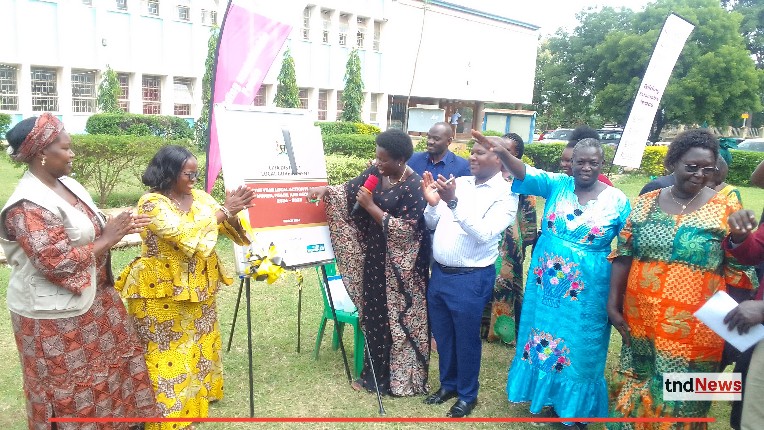
Lira | The five-year local action plan on women, peace, and security from 2024 to 2028 was introduced by the Lira district local government on May 23.
With the support of the Coalition for Action on 1325 (COACT), the Norwegian Embassy in Kampala, and UN Women, the action plan aims to empower women and girls in the district.
The Ministry of Gender, Labour, and Social Development will provide supervision until the end.
Patrick Ogwal Inyema, secretary for finance and administration, represented LC5 chairman RCM Okello Orik at the launch and described the day’s event as “important and historical” in restoring peace in Lira.
“Today marks the beginning of yet another milestone for the district of Lira, and we do not take your contribution and support for granted,” Inyema told development partners.
“First of all, I want to appreciate COACT and then UN Women for having complemented our work. The issue of peace and security for women in Lira should have been greatly the work of the district council. However, you came on to support us and today we are very much grateful for you.
“We believe the support that you have given us will bring to an end the issue of insecurity amongst our women. Allow me to bring to your attention, on behalf of the district council of Lira, that we have registered a number of cases that are arising amongst our women because of issues here and there.
“Of late, we registered two men being killed by their wives; these are the kind of things we don’t want to register more in the district.”
Also read:
- Bizarre lightning strikes Amolatar, leaving one unconscious
- TOP STORY: Lira City Council officers arrested for selling NFA land
- From shs100k to shs15m: how rural women in Serere grew wealth
Inyema cited cases reported in Aromo and Amac sub-counties where women conspired with their children and others to murder their husbands. “As the district, we really shed tears for this and we don’t take lightly your contribution to ensure that peace comes back to our mothers.”
Inyema stated that the Lira district should have done more to ensure that mothers and fathers’ mindsets were changed. “But because we have very meagre resources allocated to the department of community who embraced a number of activities, because of the meagre resources in that department they could not do more.
“Aware of the fact that Lira was among the districts that suffered the LRA insurgency, our people went through a number of trauma and their minds have not yet been rehabilitated and Lira district should have been among the districts supported heavily by the Ministry of Gender so that the minds of our people are rehabilitated, but this was not done by the line Ministry.”
According to Inyema, the people of Lira district will continue to suffer and die because the leaders cannot do more, despite the fact that there is a competent team in the department of community based services that should have mobilised and rehabilitated the people.
Judith Auma, a UN Women representative, praised the Norwegian government for its generosity and support in advancing women’s peace and security agendas in Uganda.
Their assistance, she stated, has helped to develop Uganda’s third national action plan on women, peace, and security, as well as the development and implementation of district action plans, including the Lira district action plan.
She said the government of Uganda has been instrumental in setting the centre stage for women peace and security. “In particular, the Ministry of Gender, Labour and Social Development who have stood with us hand in hand. In doing so it (the Ministry) has worked with the development partners to see this agenda come to where it is today and for that we give special recognition to COACT in this case.”
The recognition of the 1325 United Nations Security Council Resolution is a people-based bottom-up strategy based on the premise that local ownership and participation lead to more effective policymaking and implementation, she stated.
“Through this approach, civil society organisations have contributed significantly to the implementation of the 1325 Resolution especially at the local governments and grassroots level.
“I am so proud to announce that this was recognized in 2013, 2014 and 2016 as a best practice globally at the UN Secretary General’s Report to the Security Council. So, we should be proud of ourselves as Ugandans to be recognized for something positive on security and peace.
“However, we need to be aware that efforts offered towards realisation of this mission have been hampered by some challenges like limited resources in some of the districts like Luwero, Kitgum, Kaberamaido, Yumbe, Kasese and Lira. I recognize that Lira as a district has had specific conflict triggers and peace and security issues that were highlighted during the consultative meetings and this contributed to the development of the third national action plan.”
However, as UN Women, Auma stated that they have learned from COACT that the local national action plan has been shaped by peace and security issues as good practices, which have also been implemented in other districts.
There are still significant challenges at both the local and national levels. “That is why we are focusing on localising the national action plan to deal with issues based on their context.”
Angela Nakafero, commissioner of women affairs at the Ministry of Gender, Labour, and Social Development, congratulated the Lira district local government on the achievement, noting that Lira is one of 15 districts that have localised the national women’s peace and security agenda.
She asserted that when men go to negotiate peace, they are negotiating power. “Yes, who is taking what, who is going to be the minister or who has the resources? Rarely do we talk about peace as an important cornerstone for national development,”
Nakafero emphasised that good governance is the cornerstone for national development and the development at family level.
“If we don’t have peace in our homes, in our communities neither are we going to have peace at the national level. So, we must be deliberate in our efforts. We are aware that our husbands are very powerful, they have the resources, they have the opportunities; please let’s utilise the power, the privileges, and the opportunities that we give you as heads of the households to create peace within our homes.”
She urged men to create an enabling environment for their wives and family members to prosper so that they can continue to be empowered.
She stated that crimes and violence against women and girls are on the rise in Uganda.
She pointed out that Mother Nature, flooding, and temperature are all working against women, which has an impact on food security. “As we do agriculture, infrastructure development, it is an appeal that part of our peace and security agenda lets us look at our Mother Nature. If you don’t, it is going to turn against us.”
Landslides and border conflicts, such as those in West Nile and Kasese, according to Commissioner Nakfero, have resulted in the loss of many students. “We also have issues along the South Sudan-Uganda border,” she said, adding that whatever is happening in other districts will have spillover effects to other districts.
She stated that the Ministry of Gender has a positive working relationship with UN Women, Parliament, religious and cultural institutions, and called for a deliberate strengthening of partnerships between UN Women and other stakeholders.
Linda Agnes Auma, the Lira district woman MP, was the launch’s chief guest. The action plan, according to her, is a strong commitment to improving our community as well as a strategic framework.
“In my own analysis and vision, we have a clear vision to create a society as women of this country and Lira district where women and girls are not just protected. We don’t just need to be protected but are also empowered to be leaders in peace building and security.”
This action plan is a testament of our collective resolve to achieve this vision, Auma said. “There are strategic priorities that we need to focus on to ensure that we accomplish this mission.”
Auma revealed that the plan focuses on providing training, mentorship, and political engagement opportunities, as well as ensuring that women’s voices are included in governance and community initiatives.

Kabunga Daniel Sentamu, the deputy RDC of Lira district, has called for the counselling of certain women in the district who have turned violent against their men. “They have become very, very tough,” he said.
“As security we are carrying out the analysis – where does it come from? There is a lot of alcohol, a lot of early marriages here. You find a man, 45, going in for a daughter of 15 years, 16. But can you imagine after consenting with the family. Why? Because of poverty.”
Discover more from tndNews, Uganda
Subscribe to get the latest posts sent to your email.