Lamwo | From local action to global finance, there are ways to ensure that climate adaptation programmes address gender inequalities in society.
Women represent 80 per cent of climate-displaced people and in their communities, they are already experiencing serious climate and environmental impacts on food, water, land, and services necessary for human health, livelihoods, settlement, and survival.
Florence Amungo, 45, is one of tens of thousands of South Sudanese displaced by catastrophic harsh war and living conditions aggravated by both war and climate change in South Sudan in early 2019.
Her home was destroyed, and she and her children sought shelter at the Palabek refugee settlement along with several other women from her community.
Also read: The effects of climate change are on the rise
“Our husbands left to take care of the remains of our livestock and other foodstuffs left in the country,” she recalled. “Only women remained…. this led to an increase in starvation when the food ratio was reduced after us women and girls seriously.”
Amungo says the settlement started experiencing prolonged sunshine and changes in weather patterns which resulted in a lack of food and money among the refugees for the past 3 years.
According to Amungo, she and her friends do not even have enough land for cultivation which sometimes forces them to struggle for the small pieces of land in the settlement.
“We struggle to plant to supplement the food ratio but the harvest we get from our garden is very little. For example, I planted one acre last season but harvested only half a sack of the crop I planted,” Amungo said.
Amungo who doubles as the woman leader at the settlement, said that women are being greatly affected by the changes in the weather pattern since the majority are the breadwinners of their families.
The categorization of refugees into groups, she tells this publication has also partly contributed to the current severe hunger in the settlement because refugees usually associate with different classes.
“As a woman leader, I registered several cases of women lacking startup capital to earn a living and also numerous cases of Gender Based Violence cases which we try to resolve but all have been induced by the crisis of lack of food in the settlement.”
Apart from the challenges of lack of food and hunger, Amungo said that the refugee women also suffer a lot during the rainy season because even those admitted at the facilities do not have a kitchen to cook in and usually have to cook from outside which is often exposed to the rain.
Also read: Exclusive: Soliton Telmec threatens govt shut down Tuesday over substantial arrears
However, Amungo disclosed to this publication that the relationship between the host community and the refugees themselves is also a problem due to the challenge of land for cultivation to supplement the little food ration they are given.
“It is very hard for me to change my life right now and also to mitigate the effects of the changing weather patterns. All I need now are seeds and land to supplement my food ratio but even the seeds are given to us very late which becomes meaningless with the changing weather pattern at the moment,” the 45-year-old stated.
Amungo thinks that to tackle the issues of changing weather patterns and mitigate climate change, the refugees need to be trained and equipped with the skills and knowledge on how they can adapt to the changing conditions of their lives.
After years of scant rainfall in the remote district of Lamwo district, farmers’ crops failed and as the family’s income dwindled while the food ration was also cut off, her husband took his anger out on her, beating her so badly she had to go to a hospital.
“I have been beaten up so many times,” Akwero, another victim of violence told this publication. “I suffer a lot.”
Domestic violence is a little-studied side effect of climate change, especially in poorer nations and regions where increasingly frequent droughts, floods, and other heat waves can exacerbate economic hardship, which in turn can fuel anger and violence.
As families fall into penury because of failed harvests, and lost incomes, affected women say men sometimes take their frustrations out on family members, with women often bearing the brunt of the violence, especially in cultures where such behavior is already commonplace.
Also read: UPDF to develop climate change and environment security strategy
Akwero said she and her husband would fight over little things and he would often hit her. She had to seek hospital treatment several times.
She did report some of the incidents to the police but was told to try to make peace with her husband “for the sake of the children” – a common piece of advice in a conservative society where domestic violence is relatively common.
Although Lamwo district has few detailed statistics on the links between climate change-related crop failures and gender-based violence, according to Mr Geoffrey Ocana, the Lamwo Probation and Social Welfare Officer, “when basic needs are not being met, women can suffer physical, verbal and psychological abuse.
In his recent interview, Ocana cited that there are records of domestic violence where men beat their wives when even the smallest issues regarding buying food or expenses for children’s education or farming have to be discussed.
“Though they are the first providers of protection, care for nature, and sustainable development activities in their local communities, women often face additional discrimination in policy and practice thus enhanced legal protection at all levels is urgently needed,” he said.
The UN’s Intergovernmental Panel on Climate Change (IPCC) said in its sixth assessment report in 2022 that climate change can harm mental health, causing anxiety and anger and sometimes fueling drug and alcohol use, and violence.
“During and after extreme weather events, women, girls and LGBTQI people are at increased risk of domestic violence, harassment, sexual violence and trafficking,” the report stated.
Angry men, silent women
Gender-based violence (GBV) is an everyday threat for Ugandan women and girls. The National demographic data from 2020 reveal that 56 per cent of married women aged 15-19 reported having suffered physical and/or sexual violence by a husband (Uganda Bureau of Statistics, 2021).
More than one in three women (36%) had experienced sexual violence, most often from a partner; 28% reported victimization by sexual violence in the past year.
Child sexual abuse is also pervasive, with 59% of women reporting sexual abuse in childhood. National data also point out that 33% of girls below the age of 15 years were forced at first sex. Among women who said they had experienced GBV, only a minority reported it to police.
Uganda Police Force (2016-2021) crime reports documented 272,737 GBV cases between 2016 and 2021, including 2,278 homicides attributed to intimate partners. Domestic violence cases account for 33% of the female homicide caseload.
Another rural woman from Kitgum district, who asked that her name not be used for fear of reprisals said she had not been able to grow enough foodstuff to feed her family in recent years, with elephants sometimes eating part of the harvest while other stalks produced ‘empty grains’ because of water scarcity.
She said food shortages had led to violence in her home. “With the economic problems, I end up getting beaten up,” she said, adding, “When there is no money, when we talk about expenses, it builds up to a fight.”
In Uganda, more women are primarily engaged in agriculture than men, yet female farmers face more challenges in starting successful agribusinesses than their male counterparts.
This is partly determined by discriminatory gender norms that limit their access to productive resources (such as land, labour, equipment and economic resources) together with responsibilities in unpaid care and domestic work.
Other issues are exclusion from leadership and decision-making positions, and social dynamics which negatively shape the trajectories of women’s participation in agriculture.
Many women grow crops on family-owned land to feed their families, selling any surplus, while others work as farm labourers. Most of the country’s food crops are grown by small-scale farmers with properties of less than 1 hectare.
But sometimes as floods and droughts become frequent as rain patterns and temperatures change, largely as a result of climate change-crop losses are becoming regular.
Less water, less work, more dependence
Although Lamwo district has 1,010 domestic water points and serves a total population of between 142,320 people to 123,501 people in the rural areas, there are only 277 water points which have all been non-functional for over 5 years and are considered abandoned with only 2 piped schemes.
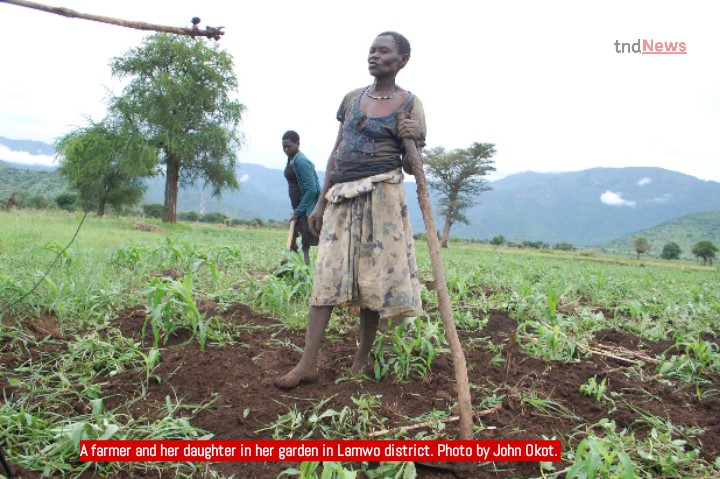
This means Akwero and other farmers are dependent on rainwater, and can only grow crops during rainy seasons which lasts from March to sometimes October which has not been the case in the recent past.
The women are trying to farm using the recently renovated Agoro Irrigation Scheme which seems less beneficial and has not yielded much more results because of the less water being pumped by the irrigation scheme.
“If we have at least a little bit of water being pumped by the scheme, we can farm beans and maize in one season and ground nuts and other food crops in the next,” Akwero said.
Harvest failures are becoming more common, decimating traditional vegetable cultivation and slashing incomes for women, leaving them reliant on their husbands, she said.
“As the women lose the income that ensured their independence, some are denied permission by their husbands even to visit their parents or siblings, exacerbating gender-based violence.
“If they try to leave home, they are beaten up or scolded, our dignity is shattered.”
“Women obey because they have to survive. What can we do if the husband beats us when the doors are closed?” she asked. “We are terrified,” she said.
Actions being taken
Putting gender equality at the centre of climate change solutions means integrating diverse gender perspectives across holistic and enduring climate, environmental, and disaster risk reduction policies and programmes.
Women’s and girls’ full and equal participation in decision-making processes is a top priority in the fight against climate change and without gender equality today, a sustainable, more equal future remains beyond reach.
Phionah Kyokuhiima, head of programs at Solidarity Uganda, an NGO which has been supporting over 160 rural women in Northern Uganda with skills and knowledge in friendly agricultural systems to mitigate climate change said that the issues of climate and land rights have to be diversified with women facilitated to take good agricultural practices like agroecology.
“We have diversified our approach to support women and facilitate them in taking on good agricultural practices like agroecology and agricultural practices that support climate justice and the use of organic manure and non-chemical pesticides while practising climate-friendly agricultural systems,” Kyokuhiima said.
She further called for the empowerment of women for them to push back against all the injustices against them like climate injustices, land wrangles and gender-based violence among others through a friendly agricultural practice.
“We do skilling of women in need of assistance and in civil resistance which gives birth to violence, and we do partnership with legal institutions that support women in such cases and for them also to learn about their rights and other procedures and systems that will support them in such cases,” Kyokuhiima said.
In 2021, Uganda developed and enacted the National Climate Change Act 2021. The Act is in line with the United Nations Framework Convention on Climate Change, the Kyoto Protocol, and the Paris Agreement and is aimed at providing climate change response, participation in climate change mechanisms, and providing an institutional and coordination and implementing mechanism for climate change actions and to foster climate change financing.
The country further has instituted the Climate Change Department, under the Ministry of Water and Environment, the National Environment Management Authority and the Parliamentary Committee on Environment as institutions mandated to monitor and enforce climate action in Uganda.
The government has also recognized and programmed climate change in the third National Development Plan (NDPIII).
This story was made possible with support from the American Jewish World Service (AJWS) through the Northern Uganda Media Club (NUMEC).
Discover more from tndNews, Uganda
Subscribe to get the latest posts sent to your email.