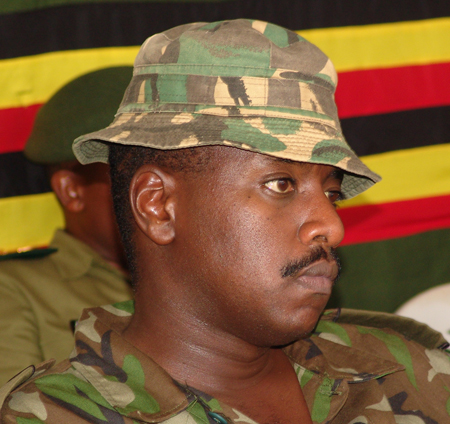
Muhoozi ought not to exhibit these challenges besides he is the president’s son.
USA| Everyone needs help from time to time. It is okay to ask for help but conditions might make asking for help difficult. When we fail to get help our actions may be an indicator.
This belief is purely medical, not political, and I will be proud to have helped save Muhoozi and Uganda.
Mental illness is real, but in Muhoozi’s case, I believe he will receive a false diagnosis, similar to the false promotions he has received. No medic will dare to give Muhoozi a definite diagnosis.
All of Muhoozi’s actions that elicit negative community ratings and outrage are typical of the negative reactions that communities have towards a supposedly adult facing mental health challenges.
Muhoozi ought not to exhibit these challenges besides he is the president’s son.
He is like a growing boy who can not meet his parents’ expectations. A boy who grows up with a coerced stepmother.
A boy knows it is wrong to kill Ugandans, but his father wants him to kill his peers. He is surrounded by killing machines, over which he has no control.
A boy who knows he has been unfairly promoted. We can see the impact on his character as he progresses from LDU to General in a short period of time. Local Defense Units are the most primitive of militias, and the president’s son should not have started there.
It was not until recently that the president decided to legitimize being an LDU by linking it to professional academic credentials.
Living a life of an LDU covered in a general itself is nerve-wracking. What are we seeing? This is purely mental health science.
Muhoozi is seeking acceptance. This boy has all the reasons to be a zombie now that even “social media hooligans are not accepting him.”
Muhoozi knows it is only the bullet that can make him a president. From his body posture, he is not a soldier.
Now the target of the presidency is a tall order, but the father wants him to be.
Muhoozi scarcely travelled, haphazardly educated, and advised and surrounded by sycophants: the young man is in trouble. He joins the 14 million Ugandans with behavioural health problems that lack attention.
He is living a life of self-indulgence and perhaps finds alcohol numbing his misery.
If statistics do not lie, for the 14 million Ugandans with mental health challenges Muhoozi becomes a (their) general. Muhoozi is cold, his emotions are flat, exaggerated, or improper. His emotions seem completely disconnected from situations or are expressed at the wrong times or in the wrong circumstances.
Why the embarrassing behaviour? Clinical medicine cannot fail to describe what we have at hand, acting impulsively without considering how others perceive his behaviour is social disinhibition.
You can read that Muhoozi doesn’t want to be associated with killings, but it is a family menu. He has been fed on since childhood and eventually conscripted into the army without choices.
The father in trying to make him has instead produced a broken man. A sad man trying to maintain appearances for which he has written scripts.
Given the inhumanity of the father’s crimes, Muhoozi was initially associated with “psychopathy,” a severe personality disorder characterized by a significant or complete lack of empathy, social responsibility, and conscience. Shuttered innocence is the language here.
Worst is the appearance of one Robert Kyagulanyi, whose stories from the ghetto are miraculous, raising the bar even higher for a child who had nothing.
Kyagulanyi, to whom he attempts to compare, is now traveling the world with great impact. Muhoozi is imprisoned in Kampala, between the state house and possibly bottles of alcohol.
The tweets are self-aware: “THEY ARE UNPROFESSIONAL, ARE ERATTIC”. Jumping on Bobi Wine is suicidal for the self-made Ghetto President.
The father says despite his notoriety he has achieved so much within a short time hence the promotion. Achievements speak for themselves; they do not need a marketing manager.
The medics who surround the family are confronted with difficult ethical dilemmas.
Manfred F. R. Kets de Vries, an executive coach, claims in a Harvard Business Review article that a surprising percentage of leaders suffer from personality disorders.
The author adds that a leader’s mental health has a direct and significant impact on the morale and structure of the workplace. “Toxic leaders” lead to unhappy workplaces. Further, a warped personality can put business plans, systems, and even, entire organizations at risk.
Most leaders would benefit from the kind of self-reflection facilitated by an executive coach, insists Kets de Vries. Even the mentally healthy can display some of the traits associated with a personality disorder.
The author explains how executive coaches – combining psychotherapy with management theory – can help leaders recognize the pitfalls in their personalities and develop more useful behavioural patterns.
The further author describes four of the most common personality disorders among executives and advises how best to deal with them.
Imagine in a matter of seconds Muhoozi almost brought the East African region into chaos. Kenya won the social media altercations.
The Narcissist
According to Kets de Vries, pathological narcissism is the most common dysfunction to be found among senior executives.
He explains that everyone exhibits some degree of narcissism (we all require a small amount to survive), but too much is dangerous, often leading to the pursuit of power at any cost.
The writer is a medical Clinical Officer/Certified Public Manager.
Discover more from tndNews, Uganda
Subscribe to get the latest posts sent to your email.