Experts’ views on Covid-19 and its impact on media landscape worldwide

In Brief:
The launch took place at Media Challenge Initiative (MCI) offices in Nsambya, Ggaba road in Kampala
While the pandemic has caused a massive disruption, it was just a catalyst for the already ailing media-sector
Kampala—8, October 2021: For two years now, Covid-19 has hit the entire world—affecting almost every organ of its economic survival. From health to education, transport to business, and media to tourism, the pandemic has left more scars.
With vaccinations ongoing across the world, poor countries—especially those on the African continent are relying heavily on vaccines donations from the rich nations. By this, the poor countries’ populations are still vulnerable to infections because the majority have just received first jab or none.
Looking at the media industry, experts say the pandemic has added additional misery to the existing ones before it came. From Africa to Asia, Europe to the Americas, dozens of media houses have been affected by the pandemic, with many closing, others reducing on the numbers of their human resources and too, a reduction in advertising.
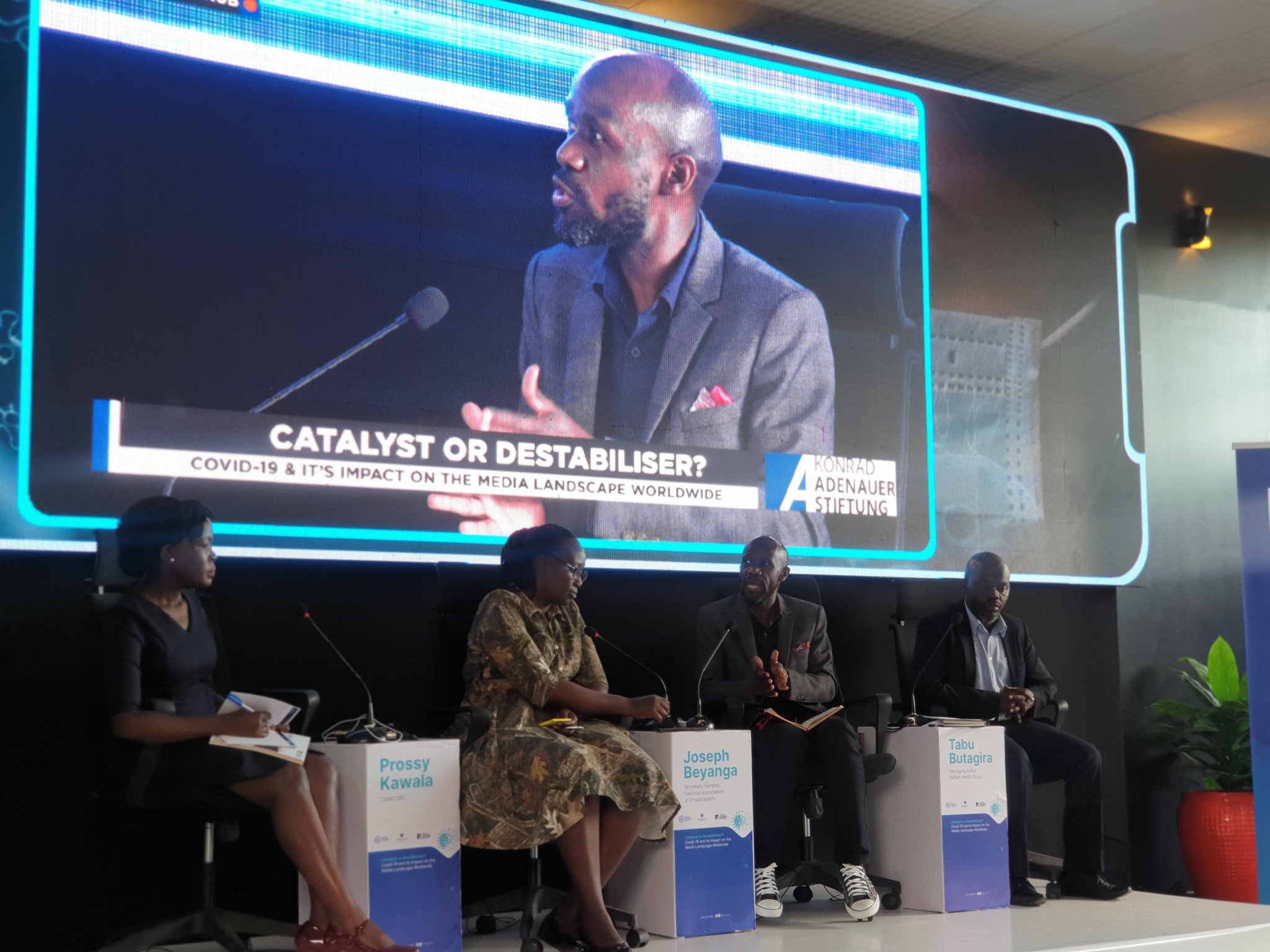
On Thursday 7, October 2021 at the launch of the book: “Catalyst or Destabilizer? Covid-19 and its Impact on Media Landscape Worldwide”, media experts shared their different perceptions.

In his keynote address, Christoph Plate who is the head of media program in Sub-Saharan Africa at Konrad Adenauer Stiftung, says, “There are people that claim to be journalists and yet they have intentions to blackmail and criticize politicians and other media houses.” He added that we need to differentiate between media houses and trash.
He added that the global pandemic has helped media houses to innovate.
Joseph Beyanga was one of the panelists. Working as the secretary-general, National Association of Broadcasters [NAB], he says Covid-19 proved to us that professional journalism has no substitution.
“When the Covid-19 pandemic came, classrooms and schools, places of worships were closed and only broadcast media was open…” he added.
The NAB secretary general disclosed that only 25% of broadcast houses in Uganda are profitable – and “Covid-19 came and found some with underlying conditions”, further calling for partnership and collaboration between media houses.
Tabu Butangira who is the managing editor at Nation Media Group, noted that Uganda Editors Guild (UEG) could help deal with journalists’ unethical behaviors, adding that one response to addressing unethical challenge has been the creation of UEG.
Jan Ajwang, the Program Manager of Media Focus on Africa says some media houses cut back on their circulation during the lockdown. What does that mean for media about Covid-19? She asked.
Judith Atim is the Program Officer at Konrad Adenauer Stiftung Uganda & South Sudan. She said at the launch that “the publication is a very interesting one that I would encourage every media personnel to read”.
What the book has captured
Separating the wheat from the chaff?
Christoph Plate wrote that the pandemic was like a turbo. Like an accelerant or like a gust of wind that stirs up a fire in the Savannah, to destroy what wants to flourish. He further wrote that Covid-19 was never the cause of the alarming developments in the media and elsewhere. Rather, the pandemic has accelerated crises that were already there before.
In Africa, he wrote that airlines like the South African airways are collapsing, hotels are closing, and small businesses are suffering.
“Just as the crisis has accelerated the decline of media companies, it has also highlighted the increased demand for verified and sound information, ideally combined with the willingness to pay for it.”
He found that media houses on the African continent are not as rigid, inflexible, and expensive to run as an airline. “But they, too, are often driven by a freighting immobility, driven by a “we’ve always done it this way”, helpless in the face of the need to act flexibly, to keep making new attempts, to fall down, get a bloody nose, and to then try again”.
In Botswana, “The Necessary Evil—Journalism after Covid-19,” Joel Konopo wrote that “never in our lifetime has there arguably been a greater need for independent, high-quality journalism.”
Konopo went on to write that “while the pandemic has caused a massive disruption, it was just a catalyst for the already ailing media sector in Botswana, which has been struggling to keep up with the advent of technology, an upsurge of social media, and declining revenue from advertising.”
In the United States, Sabina Murphy said approximately three dozen newspapers shut down during the pandemic, and an estimated 46,000 journalists were furloughed or laid off due to the quarantine.
Discover more from tndNews, Uganda
Subscribe to get the latest posts sent to your email.