In 2020, Jane Kipwola, a resident of Oruka village, Purongo sub-county in Nwoya district, joined a savings and co-operative society with the intention to borrow low interest loans and invest in agriculture.
Kipwola, a widow and a mother of eight became one of the 600 members of Nwoya District Mixed Farmers (NDIMIFA) SACCO, from eleven villages in Purongo Sub-County.
The SACCO was formed in 2019, with the intention to help women and vulnerable households access low interest loans and invest in agriculture and become water and food secure.
“Before I joined the sacco, we used to cross the River Nile and visit Centenary Bank, Nebbi Branch to borrow money. It was really a big challenge for rural women. But now, we have our own sacco. We do not have pressure to pay back after borrowing unlike in the recent past,” Kipwola said.
Majority of commercial banks in Uganda offer agricultural loans at interest rates ranging from between 23% and 30%.
However, after joining NDIMIFA, Kipwola said she is now under no pressure to pay back money.
“At NDIMIFA, we borrow loans at just 2.5%. And you pay it after six months. I usually borrow shs 2 million during the farming season. I used the money to open a 2-acre piece of land,” she explained.
Kipwola, who lost her husband in 2009, said the plant mainly grows new varieties of maize such as bazooka on her land.
“I used to harvest only four bags of maize on one acre of land. Another acre also gives me just four bags of groundnuts. But, now, I can harvest up to 16 bags of maize and another 10 bags of groundnuts in the first season,” she adds.
Kipwola said the proceeds from the sales of maize and grounds helped her to pay school fees for her children and meet other expenses.
Also read: Kwania DEO warns private school owners against high-interest loans
Kipwola earns between shs5million and shs10million annually from farming.
“My second child is now in Senior Three. Others are in lower classes. The facility from the SACCO has enabled me to live comfortably. I am now both financially and food secured. Actually, nearly all members of the SACCO are food secured. We can afford to pay our children in school too,” she noted.
The SACCO also trained its members in food security, adult illiteracy, agricultural mechanisation and financial literacy.
Members borrow between shs500,000 and shs5 million to invest in agriculture and pay back after the sale of their farm produce.
Jane Akwero, another member of the SACCO said the loan has helped her not become food secure but an agricultural entrepreneur as well.
“I used to grow staple crops such as cassava, potatoes, green peas and vegetables to keep hunger away from my household. But, now I have large gardens, where I grow maize. In a good season, I can harvest up to 10 bags of maize. Without the loan, I was not going to open 2-acres of land,” she said.
Akwero said she has not heard any report of malnutrition in her village since 2020, when the SACCO received shs 100 million as seed capital from The Hunger Project Uganda.
Hunger is defined by the United Nations as the periods when people experience severe food insecurity—meaning that they go for entire days without eating due to lack of money, access to food, or other resources.
A baseline survey conducted by the organisation in eleven villages in Purongo Sub-County, indicates that hunger fell by 60% relative to baseline, with no household reporting severe in the last six years.
The survey was conducted between 2019 and 2026.
According to the household survey report, moderate or severe hunger fell from 45.9% in 2019, to 18.5% in 2026.
Also read: Nwoya public health facilities grapple staffing gaps
William Okot, another farmer who is also a member of the SACCO, said loans from the SACCO have enabled members to fight hunger, live healthy and put children in school.
Okot noted that being a rural farmer with few assets registered to his name, he was able to access loans since he does not have collateral to surrender to commercial banks as loan security.
“The loan has helped me to engage in commercial agriculture. I used to harvest only 3 bags of maize. Now, I can get between 18 and 20 bags of maize in one season. I am now food secure,” Okot said.
The farmers through peer learning, bulking, storage and collective marketing, have been able to get premium prices for their farm produce.
The SACCO has also helped farmers to become Climate Resilient with nearly 12% able to engage climate smart agriculture, despite repeated drought, heavy rains and wildlife pressure.
Other benefits of forming the SACCO are agronomic and post-harvest handling techniques, use of quality seeds, food bank, storage, value addition and market access.
In December 2024, Nwoya district council passed the Food and Nutrition Security Ordinance, in an attempt to address local challenges, improve multi-sectoral coordination among government and civil society partners, and strengthen governance efforts.
It brings together agriculture, health, education, water, and local governance to ensure households can reliably produce and consume diverse and nutritious foods throughout the year.
Key areas of focus include dietary quality, affordability, and diversity.
A 2025 report by CARE Netherland indicates the district was grappling with high household food insecurity with 45.7% of households experiencing food insecurity, malnutrition burden/ stunting at 25.4% and wasting standing at 3.6%.
The report further indicates that 87.2% of the total population of 220,593 as per the 2024 Uganda National Housing and Population Census depend on Agriculture as their major economic activities.
Tonny Lakwo Omon, the Project Officer Oruka Epicentre, said fighting hunger is beyond food insecurity.
Omon explained that hunger is the absence of food but it is a combination of many factors, including poor quality of education and lack of access to finances.
“It has always been a misconception that hunger is all about absence of food, but hunger is beyond that. Hunger means absence of finances, hunger means absence of health services, it means lack of access to quality education. It means limited access to other basic needs. All those bring into one what we call hunger,” he noted.
In the 2025 Global Hunger Index, Uganda ranks 87th out of 123 countries with sufficient data to calculate 2025 GHI scores. With a score of 20.2 in the 2025 Global Hunger Index, Uganda has a level of hunger that is serious.
This GHI Score is based on the values of four component indicators: stunted growth among children under 5, death of children before their fifth birthday, stunted growth among children under 5, and undernourishment.
Irene Naikaali Ssentongo, the Country Director The Hunger Project Uganda, said empowering women will go a long way to addressing issues around hunger and poverty in the country.
“We start with the woman. Why do we start with the woman? In the household, who is responsible? We know the husband and wife are responsible. But when a child is hungry, who will they run to? She is the first point of contact, when a child is seeking for something to eat. It will be the mother. So, if you can work on the mindset of the mother to know that if I’ve given birth to these children, my children should never go hungry,” she noted.
The organisation invested shs700 million to set up a community hall, health facility, solar powered water system, a food bank, food store and accommodation for nurses at Oruka Epicentre in Oruka village, Purongo sub-county in Nwoya district, as part of efforts to fight hunger.
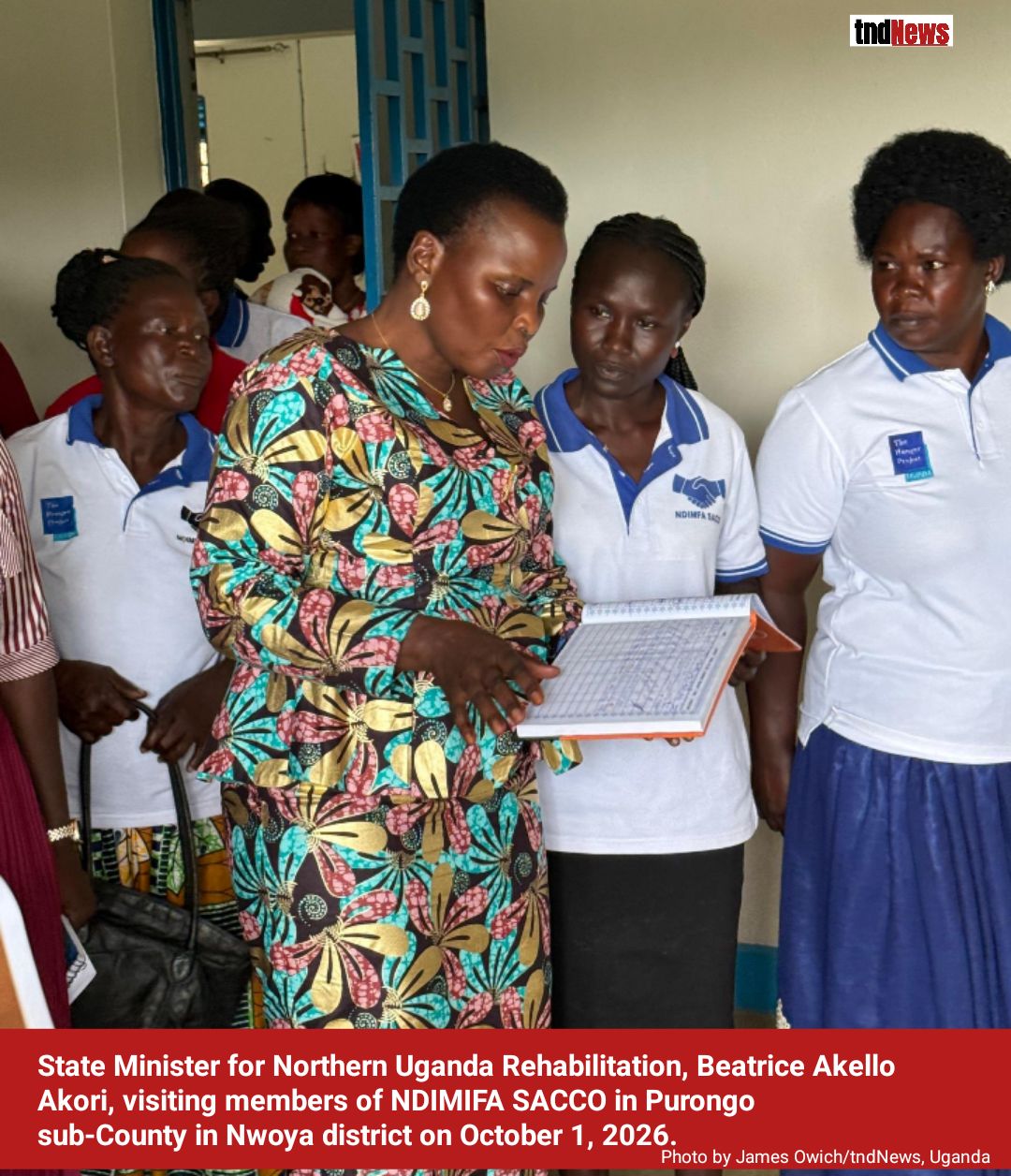
The State Minister for Northern Uganda Rehabilitation, Beatrice Akello Akori, said the government will continue to help households so that hunger and malnutrition becomes history in the country.
Minister Akori noted that through multi billion programs such as Emyooga and the Parish Development Model, they will continue to empower local farmers so that they will be able to defeat hunger in their households.
“When people are empowered, they defeat hunger from within. As a Government, our commitment remains clear. Initiatives like the PDM, Emyooga, YLP, restocking will translate into sustainable household Wealth and Food Security.
“Ending hunger is the ultimate form of national security. This Government remains committed to scaling up partnerships that champion agricultural productivity and enhance household incomes,” she adds.
By James Owich
Discover more from tndNews, Uganda
Subscribe to get the latest posts sent to your email.