Ahead of World Contraception Day and International Safe Abortion Day 2026, health experts and rights advocates are demanding accessible, safe, legal and stigma-free abortion care for all, warning that women’s bodily autonomy is under growing attack worldwide.
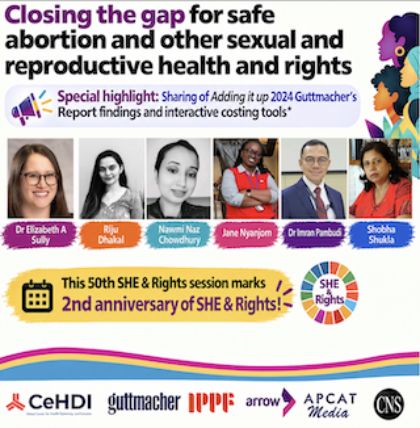
Speaking during a recent SHE & Rights session, Shobha Shukla, Coordinator and Host of the session and Executive Director of CNS, said safe abortion is an essential and lifesaving sexual and reproductive healthcare service and a fundamental human right.
“With just 51 months left to deliver on the SDG goals and targets of gender equality and health rights, not only is the progress way off the mark, but attacks against bodily autonomy and gender and health rights have been growing around the world,” Shukla said.
The session, organised by the Global Centre for Health Diplomacy and Inclusion (CeHDI), Guttmacher Institute, Asian Pacific Resource and Research Centre for Women (ARROW), International Planned Parenthood Federation, CNS and partners, examined the findings of the Guttmacher Institute’s “Adding It Up 2024” report, a landmark study covering 128 low- and middle-income countries that evaluates the costs, needs and benefits of investing in sexual and reproductive health worldwide.
Dr Elizabeth A Sully, Director of International Research at the Guttmacher Institute, shared major findings showing that investing in sexual and reproductive health and rights is a “best buy” for global health and development.
Further, every additional dollar invested in family planning and contraceptive care can save US$1.97 in pregnancy-related and newborn care costs, while meeting SRHR needs across Asia could reduce unintended pregnancies by 26 per cent, maternal deaths by 65 per cent and newborn deaths by 62 per cent.
The report also introduced a more person-centred way of measuring contraceptive need and, rather than relying solely on “unmet need,” which can overstate demand by including women using traditional methods who may not wish to switch, the Guttmacher Institute uses “unmet demand,” focusing on women who want to avoid pregnancy but are not using any contraceptive method and express a desire for future family planning.
Uganda’s unmet need
Uganda illustrates both the scale of the challenge and the potential of investment.
An estimated 648,000 women aged 15–19 in Uganda are sexually active and do not want a child in the next two years, yet more than 60 per cent of them have an unmet need for modern contraception.
Approximately half of all pregnancies among Ugandan women aged 15-19 are unintended, totalling an estimated 214,000 unintended pregnancies each year, with 88 per cent of these occurring among adolescents with an unmet need for modern contraception.
Among married women, younger Ugandans aged 15-24 face a 32.3 per cent probability of unmet need for contraception, decreasing to 26.4 per cent for those aged 35-49.
Nationally, an estimated 37 per cent of Ugandan women who want to prevent a pregnancy are not using modern contraception.
A 2024 Performance Monitoring for Action survey found that four in ten Ugandan women aged 15-49 reported that their last birth or current pregnancy was unintended within the last five years.
Further, teenage pregnancy and unsafe abortion remain major public health challenges, with approximately 25 per cent of teenage girls affected.
The Ministry of Health has reported an increasing number of women turning up at health facilities with complications associated with abortion, even as efforts to increase access to contraceptives continue.
If all unmet need for modern contraception among adolescent women in Uganda were met, unintended pregnancies among this group would drop by 72 per cent.
Therefore, combined with adequate medical care for all pregnant adolescents and their newborns, adolescent maternal deaths would drop by 76 per cent per year.
From global evidence to national action
Riju Dhakal, Programme Officer at ARROW, questioned whether international commitments and pledges are actually reflected in approved national budgets for sexual and reproductive health and rights.
Amid a 46 per cent decline in official development assistance for SRHR between 2024 and 2026, Dhakal called for the Guttmacher Institute’s tools, the Family Planning Investment Impact Calculator and the Safe Abortion Calculator, to be used to localise the numbers, track government commitments and check whether financing pledges are actually reflected in approved national budgets.
Kenya’s experience offers lessons. Jane Nyanjom, Associate Director at Reproductive Health Network Kenya, noted that while the legally binding Maputo Protocol recognises reproductive health rights, translating these rights into practice requires alignment between law, policy, financing and service delivery.
She highlighted concerns around contraceptive commodity stock-outs in Kenya, particularly their implications for women and girls in rural and hard-to-reach areas.
“Rights committed on paper must be matched by actions for commodities, trained providers, financing, referral systems and accessible services on the ground,” Nyanjom said.
Nawmi Naz Chowdhury, Executive Director of the Women’s Global Network for Reproductive Rights, said consultations across several regions had identified factors affecting access to abortion care, including political and anti-rights backlash, conflict and humanitarian crises, displacement, shrinking civic and funding space, shortages of trained providers and medicines, weak referral systems, administrative requirements, cost and geographical barriers, stigma and misinformation.
Dr Imran Pambudi, Director of Vulnerable Groups Health Services in Indonesia’s Ministry of Health, stressed that the strength of a health system can be judged by how well it protects and serves vulnerable populations, including persons with disabilities, remote island populations, survivors of violence, older people and marginalised women and adolescents.
He highlighted the need to integrate SRHR into primary healthcare, adopt person-centred approaches that protect dignity, strengthen the capacity of the healthcare workforce, and ensure medicines and referrals are available.
Uganda has taken steps in this direction, prioritising family planning as part of a strategy to achieve national development goals; the government’s FP-CIP III emphasises embedding family planning within routine health services and national development planning.
Therefore, a family planning investment case from the Ministry of Health estimates that expanding private-sector participation could avert approximately 3,175 maternal deaths and generate US$107 million in cost savings.
However, significant financing gaps remain. Based on budget allocations from the 2020/2021, 2021/2022 and 2022/2023 fiscal years, an estimated US$36 million is projected to be available by 2030, leaving a funding gap of approximately US$370 million.
More than 70 per cent of public sector funding for essential medicines and health supplies is donor-financed, underscoring the urgency of adopting innovative and sustainable financing models.
The SHE & Rights experts stressed that financing alone is not enough and services must also be accessible, affordable, adequately staffed and responsive to the needs of vulnerable populations in a rights-based, person-centred manner.

As Uganda and other countries work towards the Sustainable Development Goals, the message from the session was clear: meeting the full range of sexual and reproductive health needs, including contraception, maternal and newborn care, and safe abortion services, is not only a moral imperative but also an economic one.
Further, investing in SRHR yields substantial returns, reduces preventable deaths and advances gender equality.
The Guttmacher Institute’s Family Planning Investment Impact Calculator and Safe Abortion Calculator are available online for advocates, policymakers and journalists to model the impact of investments in their own countries.
Thus, as Shukla reminded participants, with only 51 months left to deliver on the SDGs, the time for action is now.