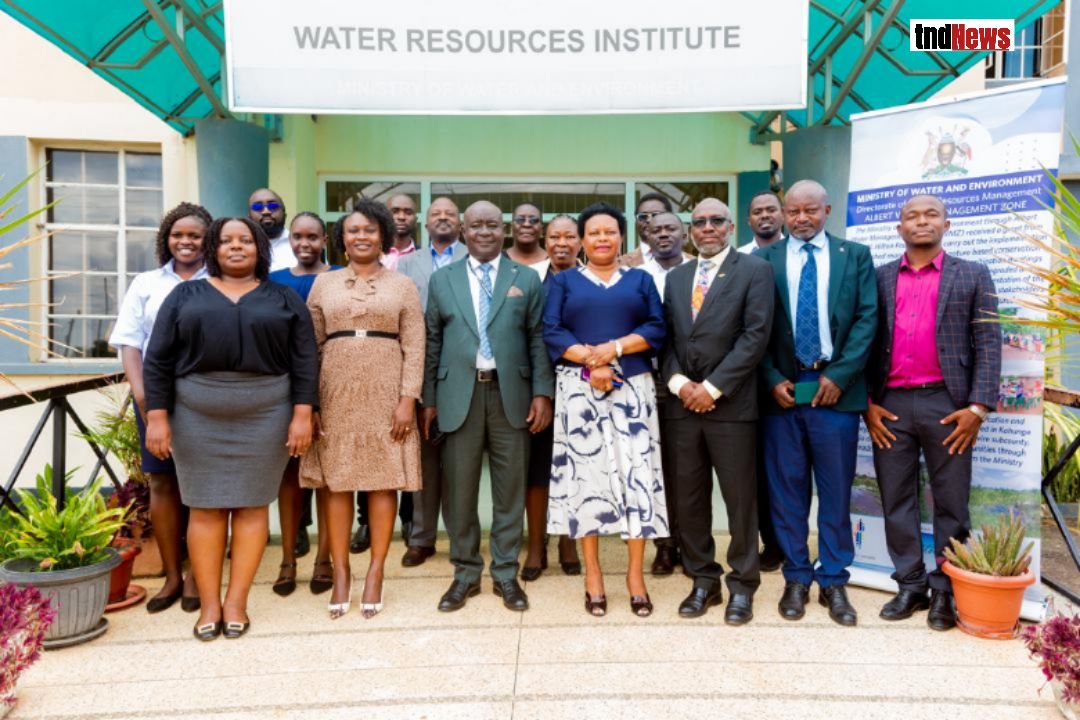
Efforts to restore and secure water resources in the Mpanga Catchment received a major boost on Tuesday morning as key stakeholders convened at the Water Resources Institute in Entebbe.
The high-level Steering Committee Meeting was to review progress of the Watershed Management and Nature-based Conservation Project.
The Mpanga Catchment, a vital water source for communities in Western Uganda, has in recent years faced mounting pressure from siltation, pollution, deforestation, and rampant wetland encroachment threats that have put water security for thousands of households at risk.
To reverse this trend, the Ministry of Water and Environment through the Albert Water Management Zone (AWMZ), under the leadership of Team Leader Dr. Brian Guma, in partnership with Water For People, IRC, and Join For Water, and with financial support from the Conrad N. Hilton Foundation, has since August 2024 been implementing an ambitious nature-based solutions project aimed at restoring the catchment’s ecological integrity.
Also read: Talking water: Kitgum’s 89% rural water access
Further, the one year into implementation, the results are already visible and the AWMZ has restored degraded landscapes, established demonstration hubs for sustainable land management, constructed hydrologic and hydromet monitoring stations in Kitagwenda and Kazo, demarcated and restored critical wetlands, and strengthened its capacity in monitoring and evaluation.
This Steering Committee Meeting, held on September 22, 2026, brought together top decision-makers including the Assistant Commissioner WRPR, Eng. Albert Orijabo, Country Directors of Water For People, IRC, and Join For Water, and Chief Administrative Officers of Kabarole, Ibanda, Kamwenge, Kyenjojo, and Kitagwenda districts.
The meeting reviewed achievements from Year One and Year Two, provided strategic guidance and recommendations, and flagged off activities for Year Three, a critical phase that will focus on consolidation, scaling up of successful interventions, and ensuring long-term sustainability.
The Watershed Management and Nature-based Conservation Project is expected to become a model for catchment-based water resources management in Uganda.
Discover more from tndNews, Uganda
Subscribe to get the latest posts sent to your email.